

Free tool
AI training data value estimator
Estimate AI training data value from published prices only: choose what your company holds and see what AI buyers reportedly paid for the same kind.
Updated

2. How much of it?
Unpublished creator footage, b-roll, product or training videos, recorded webinars. Only count what you own and may license.
Range from published prices
$600 to $4,350
Your quantities × what AI buyers were reported to pay others. Not an offer or a valuation.
Video footage: 600 minutes of footage
$600 to $4,350
$1 to $4 per minute → $600 to $2,400
AI companies, OpenAI and Google among them, buying unpublished creator footage: typically $1 to $2 a minute, more for 4K, drone and 3D. The Decoder, reporting Bloomberg, 11 January 2025
$2.62 to $7.25 per minute → $1,572 to $4,350
Adobe paying creators for everyday-action clips to train its video model, about $120 per video. The Register, reporting Bloomberg, 12 April 2024
The link holds only the kinds and amounts above, never your name or company.
Runs entirely in your browser. Nothing you type is sent to us or stored. Published prices are what specific buyers paid specific sellers; your data's rights, quality and buyer change everything.
Runs in your browserBuilt and maintained by the DataBroker team
Embed this tool on your site
Put this tool on your own site. It runs in your visitors' browsers, and the line under it credits this page.

How to use the AI training data value estimator
- Step 1
Pick your data types
Video, photos, audio, books, code, conversations, documents or tasks: tick everything your company holds and may license.
- Step 2
Enter how much
Minutes, photos, hours or books, counting only what you own the rights to. Types without a published price are listed, not valued.
- Step 3
Read and share the range
See your amount times each published price, with the buyer and source, then copy a link to the result to share.
What is AI training data worth?
AI training data value is what an AI company would pay to license your data for training models. Few prices are public; the reported ones are per minute of video, per photo, per hour of audio and per book.
AI training data value estimator specs and limits
| Data types | 8: video footage, photos and images, audio and speech, books, source code, conversations and chat logs, business documents, task and workflow data |
|---|---|
| Priced from | 4 types with a published price: video, photos, audio and books |
| Arithmetic | Your quantity × each published price; the range runs from the lowest to the highest. No multipliers, no averages |
| Share | A result link holding only the types and amounts, with its own preview card |
| Where it runs | In your browser. Nothing you type is sent to us or stored |
| Embed | Free to embed on your site with the code below the tool |
| Not included | A price for code, conversations, documents or tasks, since no buyer has published one |

More about the AI training data value estimator
The published prices behind the estimate
Most AI data deals are private. The figures below are the per-unit prices that reached the press, each tied to a named buyer and a dated report. They are the only numbers the estimator uses.
| Data type | Published price | Buyer and context | Reported |
|---|---|---|---|
| Video footage | $1 to $4 per minute | AI companies, OpenAI and Google among them, buying unpublished creator footage: typically $1 to $2 a minute, more for 4K, drone and 3D | January 2025 (Bloomberg) |
| Video footage | $2.62 to $7.25 per minute | Adobe paying creators for everyday-action clips to train its video model, about $120 per video | April 2024 (Bloomberg) |
| Photos and images | $0.06 to $0.16 per photo | Adobe paying contributors per photo for AI training | April 2024 (Bloomberg) |
| Audio and speech | $20 to $30 per hour | A consultant's recommended rate, net to stations, for licensing news content to AI companies: advice, not a deal price | November 2025 |
| Books | $5,000 per book | Microsoft's three-year training licence offered through HarperCollins, split equally between publisher and author | February 2025 (Bloomberg) |
The audio figure is a consultant's recommendation for news broadcasters, not a payment anyone reported. The tool labels it as advice.
Types with no published price
Code, conversations, business documents and task data sell, but no buyer has published a per-unit price. The best-known figure, Reddit's reported $60 million a year from Google, covers a whole platform's content and can't be divided into a price per conversation.
Rather than guess, the estimator lists these types as not estimated. For them, a real quote in the data pricing calculator, or a cost-based figure in the data value calculator, is a better start.
How to read your range
- It is what buyers paid others for similar material, not an offer for yours.
- Rights decide everything: footage with people, music or logos you can't clear is worth little whatever its length.
- Prices from 2024 and 2025 may not hold; buyers' needs shift as models change.
- One licence is not the whole value: the same data can often be licensed to several buyers.
Example: a training company with 600 minutes of unpublished course video gets $600 to $2,400 at the January 2025 rates and $1,572 to $4,350 at Adobe's 2024 rates, a range of $600 to $4,350.
If it doesn't work
- A type says no estimate
- No AI buyer has published a per-unit price for it, so we don't make one up. Use the data pricing calculator with a quote you have, or price it deal by deal.
- The range is very wide
- It spans different buyers and years. The source under each line says who paid what; the one closest to your data is the better guide.
- The shared link shows different numbers
- The link carries the amounts at the moment you copied it. Change a figure and copy the link again.
Sources
6 sources · checked Nov 9, 2026
- The Decoder, reporting Bloomberg, 11 January 2025Checked
- The Register, reporting Bloomberg, 12 April 2024Checked
- PYMNTS, reporting Bloomberg, 11 April 2024Checked
- Streaming Media, 18 November 2025Checked
- The Decoder, reporting Bloomberg, 8 February 2025Checked
- TechCrunch on Reddit's S-1 and the Reuters reportChecked

AI training data value estimator FAQ
How much is my company's data worth to AI companies?
For video, photos, audio and books, the estimator multiplies what you hold by prices AI buyers were reported to pay. For other types no price is public, so the honest answer is that it is set deal by deal.
Where do the prices come from?
From news reports of specific deals, mostly via Bloomberg, each linked under the result and in Sources. We add a price only when a named outlet published it.
Why doesn't it estimate code or chat logs?
Because no buyer has published a per-unit price for them, and inventing one would make the whole estimate look more certain than it is.
Is this different from the data value calculator?
Yes. The data value calculator uses your own costs and assumptions. This estimator uses only published AI buyer prices and shares the result as a link.
What does the shared link contain?
Only the data types and amounts you entered. No name, company or contact detail is in it, and nothing is stored on our side.
Related
- Data valuation
Data valuation explained for people selling or brokering a dataset: three standard methods, what each misses, and a worksheet to score one.
 Data value calculator
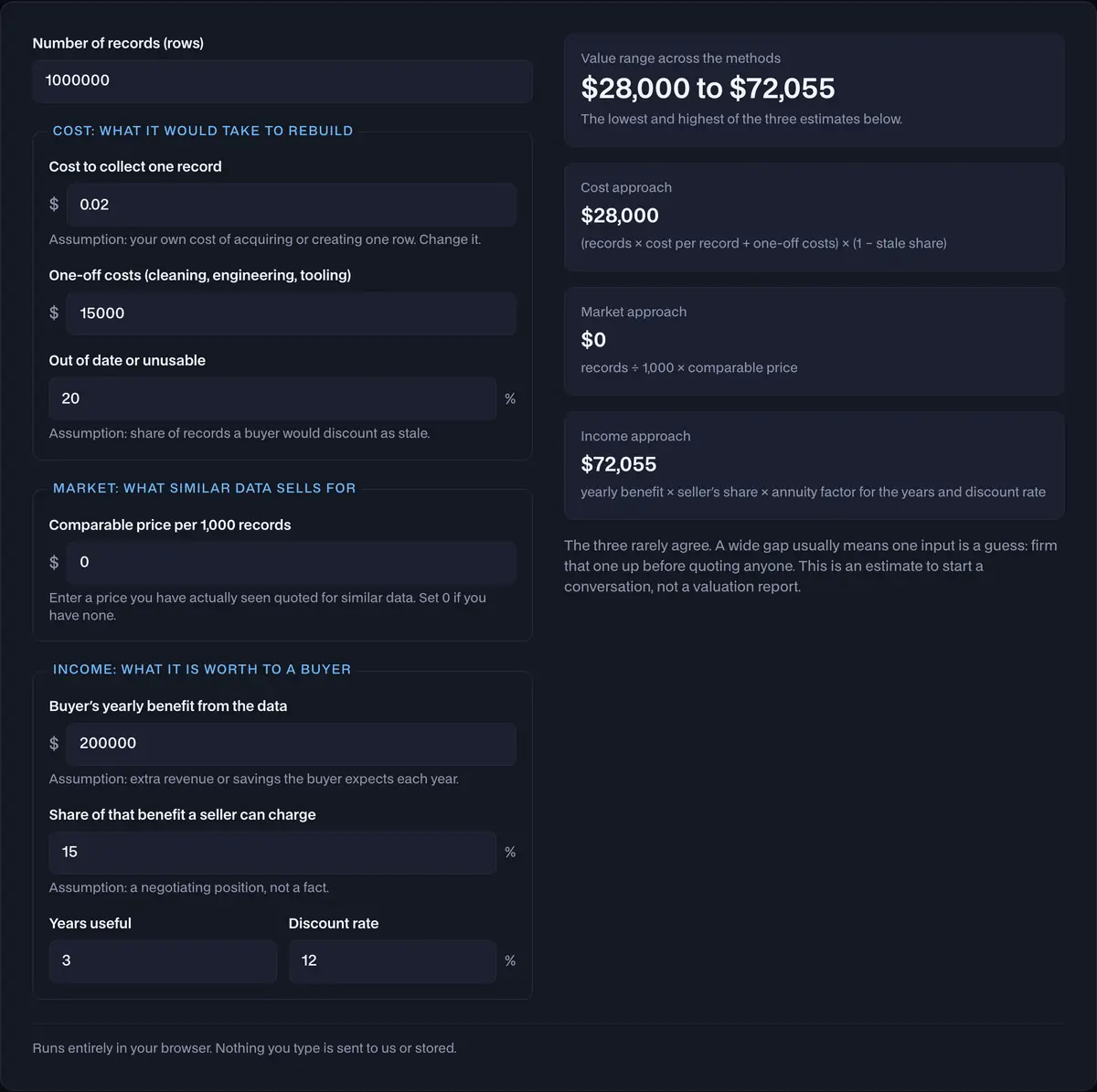
How much is data worth to a buyer? Compare three standard estimates side by side, using your own figures and assumptions you can change.
 Data pricing calculator
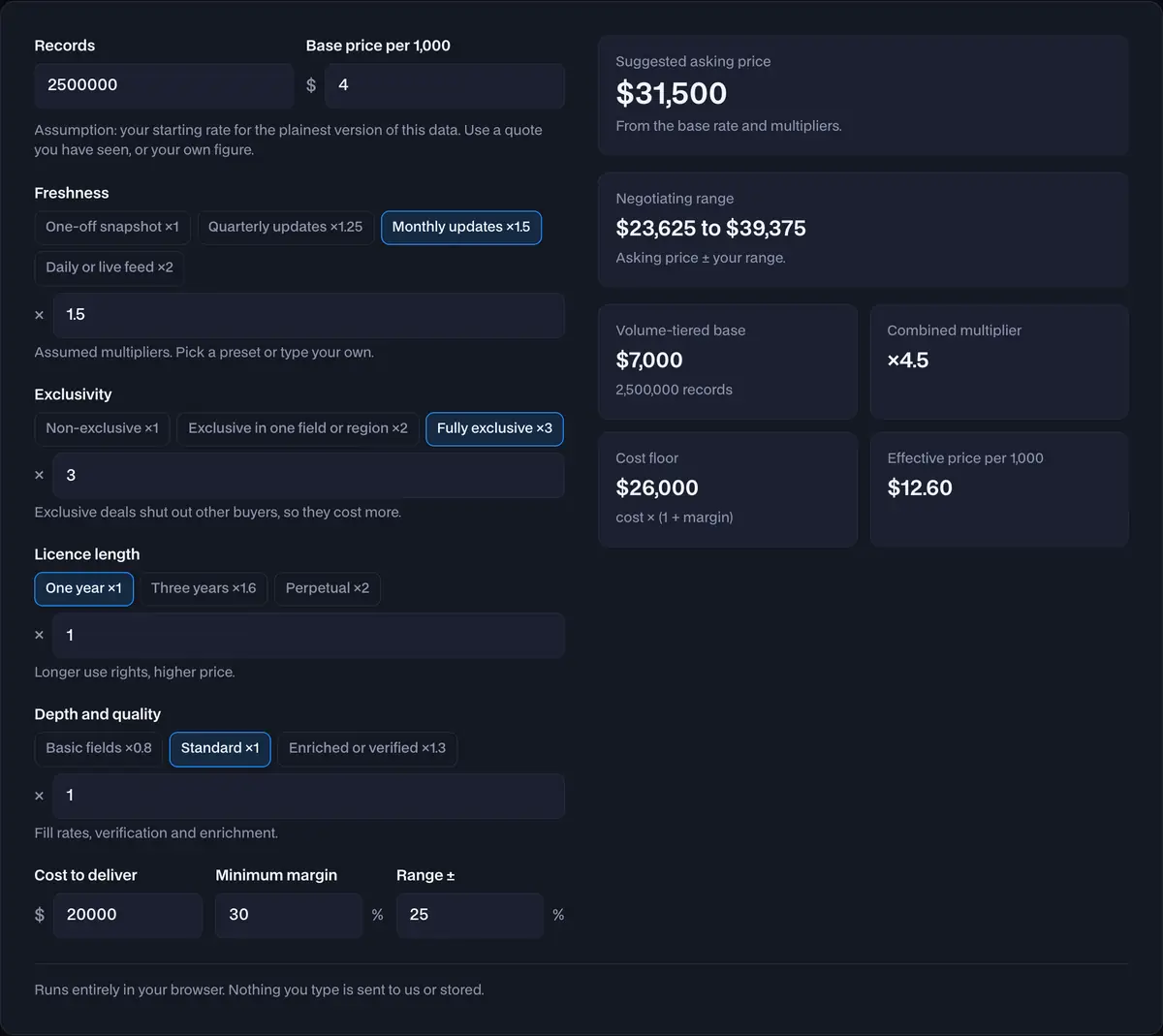
Data pricing made concrete: start from a base rate, apply volume tiers and multipliers you control, and get an asking price and range.
- AI training data
AI training data licensing explained: which datasets labs want, publicly reported deal values, and the copyright and transparency rules that now apply.




Free tool
Try the AI training data value estimator
AI training data value is what an AI company would pay to license your data for training models. Few prices are public; the reported ones are per minute of video, per photo, per hour of audio and per book.
- Free
- No sign-up
- Runs in your browser