

Free tool
Data pricing calculator
Data pricing made concrete: start from a base rate, apply volume tiers and multipliers you control, and get an asking price and range.
Updated

Assumption: your starting rate for the plainest version of this data. Use a quote you have seen, or your own figure.
Assumed multipliers. Pick a preset or type your own.
Exclusive deals shut out other buyers, so they cost more.
Longer use rights, higher price.
Fill rates, verification and enrichment.
Suggested asking price
$26,000
Raised to your cost floor: the multipliers came out below it.
Negotiating range
$19,500 to $32,500
Asking price ± your range.
Volume-tiered base
$7,000
2,500,000 records
Combined multiplier
×1.5
Cost floor
$26,000
cost × (1 + margin)
Effective price per 1,000
$10.40
Runs entirely in your browser. Nothing you type is sent to us or stored.
Runs in your browserBuilt and maintained by the DataBroker team

How to use the data pricing calculator
- Step 1
Set the base
Enter the number of records and your base rate per 1,000 for the plainest version of the data.
- Step 2
Choose the terms
Pick freshness, exclusivity, licence length and depth from the presets, or type your own multipliers.
- Step 3
Check the floor and range
Add your delivery cost and minimum margin. The tool raises the price to that floor if needed and shows a negotiating range.
What the result looks like

What is data pricing?
Data pricing is setting what a buyer pays to use a dataset, usually a rate per record or per period, adjusted for volume, freshness, exclusivity, licence length and quality, and never below what delivery costs.

More about the data pricing calculator
How the price is built
- 1
Volume tiers
The first million records are charged at the full base rate, the next nine million at half, and anything above ten million at a quarter. Big buyers expect a lower unit price.
- 2
Multipliers
The tiered base is multiplied by freshness × exclusivity × licence length × depth.
- 3
Cost floor
Delivery cost × (1 + minimum margin). If the multiplied price is lower, the floor is used instead.
- 4
Range
The asking price plus and minus your range percentage, to plan where you open and where you stop.
Example with the starting figures: 2.5 million records at four dollars per thousand gives a tiered base of $7,000 (one million at full rate, 1.5 million at half). Monthly updates multiply it by 1.5, so the list price is $10,500.
Delivery costs $20,000 with a thirty percent margin, a floor of $26,000, so the suggested asking price is $26,000. The tool tells you when this happens: it means the base rate is too low for the work involved.
Assumptions you control
Every multiplier and tier is an assumption written into the tool so the arithmetic is visible. None is a market rate, and we do not publish prices from deals. Overwrite them with what your buyers actually accept.
| Factor | Preset multipliers | Why it moves price |
|---|---|---|
| Freshness | Snapshot ×1, quarterly ×1.25, monthly ×1.5, daily ×2 | Updates cost money to produce and keep data useful |
| Exclusivity | None ×1, one field or region ×2, full ×3 | Exclusivity stops you selling to others |
| Licence length | 1 year ×1, 3 years ×1.6, perpetual ×2 | Longer rights, more value to the buyer |
| Depth | Basic ×0.8, standard ×1, enriched ×1.3 | Fill rates, verification and extra fields |
Pricing models it does not cover
- Per-query or API pricing, where buyers pay per call rather than per record.
- Revenue share, where the seller takes a percentage of what the buyer makes from the data.
- Bundles of several datasets with one price.
Each can be estimated with the same idea: find a unit, set a base rate, and adjust it for the terms. The calculator handles the most common case, a licence priced by volume.

Data pricing calculator FAQ
How do I price data I have never sold?
Start from your cost to deliver plus a margin, which is the floor. Then look for any quote for similar data, even rough, and use it as your base rate. Adjust for freshness and exclusivity.
Should I charge per record or per year?
Per record suits one-off snapshots. A yearly fee suits feeds that update. You can use the calculator for a yearly fee by pricing one year's licence.
How much more should exclusivity cost?
Enough to cover the sales you give up by not licensing to others. The preset doubles or triples the price, but the right figure depends on how many other buyers exist.
Is anything stored?
No. The calculator runs only in your browser.
Why does the price jump to the cost floor?
Because the multiplied price came out below what delivery costs plus your margin. Selling below that loses money on the deal.
Related
 Data value calculator
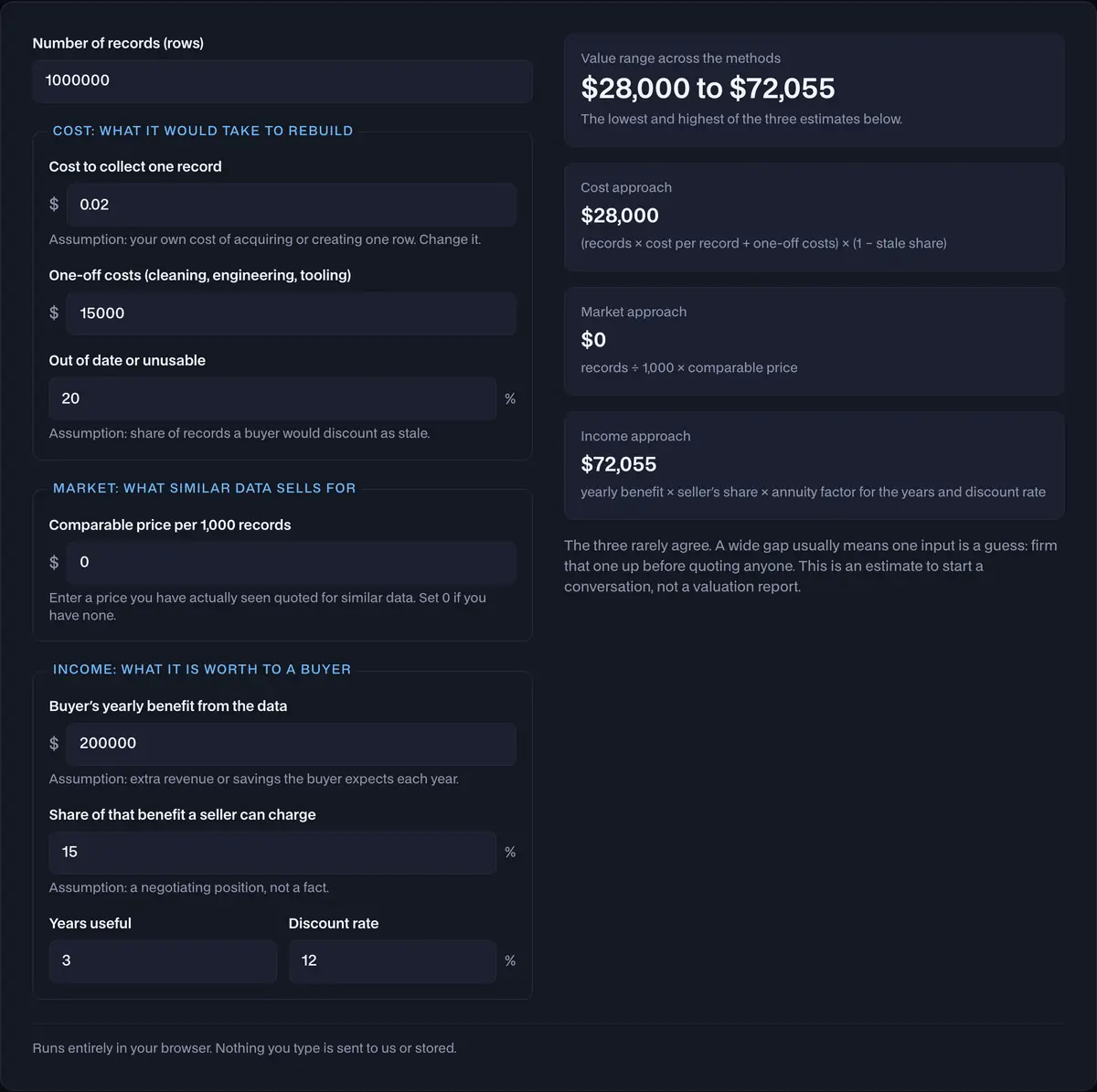
How much is data worth to a buyer? Compare three standard estimates side by side, using your own figures and assumptions you can change.
- Data broker tools
Data broker tools for every stage of a deal, free and without an account, running in your browser so nothing you type is stored.


Guides that use the data pricing calculator
- Where to sell data
Where to sell data depends on the dataset: compare cloud marketplaces, listing sites, brokers, direct deals and asset sales on fees and fit.

Free tool
Try the data pricing calculator
Data pricing is setting what a buyer pays to use a dataset, usually a rate per record or per period, adjusted for volume, freshness, exclusivity, licence length and quality, and never below what delivery costs.
- Free
- No sign-up
- Runs in your browser