

Free tool
Free PII scanner: online PII detection
A PII scanner that runs in your browser: paste text or drop a file to see personal data and leaked secrets before you share it.
Updated

Results appear here as you paste
- US Social Security number0
- Payment card number (Luhn-checked)0
- Email address0
- Phone number0
- Public IP address0
- AWS access key ID0
- AWS secret access key0
- GitHub token0
- Slack token or webhook0
- Private key block0
- Hard-coded key or password0
Runs entirely in your browser. Nothing you type is sent to us or stored. Pattern matching finds common formats; it can miss names, addresses and anything unusual, and can flag numbers that only look like a match.
Runs in your browserBuilt and maintained by the DataBroker team

How to use the PII scanner
- Step 1
Add the text
Paste rows, a log or a JSON export, or drop a text file up to 5 MB. Try the sample to see how it works.
- Step 2
Read the findings
Each detector shows a count and the first few matches, masked so they are not exposed on screen.
- Step 3
Redact and share
Copy or download a version with every match replaced by a label, then check it by eye before sending.
What the result looks like

What is a PII scanner?
A PII scanner searches text for personally identifiable information, such as email addresses, phone numbers and government ID numbers, so it can be removed or protected before the text is shared.

More about the PII scanner
What it looks for
| Detector | How it decides |
|---|---|
| US Social Security number | Three, two and four digits with dashes; skips area numbers 000, 666 and 900 to 999 and all-zero groups, which are never issued |
| Payment card number | 13 to 19 digits from a known card range that pass the Luhn checksum, which filters out most random numbers |
| Email address | A name, an @ and a domain with a real-looking ending |
| Phone number | US numbers with separators, or international numbers starting with + |
| Public IP address | IPv4 addresses, ignoring private, loopback and link-local ranges |
| AWS, GitHub and Slack keys | The fixed prefixes those services use, such as AKIA, ghp_ and xoxb- |
| Private key blocks | The BEGIN ... PRIVATE KEY header |
| Hard-coded passwords and keys | A word like password or api_key followed by a value, ignoring obvious placeholders |
Example: the sample has two customer rows and a config line. The scanner finds two emails, two phone numbers, one SSN, one card number, one public IP and one hard-coded key, eight findings in all, and the redacted copy replaces each with a label such as [REDACTED EMAIL].
When to use it
- Before sending a data sample to a prospective buyer.
- Before pasting logs or exports into a support ticket or an AI chat.
- Before publishing a repository or a dataset, to catch keys left in config files.
- As a quick check on a vendor's file before it goes into your systems.
The detectors are written so that scanning time grows in step with the size of the text, not faster, which keeps a five-megabyte file responsive even in a modest laptop browser.
Limits
| It can miss | Why |
|---|---|
| Names and street addresses | They have no fixed format, so patterns can't find them reliably |
| Identifiers from other countries | The ID detector covers US Social Security numbers only |
| Data inside spreadsheets or PDFs | It reads plain text; export to CSV or text first |
| Numbers that only look like a match | A phone pattern can catch an order number; check before acting |
Sources
2 sources · checked Nov 7, 2026
- Luhn algorithm (Wikipedia)Checked
- Social Security number (Wikipedia)Checked

PII scanner FAQ
Is my file uploaded?
No. The file is read by your browser and scanned there. Nothing is sent to us or stored, and closing the tab clears it.
Does a clean result mean the file has no personal data?
No. It means none of these patterns matched. Names, addresses and free-text notes can still identify people, so read the file too.
Which file types work?
Text formats such as CSV, TSV, JSON, logs, Markdown and source code, up to 5 MB. Convert spreadsheets and PDFs to text first.
Why are matches masked?
So the results panel does not put the sensitive values on screen in full. The redacted copy removes them entirely.
Can it check for GDPR or CCPA compliance?
No tool can do that from text alone. It finds data that may be personal; whether you may share it depends on how it was collected and the law that applies.
Related
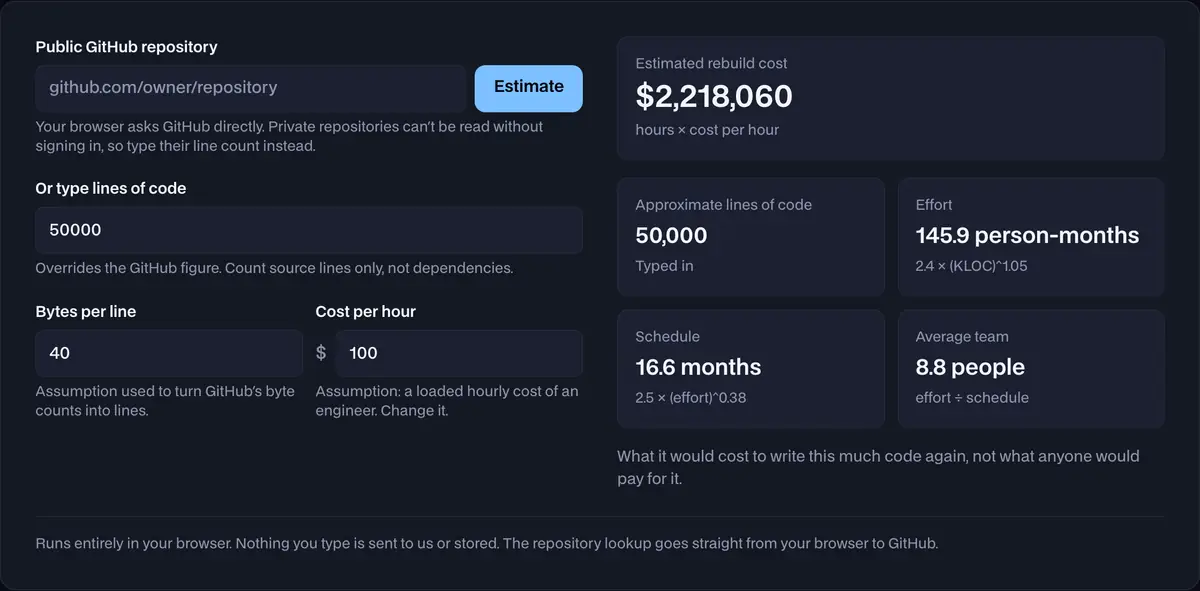 Codebase value calculator
A codebase value calculator that reads a public GitHub repository in your browser and estimates rebuild effort and cost with basic COCOMO.

Guides that use the PII scanner
- Selling a company's workspace data to AI labs
Sell workspace data only after you know who buys it, what deals have paid, and what has to be stripped out before anyone sees it.
- How to sell data to AI companies
Sell data to AI companies only after you can prove where it came from, that you may license it, and why it isn't online already.
- How to sell software you have built
How to sell software you have built, whether that means the whole product, the IP, or licensing the codebase as training data.


Free tool
Try the PII scanner
A PII scanner searches text for personally identifiable information, such as email addresses, phone numbers and government ID numbers, so it can be removed or protected before the text is shared.
- Free
- No sign-up
- Runs in your browser