
Free tool
How much is data worth? Data value calculator
How much is data worth to a buyer? Compare three standard estimates side by side, using your own figures and assumptions you can change.
Updated
Value range across the methods
$5,000 to $72,055
The lowest and highest of the three estimates below.
Cost approach
$28,000
(records × cost per record + one-off costs) × (1 − stale share)
Market approach
$5,000
records ÷ 1,000 × comparable price
Income approach
$72,055
yearly benefit × seller's share × annuity factor for the years and discount rate
The three rarely agree. A wide gap usually means one input is a guess: firm that one up before quoting anyone. This is an estimate to start a conversation, not a valuation report.
Runs entirely in your browser. Nothing you type is sent to us or stored.
Runs in your browserBuilt and maintained by the DataBroker team

How to use the data value calculator
- Step 1
Enter the size
Type how many records the dataset has. Every method scales with it.
- Step 2
Fill in what you know
Your cost per record, a price you have seen for similar data, and what a buyer might gain each year. Leave a method at zero if you have no figure for it.
- Step 3
Read the range
The tool shows each estimate and the range between the lowest and highest. A wide range tells you which input to firm up.
What the result looks like

How much is data worth?
Data value is what a dataset is worth to someone, estimated by what it would cost to recreate, what similar data sells for, or how much extra income or savings it brings the person using it.

More about the data value calculator
The formulas
Researchers group data valuation methods into three families: cost-based, market-based and income-based. The calculator uses the simplest version of each so you can see exactly where the number comes from.
| Method | Formula | Best when |
|---|---|---|
| Cost | (records × cost per record + one-off costs) × (1 − share out of date) | You built the data and know what it cost |
| Market | records ÷ 1,000 × comparable price per 1,000 | You have a real quote for similar data |
| Income | buyer's yearly benefit × seller's share × (1 − (1 + r)^−n) ÷ r | You know how a specific buyer will use it |
Example with the starting figures: one million records at two cents each plus fifteen thousand dollars of one-off work, discounted twenty percent for staleness, gives a cost estimate of $28,000. A comparable quote of five dollars per thousand gives $5,000.
A buyer gaining two hundred thousand dollars a year, with the seller charging fifteen percent of it over three years at twelve percent, gives about $72,000. The spread is the point: rebuilding cost and market price can be far apart.
Assumptions you should replace
The starting values are placeholders chosen to make the example readable. They are not market rates and we do not publish deal prices. Replace each with your own figure before showing the result to anyone.
| Input | Starting value | Status |
|---|---|---|
| Cost per record | $0.02 | Assumption |
| One-off costs | $15,000 | Assumption |
| Share out of date | 20% | Assumption |
| Comparable price per 1,000 | $5 | Assumption: use a real quote |
| Buyer's yearly benefit | $200,000 | Assumption |
| Seller's share of that benefit | 15% | Assumption: a negotiating position |
| Years useful / discount rate | 3 years / 12% | Assumption |
Limits
- The same dataset is worth different amounts to different buyers. The income method is about one buyer, not the market.
- None of the methods account for legal risk. Data you may not have the right to license is worth little whatever the formula says.
- Data can be licensed many times, so the value of one licence is not the value of the asset.
Sources
1 source · checked Nov 7, 2026

Data value calculator FAQ
How much is a dataset worth?
There is no single price. It depends on who is buying, what they can do with it, how fresh it is and whether you have the right to license it. A range from several methods is more honest than one number.
Which method is most accurate?
The market method, when you have a real comparable quote. Without one, the cost method gives a floor and the income method gives a ceiling for a specific buyer.
Is my data sent anywhere?
No. The calculator runs in your browser and does not send or store any figures.
Why does the cost method subtract stale records?
A buyer will not pay to rebuild records that are already out of date, so the cost of recreating the useful part is the fairer figure.
What discount rate should I use?
It reflects risk and the time value of money. Higher rates shrink future benefits. If you are unsure, try a few values and see how much the answer moves.
Related
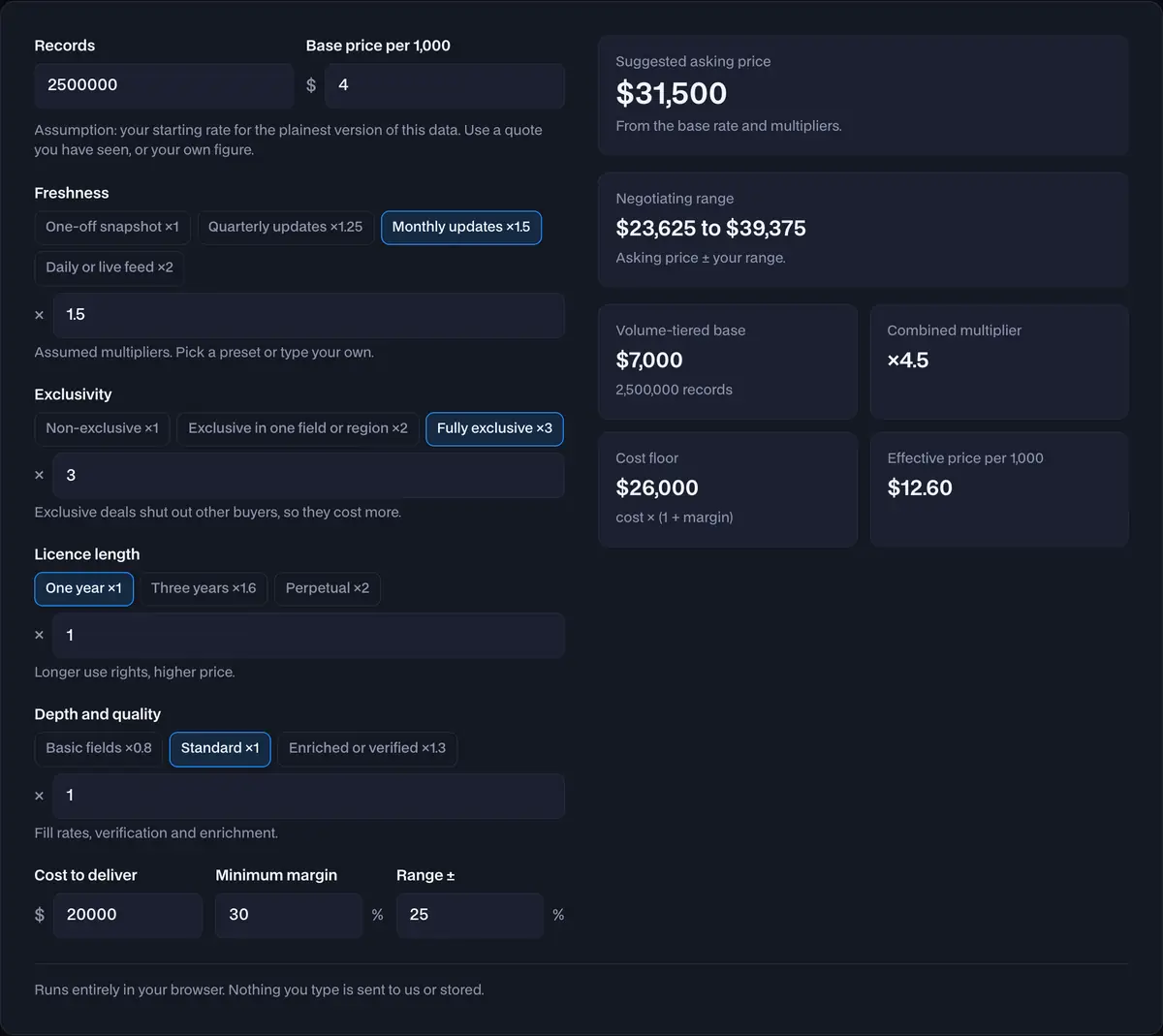 Data pricing calculator
Data pricing made concrete: start from a base rate, apply volume tiers and multipliers you control, and get an asking price and range.
- Data broker tools
Data broker tools for every stage of a deal, free and without an account, running in your browser so nothing you type is stored.


Guides that use the data value calculator
- Can a bankrupt company sell customer data?
Can a bankrupt company sell customer data? Often, but its old privacy promises follow the data into court, as RadioShack and 23andMe showed.

Free tool
Try the data value calculator
Data value is what a dataset is worth to someone, estimated by what it would cost to recreate, what similar data sells for, or how much extra income or savings it brings the person using it.
- Free
- No sign-up
- Runs in your browser