Glossary
What is a dataset?
What is a dataset, beyond a big file? Records, a schema, metadata, documentation and the rights to use them.
Updated

Definition
A dataset is a defined collection of related data, usually records sharing the same fields, kept or published together with a description of what it holds, where it came from and the terms on which others may use it.
A dataset in plain words
NIST's glossary gives the shortest answer: a dataset is a collection of data. The W3C's data catalogue vocabulary, DCAT, adds the parts that matter in practice.
A dataset there is a collection of data published or curated by a single agent and available in one or more formats. Each of those formats is a distribution, such as a downloadable CSV file or an API.
Boundary, curator, distribution
So a dataset has a boundary (what is in and what is out), an owner or curator who answers for it, and at least one way to get hold of it.
Exports versus a dataset
A shared drive full of unrelated exports has none of those. The same exports, scoped to one subject, given consistent columns and a written description, become a dataset someone else can understand without asking the person who made it.
Anatomy of a dataset

| Part | What it is | Example | Where it is defined |
|---|---|---|---|
| Records (rows) | One entry per thing observed: a transaction, a scan, a sensor reading | One row per parcel scan | Table Schema: a primary key is the field or fields that uniquely identify each row |
| Fields (columns) | The attributes every record shares, each with a name and a type | scan_time, depot_id, parcel_weight_kg, status | Table Schema: a fields array, one descriptor per field; type defaults to string |
| Schema | The rules for the fields: types, keys, which values count as missing | depot_id is an integer; an empty status means unknown | Table Schema: fields, primaryKey and missingValues |
| Metadata | Facts about the dataset as a whole: title, description, publisher, dates, coverage | Title, the depots covered, the years covered, update frequency | W3C DCAT: title, description, publisher, licence, spatial and temporal coverage |
| Documentation | Why it was made, how it was collected, known gaps and suitable uses | Scanners changed model in year three; rural depots are under-represented | Datasheets for Datasets: motivation, composition, collection process, recommended uses |
| Licence and sources | The terms of use and where the raw data came from | Licensed for route modelling; no resale of raw rows | Data Package: licenses and sources properties (the spec notes the licence field is not itself legally binding) |
| Distribution | The form a user actually receives | Monthly Parquet files plus a sample CSV | W3C DCAT: a distribution is an accessible form of a dataset, such as a downloadable file |
Why the standards help a seller
None of these standards is compulsory for a private sale. They are useful because they show what a careful buyer expects to find, and they give a seller a ready-made checklist instead of inventing one.
Dataset, database and AI dataset
- A database is the system that stores and serves data, often for day-to-day operations. A dataset is a defined slice or export with a description, even when it lives inside a database.
- An AI dataset is a dataset prepared for training, tuning or testing a model, with labels and splits where the task needs them. Every AI dataset is a dataset; most datasets are never used for AI.
- A data product is a dataset someone maintains and supports over time, with an owner and regular updates, rather than a one-off extract.
What makes a dataset sellable

Plenty of companies hold large datasets that no buyer can safely license. Size is rarely the obstacle. Three questions usually decide whether a dataset can be sold at all.
- Rights: does the seller own the records or hold a licence that lets it pass them on? Customer contracts, supplier terms and website terms can all forbid it.
- Provenance: can the seller show where each part came from, when and how it was collected, and what was done to it since? A written provenance record answers the questions a buyer's lawyers will ask anyway.
- Format: does the data arrive with a schema, consistent fields and metadata, so the buyer can load and test it without weeks of cleaning?
The fourth filter
Personal data is the fourth filter. If records name or describe people, privacy law shapes what can be shared. A first pass with a browser PII scanner shows whether obvious identifiers such as emails, phone numbers or ID numbers sit in a sample; it does not decide whether the remaining data is anonymous.
Where DataBroker fits
We don't sell datasets or data feeds. DataBroker is a paid course and a set of tools for people who broker data between companies: finding businesses that hold a sellable dataset, checking its rights and documentation, and pricing it.
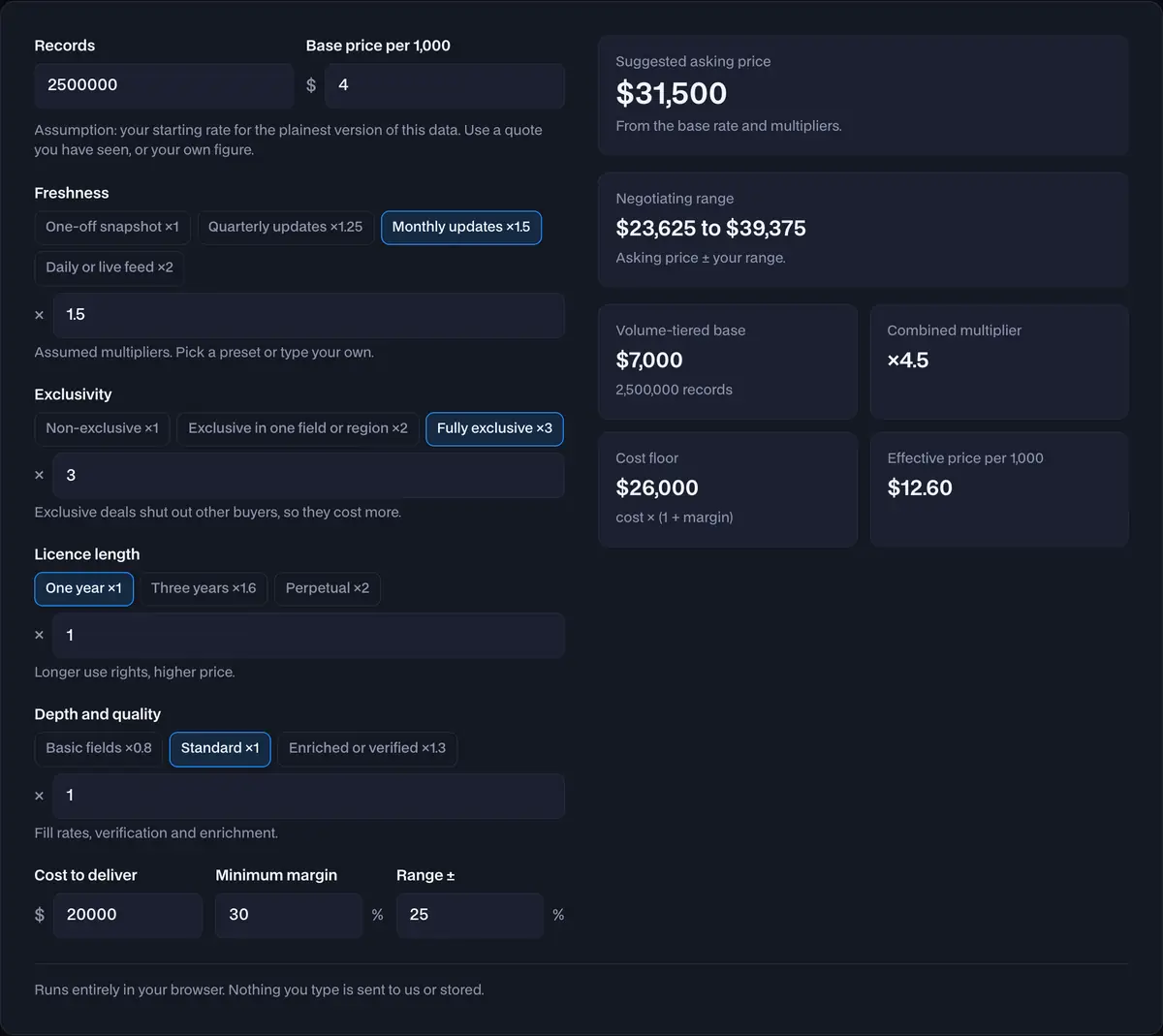
For a first price range, the dataset pricing calculator works from record counts and the buyer's use. For the deeper question of what a specific AI dataset needs, see the sibling entry on that term.
Sources
5 sources · checked Nov 9, 2026
- NIST CSRC glossary: datasetDataset as a collection of data (from NIST SP 800-188) · Checked
- W3C: Data Catalog Vocabulary (DCAT) Version 3Dataset curated by a single agent and available in one or more formats; distributions; dataset metadata properties · Checked
- Frictionless Data: Table SchemaFields, field types, primary keys and missing values · Checked
- Data Package standardLicences, sources, contributors and version in a package descriptor · Checked
- arXiv: Datasheets for Datasets (Gebru et al.)Documentation of motivation, composition, collection process and recommended uses · Checked

Dataset FAQ
What is an example of a dataset?
A table of every parcel scan a courier recorded over five years, with the same fields on each row and a note on what the fields mean, is a dataset. So are a census table, a set of labelled photos or a log of website visits.
Is a spreadsheet a dataset?
It can be. A single sheet with consistent columns and a clear subject is a small dataset. A workbook mixing notes, totals and unrelated tabs is not, until it is cleaned into one table with a description.
What is the difference between a dataset and a database?
A database is the software and storage that holds data and answers queries. A dataset is a defined collection of data with a description, which may be exported from a database, kept in files or shared through an API.
What format should a dataset be in to sell it?
Whatever the buyer can load easily, usually CSV, Parquet or JSON for tables, plus a schema and metadata. The format matters less than consistency: the same fields, types and meanings across every file delivered.
Related
- AI dataset
An AI dataset is the material a model learns from: what it contains, how it is organised, and what buyers check before licensing one.
- Data valuation
Data valuation explained for people selling or brokering a dataset: three standard methods, what each misses, and a worksheet to score one.
 Data pricing calculator
Data pricing made concrete: start from a base rate, apply volume tiers and multipliers you control, and get an asking price and range.


Free tool
Try the PII scanner
A PII scanner searches text for personally identifiable information, such as email addresses, phone numbers and government ID numbers, so it can be removed or protected before the text is shared.
- Free
- No sign-up
- Runs in your browser