Guide
How to start a data broker business
How to start a data broker business the right way: the setup, the paperwork, the registration check and a plan for the first 90 days.
Published

The short answer
To start a data broker business, form a company, open a business bank account, get insurance and reviewed contract templates, and check whether your deals would require state registration. Then pick a data niche, build a list of companies that hold that data and of buyers, and work a steady weekly pipeline toward a first signed deal.
Treat it as a business from day one
Becoming a broker is about skills: finding data, judging it, bringing buyers. Starting a broker business is about structure: a legal entity to sign contracts, a way to receive commissions, protection if a deal goes wrong, and a routine that keeps deals moving.
Sellers and buyers will ask who they are contracting with before they share anything, so the structure is part of how you earn trust.
Nothing here needs much capital. A broker owns no inventory; the main costs are setup fees, insurance, legal review and your time.
Setup, step by step

- 1
Form a legal entity
Most solo brokers in the US choose an LLC. The SBA notes that an LLC protects owners from personal liability in most cases, which matters when you sign agreements about other people's data. Ask an accountant how it will be taxed.
- 2
Get an EIN and a business bank account
An Employer Identification Number from the IRS is free, and you can apply online if the business is US-based. Keep commission payments in a separate account from day one.
- 3
Buy the right insurance
Ask a broker about professional liability (errors and omissions) and cyber cover. You will handle samples and confidential documents, and a claim of negligence or a leak is the realistic risk.
- 4
Prepare reviewed templates
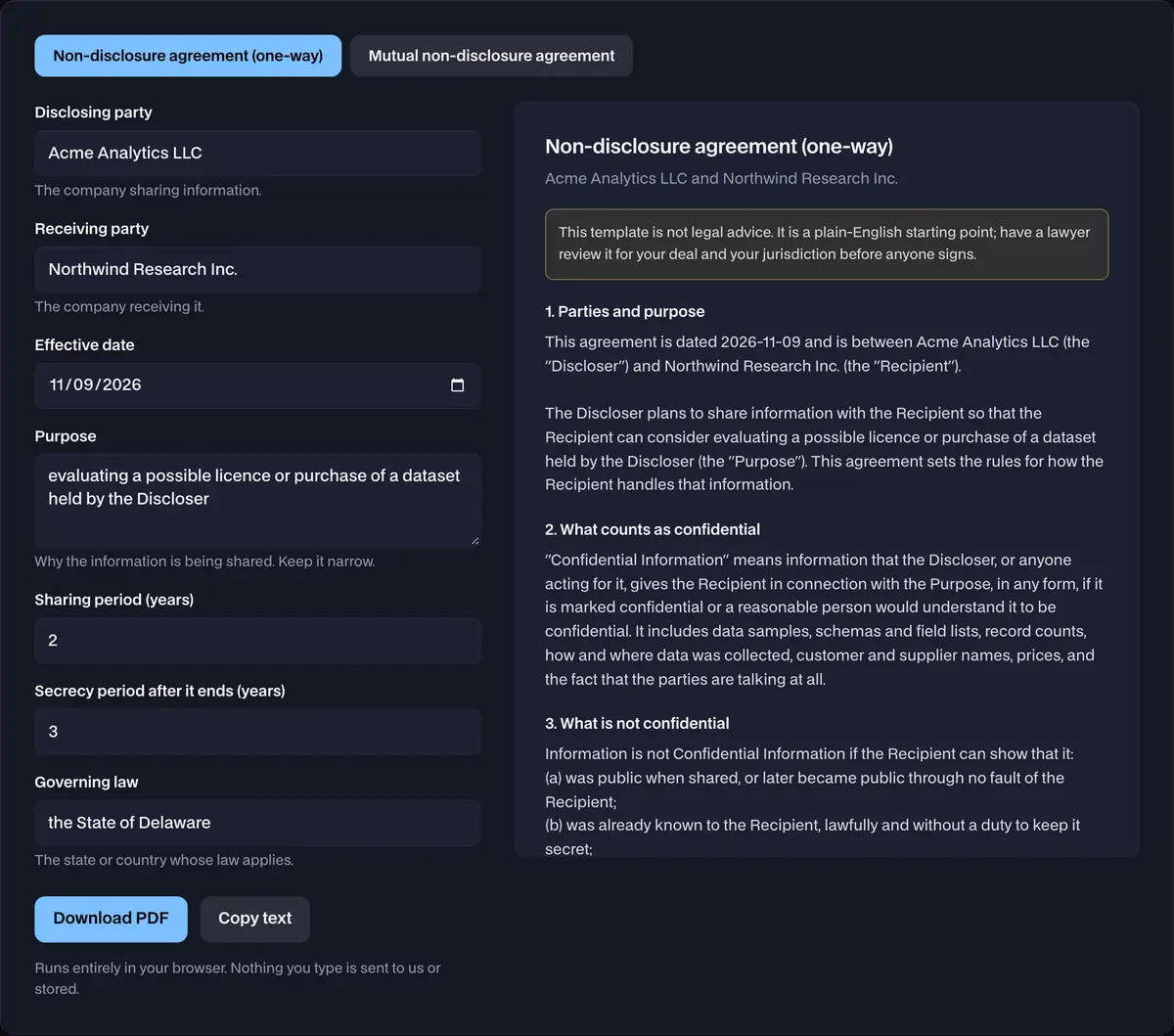
You need four documents: a mutual NDA, a letter of intent, a data licence agreement and a broker or commission agreement with each seller. Have a lawyer review them once, then reuse them.
- 5
Check registration before your first deal
If you will sell personal data about consumers you have no relationship with, California, Vermont, Texas and Oregon may require you to register. Most business-data deals don't trigger this, but check each deal.
- 6
Set up your tools
A CRM or spreadsheet for leads, a secure way to share samples (a data room with access logs), e-signature, and a place to keep each deal's documents.
First 90 days checklist
| Weeks | Focus | Done when |
|---|---|---|
| 1 to 2 | Entity, EIN, bank account, insurance quotes | You can sign a contract and receive a payment as a business |
| 2 to 3 | Templates reviewed; niche chosen | Four documents ready; one or two kinds of data picked |
| 3 to 4 | Buyer map | At least ten named buyers in your niche and what each wants |
| 4 to 6 | Seller list and first outreach | Fifty qualified companies listed; first messages sent |
| 6 to 8 | First conversations | A handful of calls held; first NDA signed |
| 8 to 10 | Intake and valuation | One dataset described, rights checked and a value range written |
| 10 to 12 | Buyer introductions | Broker agreement signed with the seller; first buyers approached |
DataBroker's app covers several rows: the lead finder for building the seller list, the CRM for the pipeline, estimations for a first value range, and contract templates in sending order. The course walks through each stage in more depth.
How the business is paid

In the usual data broker business model, the seller pays the broker a commission or finder's fee when a deal closes: a share of the deal value or a fixed fee.
Some take a share only of the seller's net proceeds after platform fees, so the agreement should say which.
Put the terms in writing
Put the rate, what it is calculated on, when it is due and what happens with repeat sales to the same buyer into the signed broker agreement before any introduction.
Why we don't quote earnings
We don't publish typical earnings. What a broker business brings in depends entirely on the deals found and closed, and early months often bring none.
Limits and honest trade-offs
- Income is lumpy. Deals close irregularly, so keep costs low and plan for months without a commission.
- Rights problems end deals late. Front-load the rights check, even when it slows the first conversation.
- Some niches are regulated. Health, finance, children's data and precise location bring rules this guide doesn't cover.
- Tax and entity advice depends on where you live. Use an accountant; this guide is general.
Sources
4 sources · checked Nov 7, 2026
The DataBroker team checked the facts on this page against 4 public sources, last on .
- US Small Business Administration, choose a business structureLLCs protect owners from personal liability in most instances · Checked
- IRS, get an Employer Identification NumberEINs are free; online application for US-based businesses · Checked
- California Privacy Protection Agency, data broker registrationCalifornia registration duty · Checked
- Texas Secretary of State, data brokersTexas registration duty · Checked

How to start a data broker business: FAQ
How much does it cost to start a data broker business?
Mostly setup and protection: state fees to form an entity, insurance premiums, a lawyer's review of your templates, and your tools. These vary by state and provider, so get quotes. You don't need money to buy data, because brokers don't own inventory.
Do I need an LLC to be a data broker?
It isn't legally required, but most brokers form one or another entity so contracts are signed by the business and personal assets are better protected. Ask an accountant which structure suits your tax position.
Can I run a data broker business part time?
Yes. Many start alongside another job. The constraint is response time: buyers and sellers in a live deal expect quick answers, so keep enough hours free for calls and diligence questions.
What insurance does a data broker need?
Commonly professional liability (errors and omissions) and cyber insurance, since you handle confidential samples and advise on deals. An insurance broker can tell you what is standard for your state and deal size.
How do I find my first clients?
Start from one niche. List the buyers first, then find companies holding the data they want, such as startups that closed or pivoted. Reach the person who can decide with a specific reason their data might be worth something.
Related
- Is selling data legal?
Is selling data legal? A plain look at when a sale is allowed, when registration applies, and when to call a lawyer first.
 How to become a data broker
 who brings company datasets to buyers: the skills, the legal checks, the documents and the order you do them in.
- How to price data
How to price data you plan to sell or license: the five common pricing models, when each fits, and how to set the number.
- Data broker
The data broker definition in plain words and in state law, the six kinds of data broker, and the rules each kind answers to.




Take the DataBroker course
The DataBroker course and tools: find companies with data to sell, price it, license it and close the deal.