Selling data
Can you sell a dataset on Kaggle or Hugging Face?
Can you sell a dataset on Kaggle? Not directly, and Hugging Face has no checkout either; here is what both hubs let a seller do instead.
Published · 6 min read

The short answer
No, not on the platforms themselves. Kaggle and Hugging Face host datasets but neither has a price field or a checkout. A public upload is effectively given away: open licences and Hugging Face's own terms let anyone keep using it. Sellers post a small, scanned sample, take payment under a separate contract, and deliver through a gated Hugging Face repo or another channel.
Can you sell a dataset on Kaggle or Hugging Face at all?
Not as a sale on the platform. Both sites are built for sharing. Kaggle's dataset metadata, as its API documentation lists it, covers a title, description, licence, files, keywords and update frequency. None is a price or an access request.
Hugging Face is similar: its terms cover fees for its own paid services, not a way for users to charge each other. What it offers is gating, a switch that makes people ask before they can download.
So the hubs are shop windows, not tills: money changes hands under a separate contract. A public sample proves the data exists, and a gated repo can hand the full set to buyers you approve.
What each hub lets a seller do

The table sets the three ways to publish side by side, from each platform's own pages.
| What a seller needs | Kaggle dataset | Hugging Face, public repo | Hugging Face, gated repo |
|---|---|---|---|
| Charge for downloads on the site | No. No price or payment field in the dataset metadata | No. No checkout for user datasets | No. Gating controls access, not payment |
| Choose the licence | Yes. Exactly one, from 28 identifiers the API accepts | Yes. A license field in the dataset card | Yes. The same field, plus custom terms shown at the gate |
| Decide who can download | No. The metadata has no access-request field | No. Anyone can download | Yes. Automatic or manual approval of each request |
| Collect details about each requester | No. Not in the dataset metadata | No | Yes. Username and email by default, plus custom text, checkbox, date, country and select fields |
| Take access back later | No. Not in the dataset metadata | Partly. You can stop sharing, but copies already taken stay licensed | Yes. Reject or reset any user at any time |
| Block users in EU countries | No. Not in the dataset metadata | No | Yes. One metadata flag, by IP address |
Why a public upload is hard to take back
Because the licences a public upload carries are built to last, a point most guides to selling datasets skip.
The Creative Commons FAQ says its licences are not revocable once granted unless someone breaches them. A licensor can stop distributing, but anyone who already has a copy may keep using and sharing it. Some licensors charge for initial access, the FAQ notes, so a price only buys the first copy.
Hugging Face adds a layer: its terms say a public repository grants each user a perpetual, irrevocable, worldwide, royalty-free, non-exclusive licence to use, reproduce and distribute the content through its services. You still own the data, but you can't sell exclusive rights to something everyone already holds a licence to.
How do sellers use a gated Hugging Face repo?

As a delivery channel for a deal agreed elsewhere. Requesters share their username and email unless you switch that off, answer any custom fields you add, and wait for approval in manual mode.
- 1
Agree the licence first
Price, permitted uses and term go in a written licence signed before any access. The gate enforces nothing about payment.
- 2
Turn on manual approval
In the dataset settings, enable access requests and choose manual approval.
- 3
Ask for what you need at the gate
Add fields such as company name and a checkbox accepting the licence. Hugging Face says you are responsible for personal data collected this way.
- 4
Grant the buyer's account
Approve the request, or grant access through the settings page or the API.
- 5
Close access when the term ends
Reject or reset the user. Files already downloaded are governed by your contract, not the gate.
Access is granted to individual users, not whole organisations, so each person on a buyer's team needs approval.
What should go in a free sample?
Enough rows to show schema and quality, and nothing you'd mind every user keeping forever. A 2026 Hugging Face forum thread on selling datasets describes the trust problem: buyers want proof of label accuracy and no duplicates, but a full audit exposes the data. Replies suggest a representative, seeded sample, not hand-picked best rows.
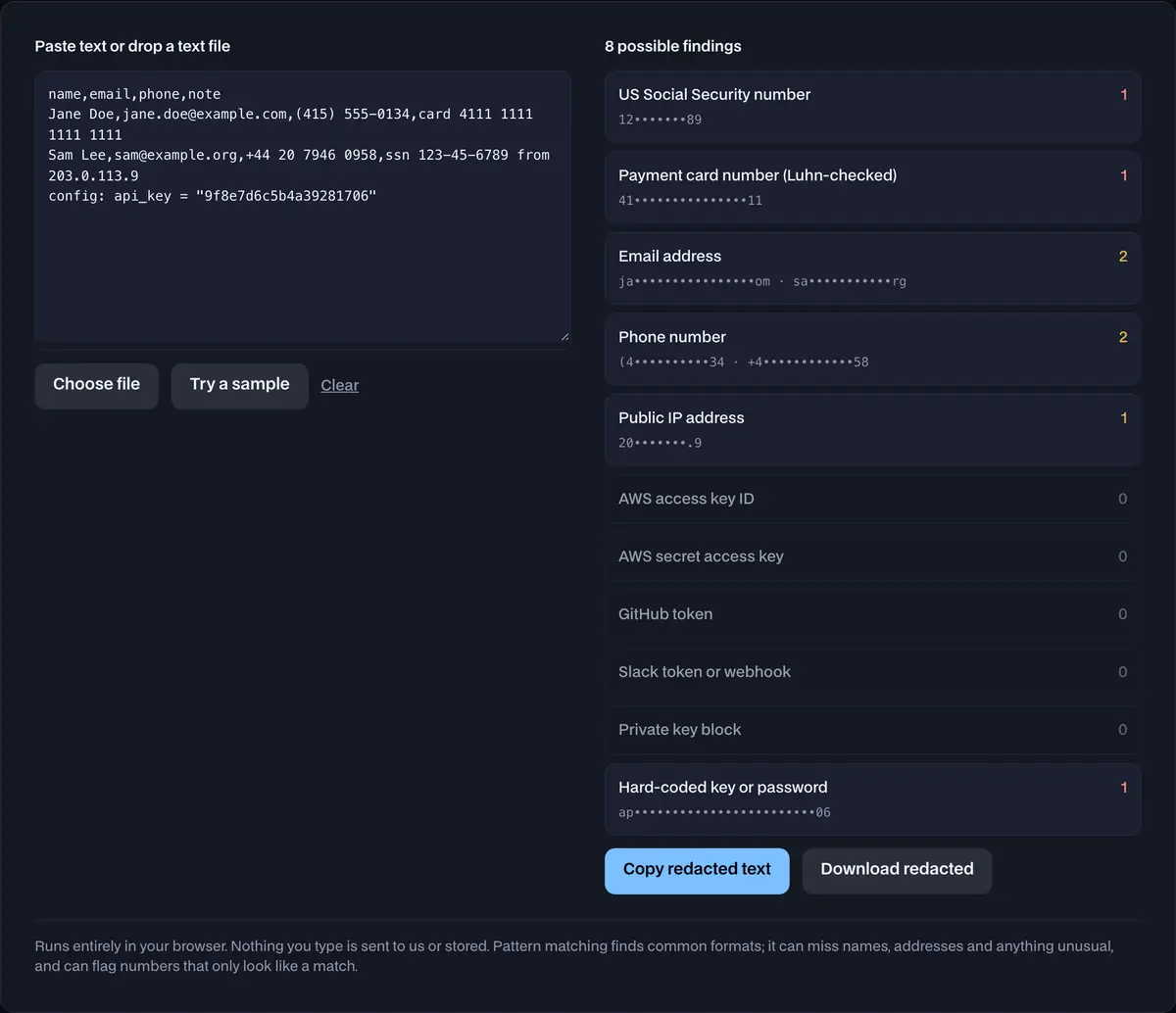
Before posting, scan it. A PII scanner searches text for personally identifiable information, such as email addresses, phone numbers and government ID numbers, so it can be removed or protected before the text is shared. We ran ours on four fictional support tickets.

It found four matches: an email, a phone number, an IP address and a card number that passes the Luhn check. It ignored a parcel tracking number. It did not flag the two names or the street address, as the tool's own page warns: they have no fixed format. Scan, redact, then read every row.
Where can you actually charge for a dataset?

On a marketplace with billing, or in a direct deal. AWS Data Exchange takes a 3% listing fee on public data offers, and private offers pay 3% under $1 million of contract value, 2% up to $10 million and 1.5% above that, per AWS's fee page effective January 5, 2024. Sellers must be registered, qualified and based in an eligible jurisdiction.
| Public offer | 3 % |
|---|---|
| Private offer under $1M | 3 % |
| Private offer $1M to under $10M | 2 % |
| Private offer $10M or more | 1.5 % |
| Any renewal | 1.5 % |
Source: AWS Marketplace listing fees page, effective January 5, 2024, checked 2026-11-13.
Snowflake Marketplace allows paid listings for providers billed in one of 20 listed countries, paid out through Stripe Express. Our guide to where to sell data compares these with listing sites and brokers. For one-off data that AI teams want, such as a codebase or recordings, a direct deal under a written licence is the usual route.
What this answer doesn't cover
Platform terms change; we read them on one day. Our Kaggle facts come from its official API documentation, not its web interface. Whether you may sell a given dataset at all depends on how it was collected, the privacy promises made to the people in it, and contracts we can't see.
Sources
8 sources · checked Nov 13, 2026
The DataBroker team checked the facts on this page against 8 public sources, last on .
- Kaggle API docs, dataset metadataMetadata fields; one licence from 28 identifiers · Checked
- Hugging Face docs, gated datasetsApproval modes, custom fields, reject and reset, EU restriction · Checked
- Hugging Face terms of servicePerpetual licence on public repositories; ownership · Checked
- Creative Commons FAQLicences not revocable; charging for initial access · Checked
- AWS Marketplace listing feesListing fee rates · Checked
- AWS Data Exchange, getting started as a providerSeller eligibility · Checked
- Snowflake docs, becoming a providerPaid-listing countries, Stripe payouts · Checked
- Hugging Face forum, 'Is selling datasets way harder than building them?'The buyer-trust problem; sample advice · Checked

Can you sell a dataset on Kaggle or Hugging Face: FAQ
Does Kaggle pay you for uploading datasets?
No. Kaggle's dataset metadata has no price or payment field, so an upload earns nothing on the site, though it can show buyers what you hold.
Can I make a Hugging Face dataset private and sell access?
You can gate a dataset and approve each requester by hand, but Hugging Face does not take payment for you. Agree the price in a signed licence, then grant the buyer's account.
Can I delete a public dataset and then sell it exclusively?
Deleting it stops new downloads but doesn't cancel licences already granted, so copies people took stay usable. Ask a lawyer before promising exclusivity.
Related
- Where to sell data
Where to sell data depends on the dataset: compare cloud marketplaces, listing sites, brokers, direct deals and asset sales on fees and fit.
- Kaggle datasets
Kaggle datasets are free to download, but each one carries the licence its uploader picked; here is how to use them and what else exists.
 PII scanner
A PII scanner that runs in your browser: paste text or drop a file to see personal data and leaked secrets before you share it.
- AWS Data Exchange and the alternatives for selling data
AWS Data Exchange sells data products to AWS customers; here are its fees, rules and delivery options, and when to use something else.



More from the blog
- Can a bankrupt company sell customer data?
Can a bankrupt company sell customer data? Often, but its old privacy promises follow the data into court, as RadioShack and 23andMe showed.

Free tool
Try the PII scanner
A PII scanner searches text for personally identifiable information, such as email addresses, phone numbers and government ID numbers, so it can be removed or protected before the text is shared.
- Free
- No sign-up
- Runs in your browser