Comparison
Datarade and its alternatives for selling data
Datarade lists commercial data products for buyers to find; here is how it charges providers and what else you can use instead.
Published

The short answer
Datarade is a data marketplace where registered businesses list data products and buyers search, compare and request samples for free. Providers pay through a plan: a commission-only tier at 30% or annual subscriptions with lower commission. It suits companies with a ready data product. One-off or unpackaged datasets often sell better through direct outreach or a broker.
What Datarade is
Datarade describes itself as a global data marketplace. Buyers use it to search data products by category and use case, look at samples and pricing where the provider shares them, post a request describing what they need, and ask Datarade's own team for sourcing help.
Who pays
Buyers do not pay to use it. The money comes from the providers: the companies that list data products there pay Datarade a subscription, a commission on sales, or both.
Discovery, not delivery
That makes Datarade closer to a lead-generation and discovery channel than a place where files change hands. Providers get a storefront, inbound contact requests and the ability to answer buyers' posted requests; the contract and the delivery are worked out between the two companies.
If you already run a data business with a defined product, it puts you in front of people already searching for data. If you are holding one dataset that has never been sold before, it is a less natural fit, for reasons covered below.
How Datarade charges providers

Datarade publishes its provider plans on its application page. Every plan carries a commission on completed sales; the paid plans trade an annual subscription for a lower rate and more listings.
| Plan | Annual subscription | Commission on sales | Listings | Proposals to buyer requests |
|---|---|---|---|---|
| Commission-only | $0 | 30% | 3 | 5 |
| Bronze | $6,000 | 20% | 20 | 10 |
| Silver | $12,000 | 15% | 60 | 25 |
| Gold | Custom | Custom | 60+ | 25+ |
Who may list
The same page says Datarade onboards legally registered businesses of any size, not unregistered individuals, and that providers must hold the legal right to commercialise their data and comply with data protection laws.
So a person who wants to sell someone else's data, or their own personal data, cannot list it there; the company that owns the data has to be the provider.
The alternatives, side by side
- Datarade's commission on the commission-only plan
- 30%
- Datarade's lowest published commission (Silver, with a $12,000 annual fee)
- 15%
- AWS Data Exchange fee on public offers
- 3%
Each option below reaches a different kind of buyer and asks different things of the seller. The table sticks to what each provider publishes about itself; where a fact isn't published, it says so.
| Route | Who can sell | What the seller pays | How buyers get the data | Best for |
|---|---|---|---|---|
| Datarade | Registered businesses holding the rights | Commission of 15% to 30% depending on plan, plus an annual fee on paid plans | Agreed directly between provider and buyer | Data companies with a packaged product that want inbound buyers |
| Snowflake Marketplace | Organisations with a full Snowflake account and an approved provider profile | Fee on paid listings: not published in the docs we checked | Shared into the buyer's Snowflake account | Tables that buyers query inside Snowflake |
| AWS Data Exchange | Registered AWS Marketplace sellers in eligible countries, qualified by AWS | 3% listing fee on public offers; 1.5% to 3% on private offers | Files, S3 access, Redshift, APIs or Lake Formation inside AWS | Data delivered to buyers who already run on AWS |
| Direct sale | Anyone with the rights | Your own time, legal and sales costs | Whatever the contract says | A known buyer and a seller with sales capacity |
| A broker | The owner, represented by the broker | A commission agreed with the broker | Agreed per deal, often through a data room | One-off or unpackaged datasets, such as codebases or archives |
When Datarade is the better choice

- You sell a repeatable data product, such as a firmographic feed or a location dataset, and want buyers who are already searching to find it.
- You want a storefront and request inbox without building your own marketing site for the data.
- Your buyers are spread across industries and you don't know them by name yet. A marketplace gives you reach a single broker or a sales hire can't match.
- You can live with a commission on each sale in exchange for no upfront cost on the entry plan.
Where a marketplace wins
In those cases a marketplace is usually cheaper and faster than hiring someone to find buyers one by one. DataBroker does not run a self-serve public data marketplace on this site, so if reach to unknown buyers is the main thing you need, Datarade or a cloud marketplace will serve you better.
When another route fits better
- The data has never been sold and isn't packaged. A shut-down startup's codebase or ten years of support tickets need rights checks, cleaning and a price range before any listing makes sense.
- The buyer pool is small and specific. AI labs licensing code or conversation data are few enough to approach directly, and they often want exclusivity, which a public listing works against.
- The owner doesn't want the data advertised. Some companies will only sell quietly, under NDA, to one buyer.
- You are an individual representing a company. You can't list on its behalf, but you can broker the deal under a signed agreement with the owner.
Where a broker comes in
This is the gap a broker fills.
The DataBroker academy teaches the deal from finding the owner to closing with a buyer, and the app supports each step: a lead finder that ranks companies likely to hold sellable data, value ranges for codebases, tasks and raw data, contract templates in the order you send them (mutual NDA, letter of intent, data license agreement, broker agreement) and a CRM for the pipeline.
How to choose in four questions

- 1
Is the data a product or a one-off?
A product that updates and sells to many buyers suits a marketplace. A one-off archive or codebase usually suits a direct or brokered sale.
- 2
Do you know who would buy it?
If you can name the ten likeliest buyers, approach them. If you can't, a marketplace's search traffic does that work for you.
- 3
Where do buyers want to receive it?
If they live in Snowflake or AWS, the cloud marketplaces deliver into their accounts with no file transfers. Datarade leaves delivery to you.
- 4
Does the owner need privacy or exclusivity?
Public listings advertise the data. A quiet, exclusive licence is easier to arrange off-market.

More about datarade and its alternatives for selling data
Limits of this comparison
Sources
5 sources · checked Nov 7, 2026
The DataBroker team checked the facts on this page against 5 public sources, last on .
- Datarade provider application pagePlans, annual fees, commission rates, listing limits, who may apply · Checked
- Datarade homepageFree use for buyers, samples, data requests, sourcing help · Checked
- Snowflake docs: Use listings as a providerFull account and approved provider profile required · Checked
- AWS Marketplace Seller Guide: listing fees3% public offer fee for AWS Data Exchange; private offer tiers · Checked
- AWS Data Exchange: getting started as a providerEligible jurisdictions and qualification · Checked

Datarade and its alternatives for selling data FAQ
Is Datarade free to use?
For buyers, yes: Datarade says searching, comparing and requesting data cost them nothing. Providers can start on a commission-only plan with no subscription, but Datarade then takes 30% of completed sales.
Can an individual sell data on Datarade?
Datarade's provider page says it onboards legally registered businesses, not unregistered individuals, and that providers must hold the right to commercialise the data. An individual can still represent a company as its broker, but the company owns the listing.
Does Datarade deliver the data to the buyer?
Its pages describe discovery, samples, contact requests and proposals; the delivery method and the contract are agreed between provider and buyer. If you want delivery handled inside the buyer's cloud account, look at Snowflake Marketplace or AWS Data Exchange.
Which is cheaper to sell through, Datarade or AWS Data Exchange?
On fees alone, AWS publishes a 3% listing fee for public Data Exchange offers, below Datarade's lowest published commission of 15%. But AWS only reaches buyers who use AWS and expects you to deliver there, so the cheaper fee is not always the cheaper sale.
What should I use for a one-off dataset like a codebase?
One-off datasets usually need rights checks, a value range and a short list of likely buyers before a listing helps. A direct approach or a broker working under a commission agreement tends to fit better than a public product listing.
Related
- Where to sell data
Where to sell data depends on the dataset: compare cloud marketplaces, listing sites, brokers, direct deals and asset sales on fees and fit.
- Snowflake Marketplace and the alternatives for data sellers
Snowflake Marketplace shares live tables into buyers' own accounts; here is who can list there and what to use when it doesn't fit.
- AWS Data Exchange and the alternatives for selling data
AWS Data Exchange sells data products to AWS customers; here are its fees, rules and delivery options, and when to use something else.
 Selling data your company holds
Selling data your business already holds, from listing what you have to signing the licence and handing it over safely.



Free tool
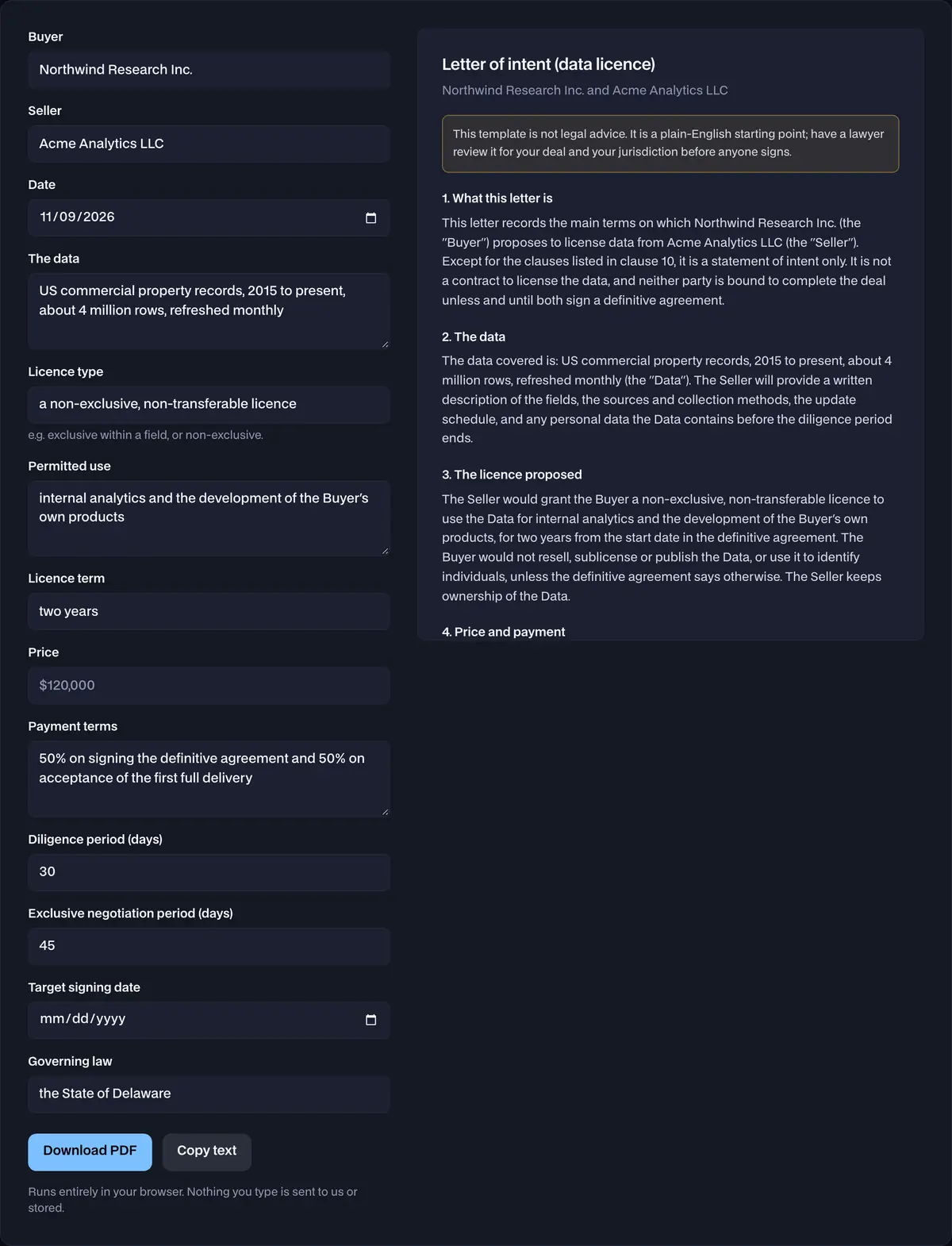
Try the letter of intent generator
A letter of intent generator is a form that produces a letter recording the main terms two parties expect to agree, such as price, scope and timing, before lawyers write the final contract.
- Free
- No sign-up
- Runs in your browser