AI training data
What is a datasheet for a dataset, and should sellers write one?
A datasheet for a dataset answers 57 standard questions about your data; here is what buyers read in one and how to write it.
Published · 6 min read

The short answer
A datasheet for a dataset is a document that answers standard questions about why a dataset was made, what it contains, how it was collected and cleaned, and how it may be used. The original proposal asks 57 questions in seven sections. Sellers should write one: it answers a buyer's first checks, though quality promises belong in the licence.
What is a datasheet for a dataset?
A datasheet for a dataset is a written record answering set questions about a dataset: why it was made, what is in it, how it was collected and cleaned, what it is fit for, how it is distributed and who maintains it.
It comes from a paper by Timnit Gebru and six co-authors, posted in March 2018 and published in Communications of the ACM in December 2021, modelled on the datasheets that ship with electronic components. It names two readers, a dataset's creators and its users: in a sale, the seller and the buyer.
What questions does a datasheet answer?

It answers 57 questions, by our count of the paper's final version, in seven sections that follow a dataset's life.
| Section | Questions | What a buyer learns |
|---|---|---|
| Motivation | 4 | Why the data exists and who paid for it |
| Composition | 16 | What a record is, how many, what is missing, whether any is about people |
| Collection process | 12 | How and when it was gathered, and whether people consented |
| Preprocessing, cleaning and labelling | 4 | What was removed or changed; whether the raw data survives |
| Uses | 6 | What it should and shouldn't be used for |
| Distribution | 7 | The licence, fees and third-party restrictions |
| Maintenance | 8 | Who fixes errors and whether old versions stay available |
The authors say the questions aren't prescriptive. Skip what doesn't apply, but say you skipped it.
Is a datasheet the same as a dataset card?
Not quite. A dataset card is the README that documents a dataset: what it contains, how it was collected, what it is suitable for and under what licence, with machine-readable metadata at the top. A datasheet is the set of questions such a card can answer.
| Format | Published by | Form | What it records |
|---|---|---|---|
| Datasheets for Datasets (2018) | Gebru and co-authors | Free text, 57 questions | Motivation to maintenance, seven sections |
| Hugging Face dataset card | The dataset's owner on the Hub | README.md with a YAML header | Licence, languages and tags, then a description |
| Data Cards template (2022) | Google's PAIR team | Structured summary, 15 themes | Essential facts for people building and reviewing AI |
| Croissant RAI 1.0 (March 2024) | MLCommons | Machine-readable JSON-LD | Collection, annotation, personal data, biases, limits, uses |
| EU training-content summary | General-purpose AI model providers | Public form, set fields | Training data by source, including private datasets |
Croissant RAI cites the Gebru paper directly. A Hugging Face card is where many datasets carry the answers, because the Hub turns its YAML header into licence labels and search filters.
Do buyers actually read dataset documentation?

On the largest public hub, documented datasets get almost all the use. Yang, Liang and Zou studied all 24,065 dataset repositories on Hugging Face as of March 16, 2023 (ICLR 2024). Only 30.9% had a card with any content, yet those drew 95.0% of downloads.
That is a correlation; popular datasets get more care. More telling is what scored worst when five annotators rated 150 random cards out of 5 (six of seven scores published).
| Aspect rated | Mean score (out of 5) |
|---|---|
| Dataset description | 2.92 |
| Structural organisation | 2.82 |
| Data structure | 2.70 |
| Content comprehensiveness | 2.48 |
| Data preprocessing | 1.21 |
| Usage guidance | 1.14 |

Preprocessing and usage guidance scored lowest, and a buyer can't work either out by opening the files. Only the seller knows those.
Why does an AI buyer need the answers?
Because many AI buyers must now describe their training data in public. Since 2 August 2025, Article 53(1)(d) of the EU AI Act has required every provider of a general-purpose AI model to publish a training-content summary, on a template the Commission adopted as C(2025) 8311.
Section 2.2.2 covers private datasets from third parties, naming data intermediaries, where no licence was agreed with the rightsholders. For those not publicly known, the provider gives the modality, the nature of the content (such as personal data or copyrighted works) and the languages. Datasets licensed from rightsholders, under Section 2.2.1, need only a yes and the modalities.
How should a seller write one?

- 1
Start with composition and collection
They hold 28 of the 57 questions and the facts an AI buyer reports: what a record is, how many, where they came from, and whether any are about people.
- 2
Write down every cleaning step
What was removed, merged or labelled, and whether the raw data still exists. Cards rated this second-worst.
- 3
State the uses you won't allow
Match them to the licence you intend to offer.
- 4
Give facts, not legal conclusions
Say how notice and consent were given, not that the data is compliant. The paper's authors swapped compliance questions for factual ones after a legal review.
- 5
Scan before you share
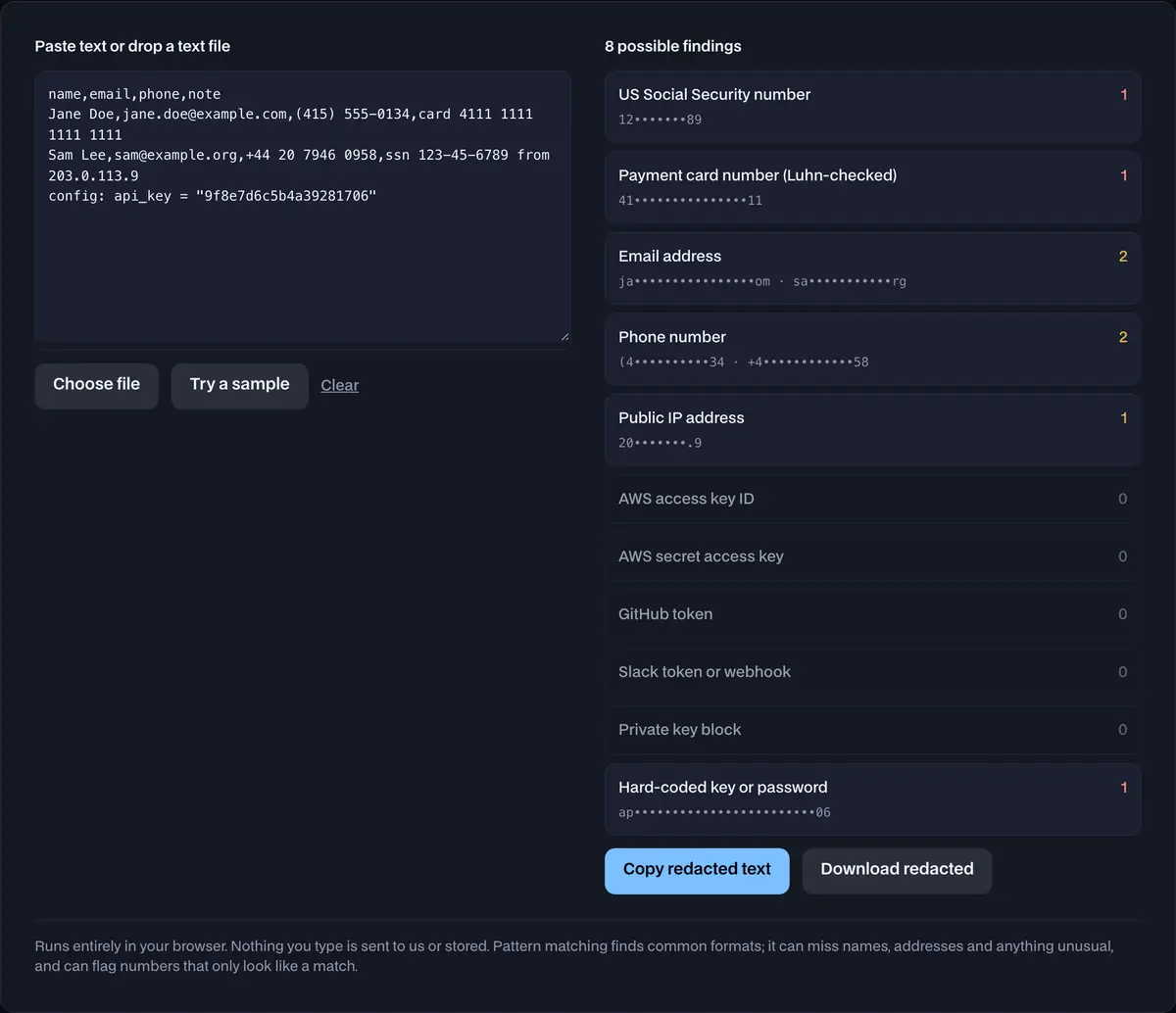
A PII scanner searches text for personally identifiable information, such as email addresses, phone numbers and government ID numbers, so it can be removed or protected before the text is shared.
Our dataset card generator turns short answers into a README.md with Hugging Face metadata and the same seven sections, marking blanks as [Not stated]. It doesn't write the answers; the paper says datasheets shouldn't be automated.
A broker can draft it with the seller: the paper notes the people writing a datasheet may not be the dataset's creators. Send it with the data sample.
What a datasheet doesn't do
A datasheet describes; it doesn't promise. If a buyer relies on a quality level, a record count or a consent basis, put it in the licence as a warranty. We read these documents on one day, the Hugging Face figures date from March 2023, and we can't say what a given buyer requires. Whether you may sell the data at all is a separate question.
Sources
6 sources · checked Nov 16, 2026
The DataBroker team checked the facts on this page against 6 public sources, last on .
- Gebru et al., "Datasheets for Datasets", arXiv 1803.09010v8 (CACM, December 2021)Definition, sections, questions, legal review · Checked
- Yang, Liang and Zou, ICLR 2024Card coverage, downloads, ratings · Checked
- Hugging Face Hub docs, dataset cardsREADME.md cards and YAML metadata · Checked
- Google PAIR, Data Cards PlaybookTemplate with 15 themes; 2022 · Checked
- MLCommons, Croissant RAI 1.06 March 2024; RAI properties; cites Gebru · Checked
- European Commission, training-content summary, C(2025) 8311Article 53(1)(d), Section 2.2, dates · Checked

What is a datasheet for a dataset: FAQ
Is a datasheet the same as a data dictionary?
No. A data dictionary lists each field, its type and its unit. A datasheet covers why the data was made, how it was collected and cleaned, and how it may be used. Send both.
Can I share a datasheet before an NDA is signed?
Usually, if it holds no personal data or trade secrets. It describes the data rather than containing it, so it often works as the first document a buyer sees.
Should a datasheet say what the data costs?
The paper's Distribution questions ask for the licence and any fees tied to it. In a private sale, you can name the licence type and leave price to the letter of intent.
Do I need a datasheet to list a dataset on Hugging Face?
No. The Hub shows a dataset's README.md as its card if there is one. In the 2023 study, though, datasets without a card that said anything drew only 5.0% of downloads.
Related
- AI dataset
An AI dataset is the material a model learns from: what it contains, how it is organised, and what buyers check before licensing one.
- What is a data sample
A data sample is the slice of a dataset a buyer sees first; here is what goes in one and how many rows it needs.
 PII scanner
A PII scanner that runs in your browser: paste text or drop a file to see personal data and leaked secrets before you share it.
- AI training data
AI training data licensing explained: which datasets labs want, publicly reported deal values, and the copyright and transparency rules that now apply.



More from the blog
- What is a training data cutoff?
A training data cutoff is where a model's knowledge stops; here is how far behind models ship and what that means for data sellers.
- Can you sell a dataset on Kaggle or Hugging Face?
Can you sell a dataset on Kaggle? Not directly, and Hugging Face has no checkout either; here is what both hubs let a seller do instead.
- Can a bankrupt company sell customer data?
Can a bankrupt company sell customer data? Often, but its old privacy promises follow the data into court, as RadioShack and 23andMe showed.


Free tool
Try the PII scanner
A PII scanner searches text for personally identifiable information, such as email addresses, phone numbers and government ID numbers, so it can be removed or protected before the text is shared.
- Free
- No sign-up
- Runs in your browser