Selling data
What is a data sample, and how big should it be?
A data sample is the slice of a dataset a buyer sees first; here is what goes in one and how many rows it needs.
Published · 7 min read

The short answer
A data sample is a small, representative slice of a dataset that a buyer checks before licensing the rest. No size is standard: Dawex caps samples at 5% of a file or 100 lines, and AWS Data Exchange allows ten files of up to 50 MB per data set. Size it for your claim: showing an error rate under 1% takes about 300 clean, randomly drawn rows.
What is a data sample?
A data sample is a small piece of a dataset, shared so a buyer can judge the whole before licensing it. AWS Data Exchange defines it as a small part of the data in a product, intended to show what the entire data set is like.
A sample does one of two jobs. A preview sample shows the shape: columns, formats and date range. An audit sample backs a quality claim, such as how many rows have errors. Most guides treat these as one thing.
How big are samples on data marketplaces?
There is no common size. Four marketplaces' own documentation, read on November 15, 2026, gives four different rules.
| Marketplace | Who builds the sample | Size limit | Format and preview | Who can see it |
|---|---|---|---|---|
| AWS Data Exchange | The provider uploads it | Up to 10 samples per data set, 50 MB each | Any file type S3 accepts; only CSV previews in the console | Subscribers, before they subscribe |
| Dawex | The platform's own algorithm, for objectivity | No more than 5% of the file or 100 lines | One sample per dataset in an offering; formats not stated | Not stated on the help page |
| Snowflake Marketplace | The provider, as a limited trial listing | A subset or the full product, for 1 to 90 days | Shared tables in the consumer's own account | Consumers who get the trial; full access on request |
| Bright Data | The provider | Not fixed: varies by dataset | JSON, CSV and Parquet | Anyone; no signup for most downloads |
- Dawex's cap on a sample (or 5% of the file)
- 100 lines
- AWS Data Exchange's limit per sample file
- 50 MB
- Snowflake's range for a limited trial
- 1–90 days
Dawex doesn't let sellers choose the rows, the strongest guard against a cherry-picked sample. Snowflake's trial swaps the file for time-limited access, so the buyer tests the data in place without keeping a copy.
How many rows does a sample need to prove quality?
About 3 divided by the error rate you want to claim, if every row checked is clean. This is the rule of three: when none of n random rows has a problem, the true rate is below 3/n with 95% confidence.
| Under 5% | 59 rows |
|---|---|
| Under 3% | 99 rows |
| Under 2% | 149 rows |
| Under 1% | 299 rows |
| Under 0.5% | 598 rows |
| Under 0.1% | 2,995 rows |
Source: Computed by DataBroker as the smallest n with (1 − p)^n ≤ 0.05, the exact form behind the rule of three (3/n). Assumes zero errors found in a random draw.
So a clean 100-line Dawex sample supports a claim of under about 3%, nothing tighter. A promise of under 1% duplicates or mislabels needs around 300 clean rows; under 0.1%, about 3,000.
Who should choose the rows?
Ideally not the seller alone. Dawex generates samples itself for objectivity. In a 2026 Hugging Face forum thread on selling datasets, one reply called a seller-curated set of unusually good examples "a demonstration, not an audit sample" and suggested a published random seed, stratified across the data.
Stratified means drawing from each important group, such as each year or source, so a small group isn't missed. A published seed lets the buyer redraw the same rows.
Researchers agree. Firmani and colleagues (2023) call marketplaces shop windows where buyers see occasionally small samples; Azcoitia and Laoutaris (2020) argue for testing data before paying.
What should a seller do before sending a sample?
- 1
Decide what the sample must prove
Format only, or a quality claim. Size an audit sample from the chart above.
- 2
Draw it at random and record the seed
Stratify by the groups that matter, and write down how the rows were drawn.
- 3
Scan and redact it
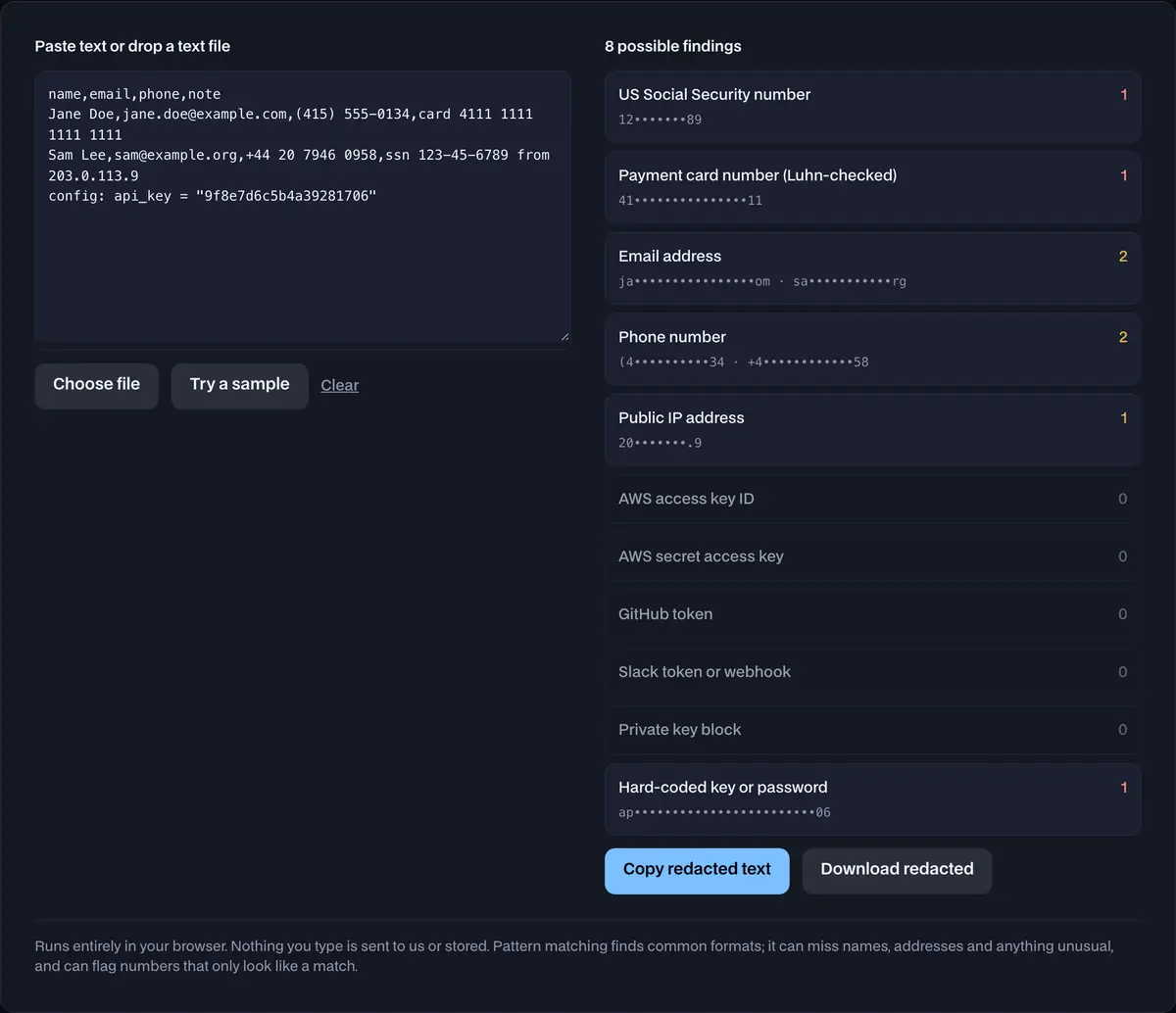
A PII scanner searches text for personally identifiable information, such as email addresses, phone numbers and government ID numbers, so it can be removed or protected before the text is shared. Then read the rows by hand.
- 4
Send it with a data dictionary
Column names, types and units, plus the full row count and date range.
- 5
Put anything beyond a preview under an NDA
Say what the buyer may not do with the sample, and log who received which version.
AWS Data Exchange shows samples before anyone subscribes, and Bright Data offers most downloads without signup, so a public sample should be one you are happy for anyone to keep.
What the NDA should say about samples
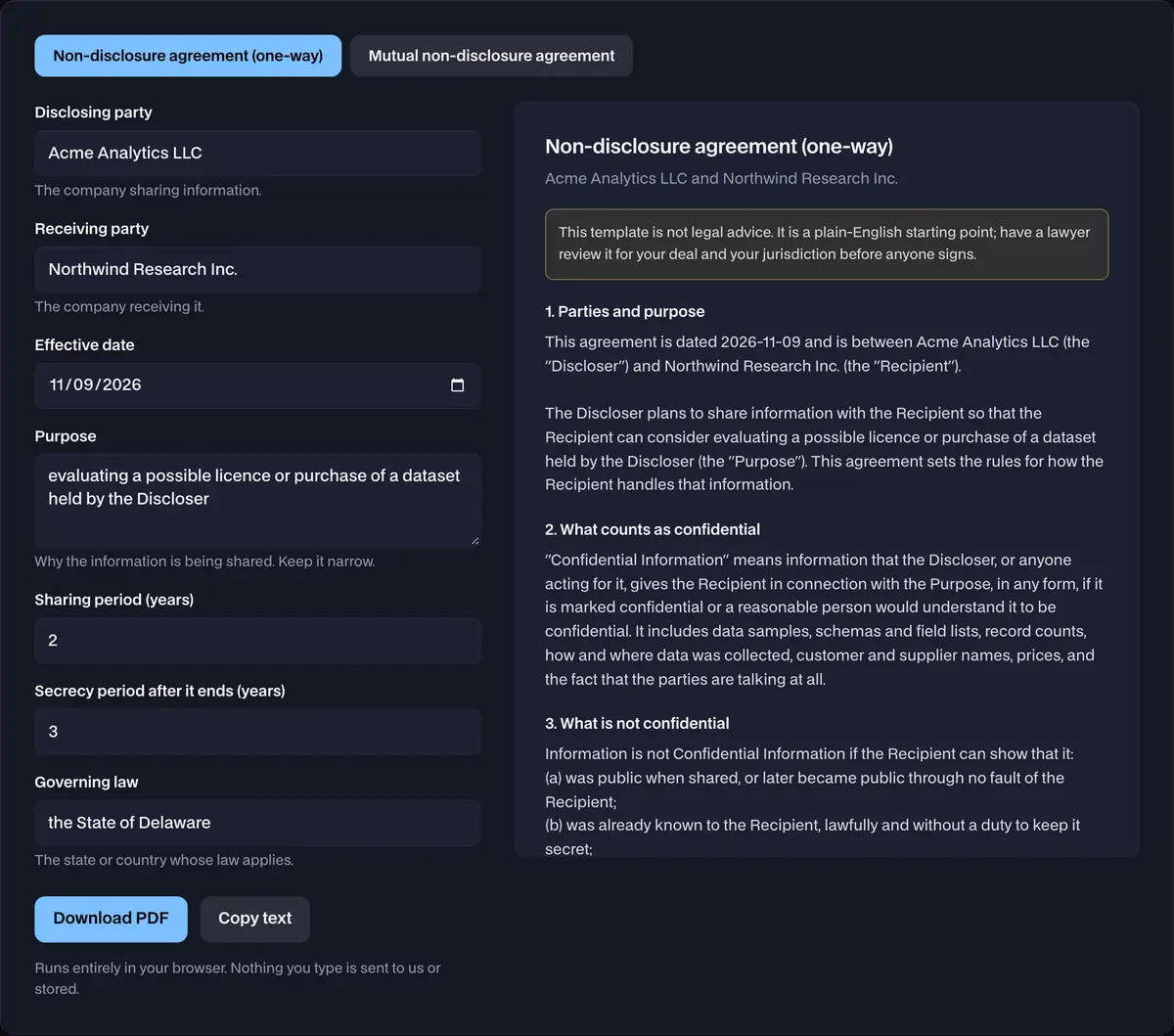
An NDA generator is a form that turns a few facts, such as who is sharing, who is receiving, why, and for how long, into a complete non-disclosure agreement you can review, sign and keep. Ours includes a clause written for data samples.

It bars re-identifying anyone, using samples to build, train, test or improve any product, model or dataset, contacting people in them, and keeping them after the purpose ends. The NDA also says information is shared as it is: quality promises belong in the licence.
What this answer doesn't cover

We read four marketplaces' rules on one day; they change. The rule of three covers zero failures only; measuring a rate when errors turn up, or checking rare groups, needs more rows and proper statistics. We publish no deal data, so we can't say what sizes buyers accept in private deals.
Whether you may share a sample at all depends on how the data was collected and the promises made to the people in it.
Sources
8 sources · checked Nov 15, 2026
The DataBroker team checked the facts on this page against 8 public sources, last on .
- AWS Data Exchange User Guide, sample dataDefinition; 10 samples of 50 MB; CSV preview; visible before subscribing · Checked
- Dawex help, how the representative sample is generatedPlatform-built samples; 5% or 100 lines · Checked
- Snowflake docs, about listingsTrials of 1 to 90 days; subset or full product · Checked
- Bright Data, free dataset samplesSize varies; formats; no signup for most · Checked
- Wikipedia, rule of three (statistics): en.wikipedia.org/wiki/Rule_of_three_(statistics)The 3/n bound at 95% confidence · Checked
- Hugging Face forum, 'Is selling datasets way harder than building them?'Seeded, stratified samples · Checked
- Firmani et al., "Bridging the Gap between Buyers and Sellers in Data Marketplaces with Personalized Datasets", SEBD 2023Marketplaces as shop windows · Checked
- Azcoitia and Laoutaris, "Try Before You Buy" (2020)Buying by volume; testing before paying · Checked

What is a data sample: FAQ
Should a data sample be free?
Usually. AWS Data Exchange and Bright Data let buyers view samples before paying. A larger audit sample can wait for an NDA.
Can a buyer train a model on a data sample?
Only if nothing forbids it, so say so in writing. Our NDA wording bars using samples to build, train, test or improve any product, model or dataset.
Does a clean sample prove the whole dataset is clean?
No. 300 clean random rows support only a claim of under 1% errors at 95% confidence. Promises about the whole dataset belong in the licence.
Should the sample be the first rows of the file?
No. The first rows are often the oldest or from one source. Draw at random across the whole file.
Related
 NDA generator
An NDA generator for data deals: type the parties, purpose and terms, then download a one-way or mutual agreement as a PDF.
 PII scanner
A PII scanner that runs in your browser: paste text or drop a file to see personal data and leaked secrets before you share it.
- Dataset
What is a dataset, beyond a big file? Records, a schema, metadata, documentation and the rights to use them.
 Selling data your company holds
Selling data your business already holds, from listing what you have to signing the licence and handing it over safely.
- Can you sell a dataset on Kaggle or Hugging Face?
Can you sell a dataset on Kaggle? Not directly, and Hugging Face has no checkout either; here is what both hubs let a seller do instead.
- Data licensing
Data licensing lets a buyer use a dataset under written conditions while the seller keeps control, which is how most data deals are structured.




More from the blog
- What is a datasheet for a dataset
A datasheet for a dataset answers 57 standard questions about your data; here is what buyers read in one and how to write it.
- What is a training data cutoff?
A training data cutoff is where a model's knowledge stops; here is how far behind models ship and what that means for data sellers.
- Can a bankrupt company sell customer data?
Can a bankrupt company sell customer data? Often, but its old privacy promises follow the data into court, as RadioShack and 23andMe showed.


Free tool
Try the NDA generator
An NDA generator is a form that turns a few facts, such as who is sharing, who is receiving, why, and for how long, into a complete non-disclosure agreement you can review, sign and keep.
- Free
- No sign-up
- Runs in your browser