Data type
Physical AI training data for robots
Physical AI training data teaches robots to act in the world; here is what it contains, where it is sold, who buys it and what to check.
Published

What is physical AI training data?
Physical AI training data is recorded evidence of tasks being done in the real world, such as robot teleoperation logs, first-person video of people working, motion capture and touch sensor readings, used to train models that control robots.
What robot builders are buying
Language models learned from text that already existed. Robots have no such archive, so the companies building humanoids, warehouse arms and home robots pay to have physical tasks recorded.
The shapes the data comes in
The data comes in a few shapes: a person steering a robot by remote control while every joint position and camera frame is logged (teleoperation), a person wearing a head or wrist camera while doing a chore (egocentric video), gloves and suits that capture hand and body motion, and sensors that measure force, pressure and touch.
- Countries where Micro1 pays workers to film chores
- 50+
- Estimated yearly spend on real-world robot data (Micro1's estimate)
- $100M+
- Footage Scale AI announced
- 100,000+ hours
How big the market is
It is a young market and a fast one. In April 2026 MIT Technology Review reported that Micro1, a Palo Alto company paying contract workers in more than 50 countries to film their chores, estimated that robotics companies spend more than $100 million a year on real-world data from it and firms like it, and that Scale AI had announced more than 100,000 hours of collected footage.
Those are company figures, not audited ones, but they show why sellers keep appearing. For the wider picture of how labs license text, images and code, see our page on AI training data.
Data types and the formats sellers name

| Data type | What is recorded | Formats named by sellers |
|---|---|---|
| Teleoperation demonstrations | Robot joint states, actions and synchronised camera streams while a human drives the robot | LeRobot, HDF5, ROS2 MCAP; RLDS for Open X-Embodiment |
| Egocentric video | Head- or wrist-camera footage of a person doing a task, often with hand and object labels | MP4 video with JSON or COCO-style annotations |
| Motion capture | Body and hand pose from suits, gloves or camera rigs | BVH, FBX |
| Touch and force | Hand pressure, finger flexion, force-torque and orientation time series | Time-series files delivered with the video they sync to |
| Vehicle and drone sensor logs | Camera, lidar, radar and flight logs | Seller-specific; ask for a schema and a sample |
Format matters more here than in most data markets, because a buyer's training code expects one layout. A seller who can deliver in the buyer's format, or convert cheaply, removes a week of engineering from the deal.
Where robotics data is sold
Three routes exist: open research datasets, marketplaces that list recorded data from many collectors, and service firms that record to order. The table lists what each company or project says on its own pages. Inclusion is not an endorsement and the order is not a ranking.
| Seller or source | Route | What it says it offers | Published terms |
|---|---|---|---|
| The Robotics Center marketplace | Marketplace | Robot-learning datasets ordered online: egocentric video, teleoperation, hands and tactile, handheld gripper, motion capture | $90 to $1,800 per recorded hour, 10-hour minimum; every order under its RC Standard Data License v1; collectors apply to sell |
| deepen.ai Refinery | Marketplace | First-person video, hand and body motion capture, vehicle, drone and audio data, multimodal sessions with head and wrist cameras and hand pressure | Sellers keep ownership and set how data may be licensed; no fee published |
| Defined.ai | Marketplace and custom collection | Robotics datasets with video, 3D point clouds, lidar, radar, motion capture, force-torque and human demonstration data (expanded January 2026) | Quoted per dataset |
| TELUS Digital | Collection and annotation service | Teleoperation sessions, egocentric and wrist-mounted video, physics-aware labelling, simulation and digital twins | Quoted per project |
| HumanSignal EgoChores | Evaluation sample | First-person 1080p, 30fps video of 27 household chores with action and hand-object labels | Free one-hour sample on request; built to show its collection service |
| Micro1 | Collector | First-person chore video filmed by contract workers who are told to keep faces and personal details out of frame | Doesn't name its clients, per MIT Technology Review |
| Open X-Embodiment | Open dataset | Robot episodes pooled from many labs, in the RLDS episode format | README: software Apache 2.0, other materials CC-BY 4.0; cite each dataset used |
| Ego4D | Research dataset | Large first-person video corpus, about 7.1 TB for the primary set | Licence must be accepted first; approval takes about 48 hours; check its terms before any commercial use |
Rights and consent to check

- People in frame: get written consent from everyone recorded, not just the person wearing the camera. Faces and voices can be biometric data under laws such as Illinois's BIPA.
- Places in frame: footage from homes, shops and factories shows other people's property, screens and documents. Ask whether the seller masks them.
- Workplace recordings: footage of staff at work usually belongs to the employer, and staff may need to be told how it will be used.
- Open datasets: a permissive top-level licence doesn't always cover every pooled subset. Read each subset's terms before training a commercial model.
- Exclusivity and resale: marketplaces often sell the same hours to many buyers. If you need exclusive data, it has to be written into the licence.
If you hold robot or sensor data
Operators of robot fleets, warehouses with instrumented pick stations, motion capture studios and research labs often hold hours of recordings that have value beyond their first use.
Before you sell it
Before you sell it to an AI company, confirm who owns it, whether the people recorded agreed to this use, and what format it is in. Then price a dataset on hours, task variety and labels rather than on raw terabytes.
What DataBroker is, and isn't

DataBroker doesn't record or sell robotics data, and we hold no inventory. We run a paid academy and a set of tools for people who broker data deals: finding companies that hold useful recordings, checking the rights, valuing the data and taking it to buyers.
The sellers above are listed so you can compare routes, not because we work with them.
Sources
8 sources · checked Nov 9, 2026
The DataBroker team checked the facts on this page against 8 public sources, last on .
- The gig workers who are training humanoid robots at home, MIT Technology Review, 1 April 2026Checked
- Robotics Data Marketplace, The Robotics CenterChecked
- Refinery, deepen.aiChecked
- Defined.ai Reinforces Training-Ready Physical AI Data to Accelerate Robotics and Embodied Intelligence, Defined.ai, 5 January 2026Checked
- Physical AI and robotics data solutions, TELUS DigitalChecked
- EgoChores egocentric household dataset, HumanSignalChecked
- Open X-Embodiment repository README, Google DeepMindChecked
- Ego4D: Start here, Ego4DChecked

Physical AI training data for robots FAQ
How much does robotics training data cost?
Few prices are public. One marketplace, The Robotics Center, lists datasets at $90 to $1,800 per recorded hour with a 10-hour minimum. Custom collection is quoted per project.
What format is robot learning data delivered in?
Sellers name LeRobot, HDF5 and ROS2 MCAP for teleoperation, MP4 with JSON labels for egocentric video, and BVH or FBX for motion capture. Open X-Embodiment uses the RLDS episode format.
Can I train a commercial robot model on open datasets?
Sometimes. Open X-Embodiment's README puts its materials under CC-BY 4.0, but pooled subsets can carry their own terms, and some research datasets require a signed licence. Check each one.
Is egocentric video the same as teleoperation data?
No. Egocentric video shows a person doing a task through their own camera. Teleoperation data records a robot's own joints and cameras while a person steers it, so it maps directly onto robot actions.
Related
- AI training data
AI training data licensing explained: which datasets labs want, publicly reported deal values, and the copyright and transparency rules that now apply.
- How to sell data to AI companies
Sell data to AI companies only after you can prove where it came from, that you may license it, and why it isn't online already.
- How AI companies get training data
How do AI companies get training data? From five sources: web crawls, licensed archives, paid human work, synthetic data and their own users.
 Data pricing calculator
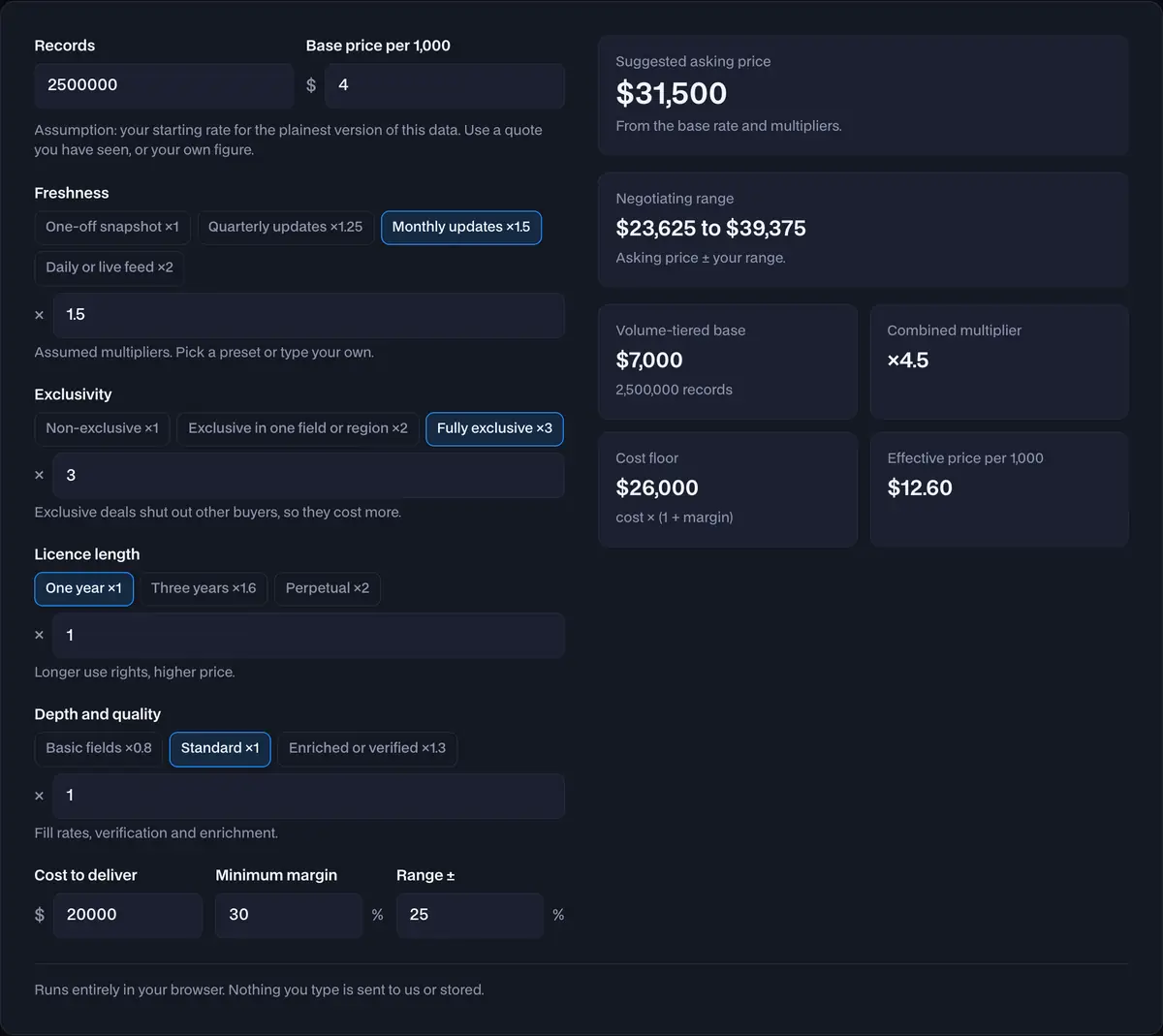
Data pricing made concrete: start from a base rate, apply volume tiers and multipliers you control, and get an asking price and range.




Free tool
Try the data pricing calculator
Data pricing is setting what a buyer pays to use a dataset, usually a rate per record or per period, adjusted for volume, freshness, exclusivity, licence length and quality, and never below what delivery costs.
- Free
- No sign-up
- Runs in your browser