Contracts and legal
What is a tail clause in a broker or finder's fee agreement?
A tail clause keeps your fee owed after the agreement ends; here is what eight filed agreements set and how to write one.
Published · 6 min read

The short answer
A tail clause says a broker or finder still earns the fee if the client closes a deal with someone the intermediary introduced within a set period after the agreement ends. Six of the eight agreements we read on SEC EDGAR used 12 months. Who counts as introduced, and what event triggers the fee, matter as much as the length.
Key takeaways
- A tail clause keeps a fee owed for deals closed after the agreement ends, with parties the intermediary brought in.
- Six of eight agreements filed on SEC EDGAR used a 12-month tail; one used 6 months and one 18.
- Who counts as introduced and what triggers the fee matter as much as the length.
What is a tail clause?
A tail clause is the part of a broker, finder or adviser agreement that keeps the fee owed after the agreement ends, for a deal closed within a set period with a party the intermediary introduced. That period is the tail.
Without one, a seller could end the agreement once a buyer is interested, wait, then sign and owe nothing. It matters most for a finder's fee: a payment to someone whose introduction leads to a completed deal, usually a percentage of the deal or a fixed sum, paid only if the deal closes.
How long do tail periods run in real agreements?

Usually 12 months. We read the tail clause in eight finder, adviser and placement-agent agreements filed as exhibits on SEC EDGAR. Six set 12 months, one 6 and one 18; two change the length when something happens.
| Agreement | Tail (months) | Who it covers | What triggers the fee |
|---|---|---|---|
| High Sierra and Vestech, finder (2022) | 18 | Anyone the finder introduced, directly or indirectly | Entering a deal; fees run for its life |
| Akanda and Cannera, finder (2021) | 6 | Any buyer of one named business | Completion; none if the finder quits |
| Waton and Ocasia, finder (2026 form) | 12 | Targets the finder introduced | Closing and receipt of proceeds |
| Invech and Craft Capital, finder (2026) | 12 (to 24 after an investment in the term) | Introduced parties, affiliates, anyone met through them | A securities purchase |
| AIMS Worldwide and Maxim, adviser (2009) | 12 | Only targets listed in an exhibit | Starting or completing a deal |
| HiEnergy and Seabury, adviser (2002) | 12 (6 after a company termination event) | Buyers identified, advised on or in substantive talks | A securities sale |
| RedRoller and Burnham Hill, adviser (2007) | 12 | Parties in significant discussions | A deal or financing |
| Decent Holding and FT Global, agent (2026) | 12 | Investors introduced, contacted or wall-crossed | A financing |

Eight agreements are a small sample, and most raise money or buy companies rather than license data. Treat 12 months as a common starting point, not a market rate for data deals.
Which buyers does a tail cover?
Only the ones the clause names, and the filed agreements draw that line in different places. The wider the definition, the more deals the seller pays on.
FindLaw's guide makes the same point for sellers: agree before signing whether an introduction means passing on contact details or arranging a meeting.
What has to happen during the tail for the fee to be owed?

Whatever event the clause names. Some filed agreements pay when a deal is entered into, others only on completion, and Waton's form only on closing and receipt of proceeds.
Akanda's counts a definitive agreement signed inside the six months only if the sale later completes. That stops a fee on a deal that collapses, and stops a seller dodging the tail by closing a week after it ends.
Licences that renew
Data deals add a problem the business-broker guides skip: many are licences paid yearly. High Sierra's finder keeps a fee "for the duration of a Transaction" after the agreement ends. Say whether renewals and a second dataset for the same buyer pay commission, and for how many years. Our commission calculator shows what each extra yearly payment adds.
Is there a legal limit on how long a tail can run?
For one kind, yes. FINRA Rule 5110(g)(5)(B) lets a member firm in a public offering collect a termination fee only if a transaction closes within two years of the issuer ending the engagement.
The rule also requires a right to terminate for cause, including the firm's material failure to provide its services, and using it cancels the fee. A client who ends the deal for good reason owes no tail.
- Longest termination-fee window under FINRA Rule 5110
- 2 years
- Tail in six of the eight filed agreements
- 12 months
We found no rule that caps a tail in a private data sale or licence. The contract decides, under the governing state's law; the legal guides we read put common tails between 3 and 24 months.
How do you write a tail clause for a data deal?

- 1
Match the length to the sales cycle
Count how long similar buyers took from first call to signature, then add a margin.
- 2
Send a list when the agreement ends
The broker sends a dated list of introduced buyers within a set number of days. Only buyers on it count.
- 3
Name the trigger
Signature, completion or first payment. Signature followed by completion, as in Akanda's clause, is a fair middle.
- 4
Decide what renewals pay
Say whether renewals and new datasets for the same buyer earn commission, and for how long.
- 5
Say what early termination does
Cut the tail if the broker quits or breaches, as Akanda and Seabury do.
What this post doesn't cover
We read eight public agreements and one FINRA rule on one day, and we have no data-deal tails of our own to report. Enforcement varies by state, a tail can clash with a later broker's agreement, and securities deals raise broker-dealer questions left out here. Ask a lawyer about any of those.
Sources
13 sources · checked Nov 17, 2026
The DataBroker team checked the facts on this page against 13 public sources, last on .
- High Sierra Technologies, EX-10 filed 2022-08-1518-month tail · Checked
- Akanda Corp., EX-10.25 filed 2024-03-116-month tail, trigger · Checked
- Waton Financial, EX-10.2 filed 2026-04-2112-month tail, trigger · Checked
- Invech Holdings, EX-99.1 filed 2026-03-3112 and 24-month tails · Checked
- AIMS Worldwide, EX-10 filed 2009-11-16Listed targets · Checked
- HiEnergy Technologies, EX-10.32 filed 2003-02-2512 and 6-month tails · Checked
- RedRoller Holdings, EX-10.15 filed 2008-04-29Significant discussions · Checked
- Decent Holding, EX-10.1 filed 2026-10-06Tail financing · Checked
- FINRA Rule 5110Two-year termination fee limit · Checked
- FindLaw, broker listing agreementDefining an introduction · Checked
- Sprintlaw, brokerage agreements3 to 12-month tails · Checked
- Aaron Hall, tail period clausesSix months to two years · Checked
- Website Closers, business broker agreementsTails up to 24 months · Checked

What is a tail clause in a broker or finder's fee agreement: FAQ
Is a tail clause enforceable?
It is a contract term, so it binds as far as the agreement does, under the governing state's law. Most arguments are about whether a buyer was really introduced, so keep a dated list.
Does the tail still apply if the broker ends the agreement?
Only if the clause says so. Akanda's finder agreement removes the tail if the finder quits without cause.
Can a seller owe two brokers for the same deal?
Yes, if a buyer on the first broker's tail list closes through a second broker whose agreement doesn't exclude that list. Exclude it in the new agreement.
Is a tail period the same as a non-circumvention clause?
No. A tail keeps a fee owed after the agreement ends. A non-circumvention clause stops a party going around the intermediary, often while the agreement still runs.
Related
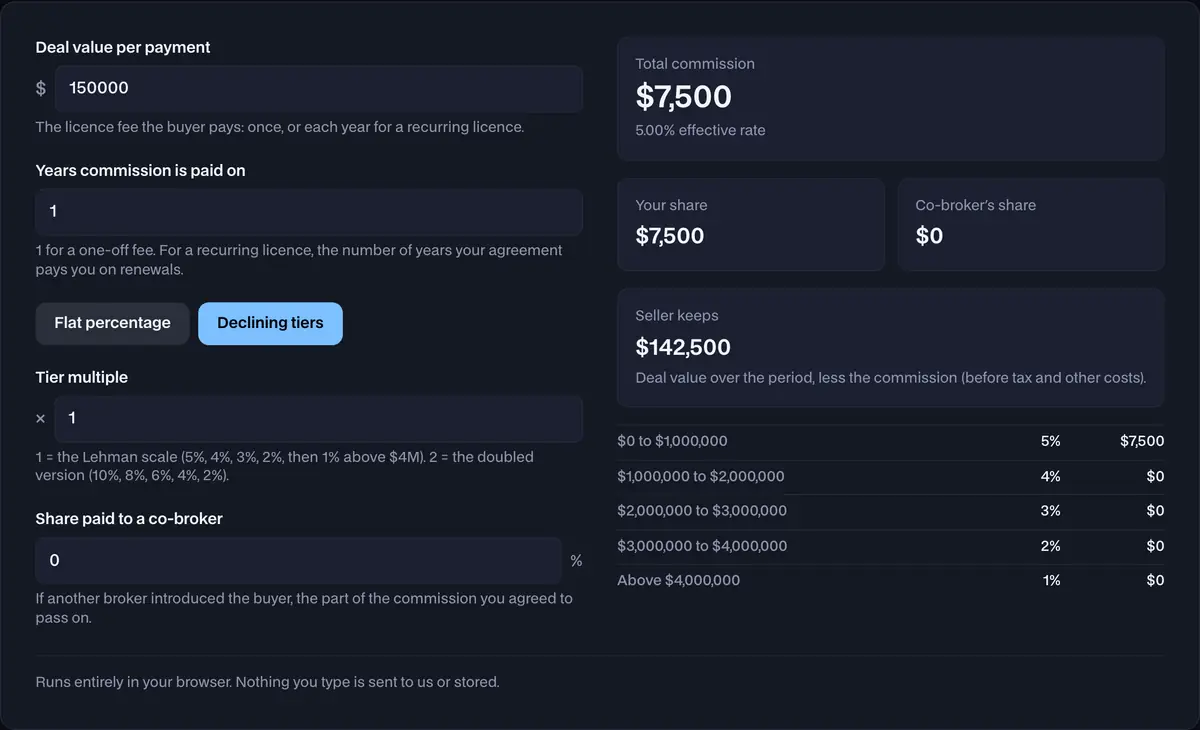 Data broker commission calculator
Work out a data broker commission on any deal: flat or tiered rates, recurring licences, and a split with a co-broker.
- Finder's fee
A finders fee rewards someone for an introduction that leads to a deal; in some fields only licensed people can lawfully receive one.
- Data broker salary
Data broker salary questions have no clean answer: no agency counts the job, so here are the nearest official figures and the pay models.
- How to start a data broker business
How to start a data broker business the right way: the setup, the paperwork, the registration check and a plan for the first 90 days.




More from the blog
- Can a bankrupt company sell customer data?
Can a bankrupt company sell customer data? Often, but its old privacy promises follow the data into court, as RadioShack and 23andMe showed.
- What is a datasheet for a dataset
A datasheet for a dataset answers 57 standard questions about your data; here is what buyers read in one and how to write it.
- What is a data sample
A data sample is the slice of a dataset a buyer sees first; here is what goes in one and how many rows it needs.


Free tool
Try the data broker commission calculator
A data broker commission is the fee a broker receives for arranging a data sale or licence, usually a percentage of what the buyer pays, agreed in writing with the seller before any introduction.
- Free
- No sign-up
- Runs in your browser