Glossary
Finders fee: what it is and when it's allowed
A finders fee rewards someone for an introduction that leads to a deal; in some fields only licensed people can lawfully receive one.
Updated

Definition
A finder's fee is a payment to someone whose introduction leads to a completed deal, usually a percentage of the deal or a fixed sum, paid only if the deal closes. The finder brings the parties together but does not negotiate for either side.
How a finders fee works
A business wants a buyer, an investor or a partner. Someone it knows says, "I can introduce you." If the introduction leads to a signed deal, the business pays that person a fee.
Where a finder stops
The finder's job ends at the introduction: no negotiating, no advice, no signing. That limit matters, because the more someone does to make a deal happen, the more likely the law treats them as a broker or agent rather than a finder.
The fee is usually set in writing before the introduction: a percentage of the money the business receives from the deal, or a fixed amount. Good agreements also say how introduced contacts are recorded and how long after the agreement ends a deal still counts.
Typical finders fee percentages

- most common structure, per ReferralHero's guide
- 5–15%
- per ReferralHero's FAQ
- 5–10%
- introduction fee range, per UpCounsel
- 5–35%
There is no official rate, and published figures disagree. ReferralHero's guide says the most common structure is 5 to 15% of the deal value, and its FAQ says 5 to 10%.
UpCounsel says introduction fees often range from 5 to 35% of the transaction value. Neither cites data. Treat any single number as a starting point for negotiation, not a market rate.
What moves the percentage
ReferralHero adds that percentages generally fall as deal size grows and depend on how warm the introduction was. For a percentage on a data deal, our commission calculator shows what different rates come to on a given price.
When a finder needs a licence
| Field | The rule | What it means for a finder | Source |
|---|---|---|---|
| US securities (raising money from investors) | No formal finder exemption. Transaction-based pay is treated as a hallmark of broker-dealer activity. | A percentage of money raised, paid to an unregistered person, can make the deal voidable under Exchange Act section 29(b) and give investors rescission rights. | Davis Wright Tremaine; Goodwin |
| US securities: proposed finder exemption | In October 2020 the SEC proposed Tier I and Tier II exemptions for individuals who connect issuers with accredited investors. | Proposed, not adopted when our sources were written. Check its status before relying on it. | SEC press release 2020-248; Davis Wright Tremaine |
| US real estate, state licence law | State laws limit who a licensed broker may pay for bringing in a buyer or seller. | California courts have recognised a narrow finder's exception since 1923: a bare introduction, with no negotiation and not on the brokerage's behalf. | CRES Insurance |
| US residential loans (RESPA) | RESPA bars fees for referrals of settlement services on federally related loans on one to four units. | A referral fee on such a transaction can violate federal law even where the state allows it. | CRES Insurance |
| Introductions to buyers of goods, services or data | No general finder's licence in the US. | Usually a matter of contract, unless the deal is really a sale of a company's shares or another regulated product. | Our reading; see the template's notes |
Safer ways to structure a finder's fee

- Keep the finder's role to introductions, and say so in writing.
- In capital raising, Davis Wright Tremaine says issuers should typically not pay finders a percentage of money raised; ask counsel about alternatives.
- Have the finder disclose to the introduced party that a fee may be paid.
- Pay only on money actually received, so the business never pays out before it is paid.
- Use a broker agreement instead if the person will negotiate or run the sale.
Finder's fees in data deals
Data brokering produces plenty of introductions: an engineer who knows a company with a large dataset, or a contact at a buyer looking for one.
A template for data introductions
If you reward that kind of introduction with a fee, our finder's fee agreement template is written for exactly this case, with clauses for registering contacts and a tail period. It owns the contract itself; this page is the definition and the licence map.
Sources
6 sources · checked Nov 9, 2026
- SEC: Press release 2020-248, proposed finder exemptionTier I and Tier II conditions, accredited investors, proposal date · Checked
- Davis Wright Tremaine: Transaction-based fees and unlicensed broker-dealersHallmark of broker activity, void agreements, rescission, advice against percentage fees, exemption not final · Checked
- Goodwin: Regulating unregistered findersSection 29(b), rescission, transaction-based pay as a key factor · Checked
- CRES Insurance: Allowable referrals and commission splits in CaliforniaCalifornia finder's exception and its limits; RESPA · Checked
- ReferralHero: Finder's fees guideQuoted 5 to 15% and 5 to 10% ranges; rates falling with deal size · Checked
- UpCounsel: Business introduction feeQuoted 5 to 35% range · Checked

Finder's fee FAQ
How much is a typical finders fee?
There is no standard. Published guides quote anything from 5% to 35% of the deal, without data behind the figures. Many deals settle on a percentage of money actually received, or a fixed sum, agreed before the introduction.
Can a startup pay a finder's fee for introducing investors?
It is risky in the US. Paying an unregistered person a percentage of money raised can look like unregistered broker-dealer activity, which can let investors unwind their investments. Ask securities counsel before agreeing to one.
Can a real estate agent pay a finder's fee to someone without a licence?
Often not. State licence laws restrict who brokers may pay, and RESPA covers referral fees on federally related residential loans. California recognises a narrow exception for a bare introduction. Check your state's rules.
Is a finder's fee the same as a commission?
Not quite. A finder is paid once for an introduction and steps back. A commission usually rewards ongoing selling, often with renewals. If the person negotiates, use a broker or commission agreement instead.
Related
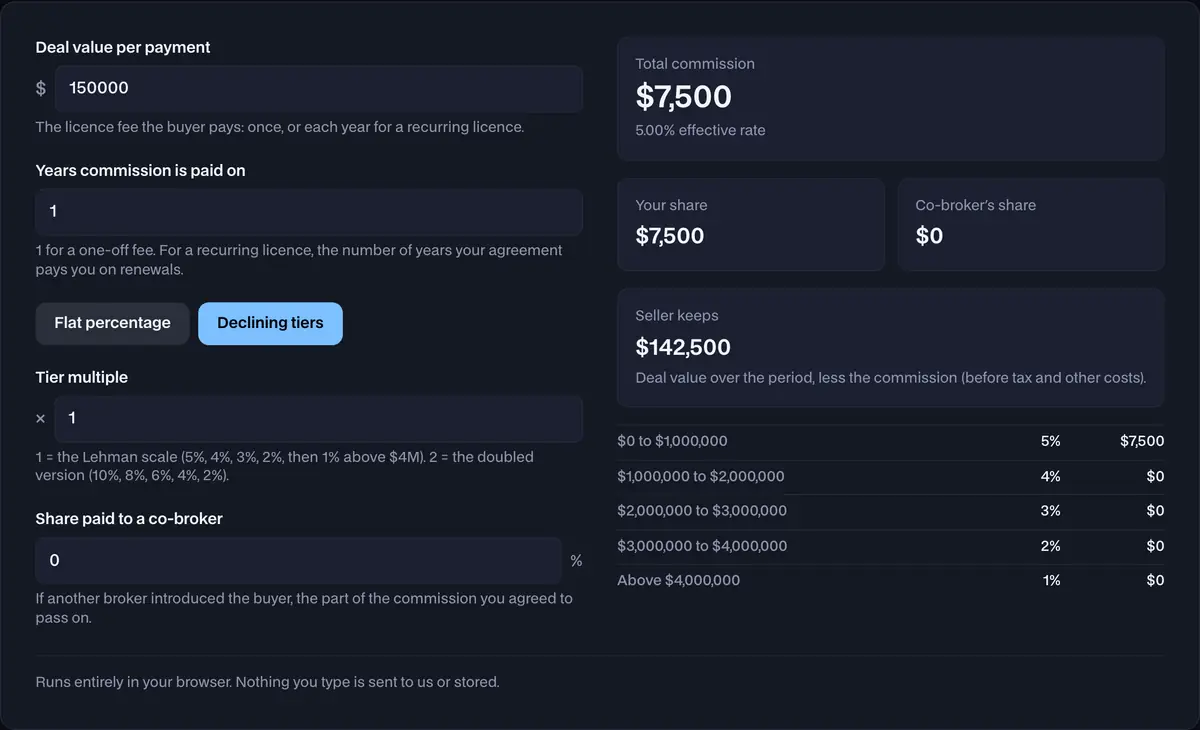 Data broker commission calculator
Work out a data broker commission on any deal: flat or tiered rates, recurring licences, and a split with a co-broker.
 How to sell data to companies
 that buy it: who the business buyers are, what they test, and how to pitch and pass diligence.


Free tool
Try the data broker commission calculator
A data broker commission is the fee a broker receives for arranging a data sale or licence, usually a percentage of what the buyer pays, agreed in writing with the seller before any introduction.
- Free
- No sign-up
- Runs in your browser