Selling data
Exclusive data license: what is exclusivity worth, and when should a seller give it?
An exclusive data license is worth what the seller gives up: the other buyers it can no longer license for the term.
Published · 6 min read


The short answer
No published standard sets the price of exclusivity. Price it against the sales it blocks: what other buyers would pay over the exclusive term. Give it only for a named field, region or period, keep earlier licences and your own use outside it, and put it in signed writing: under US copyright law an exclusive licence transfers ownership.
Key takeaways
- No source we could trace publishes a standard exclusivity premium; the circulating 2.5 to 5 times figure has no original we could find.
- On our calculator's own example, field exclusivity added nothing to the asking price, because the cost floor already set it.
- Under US copyright law an exclusive licence is a transfer of ownership: it must be signed in writing, and earlier signed licences survive it.
What is an exclusive data license?
An exclusive data license is a licence under which the seller promises not to license the same data to anyone else within an agreed scope. Data licensing is granting another party permission to use a dataset under stated conditions, such as purpose, duration, territory and whether it may be shared, while the licensor keeps its own rights. The licence agreement is the contract that records those conditions.
Full exclusivity covers every use, everywhere, for the whole term. Narrower grants cover one field of use, one region or a fixed period.
Two kinds of exclusivity in one deal
Our letter of intent generator writes a binding clause in which the seller, for 45 days by default, won't offer or agree a licence of the data to anyone else for the same use. That is a no-shop while the contract is drafted, not an exclusive licence.
What is exclusivity worth?

Exclusivity is worth the sales it stops, not a fixed multiple. Ddiy.co quotes an exclusive licence at about 2.5 to 5 times a non-exclusive one, credited to AIData.Broker; we could not find that original, so we don't use it.
FE International, an M&A adviser, treats exclusivity as a negotiated premium, never a default. Our guide to pricing data agrees: there is no standard multiple.
What our calculator shows
We ran our data pricing calculator on its own example inputs, which are not market rates: 2,500,000 records at $4 per 1,000, monthly updates (×1.5), a one-year term, $20,000 to deliver and a 30% margin. The tiered base is $7,000; the cost floor is $26,000.
| Exclusivity setting | Combined multiplier | List price from multipliers | Asking price |
|---|---|---|---|
| Non-exclusive | ×1.5 | $10,500 | $26,000 |
| Exclusive in one field or region | ×3 | $21,000 | $26,000 |
| Fully exclusive | ×4.5 | $31,500 | $31,500 |
| Two non-exclusive licences | ×1.5 each | $21,000 | $52,000 |

Field exclusivity doubled the list price and changed nothing, because both prices sat under the cost floor. Full exclusivity, a ×3 multiplier, raised the asking price by $5,500, about 21%. If a second buyer would pay $26,000, selling exclusive gives up $20,500.

What does US law change when a licence is exclusive?
Under the US Copyright Act, an exclusive licence counts as a transfer of copyright ownership and a non-exclusive one does not. That matters for copyrightable data: code, recordings, text and original compilations.
| Question | Exclusive licence | Non-exclusive licence | Source |
|---|---|---|---|
| Is it a transfer of ownership? | Yes: the definition lists an exclusive license | No: it is expressly left out | 17 U.S.C. §101 |
| Must it be signed in writing? | Yes: not valid without a signed writing | No: §204(a) covers transfers only | 17 U.S.C. §204(a) |
| Can the licensee sue infringers? | Yes: an exclusive right's owner may sue for that right | No: §501(b) names owners of exclusive rights | 17 U.S.C. §§201(d)(2), 501(b) |
| Does it cancel licences granted earlier? | No: an earlier signed non-exclusive licence prevails | No: licences can coexist | 17 U.S.C. §205(e) |
| Does it cover raw facts in a table? | No: facts can't be copyrighted, so exclusivity rests on the contract | No: the same | Feist v. Rural (1991) |
Under §205(e), a buyer who took a signed non-exclusive licence before the exclusive grant keeps it, so a seller with earlier licensees must list them as carve-outs. Under Feist, a table of plain facts carries no copyright, so exclusivity there binds only the parties.
When should a seller give exclusivity?

Give it when the buyer pays for sales you could actually make, and refuse it when the premium is a guess.
| Situation | Exclusivity? |
|---|---|
| Few realistic buyers for this data in the term | Yes, narrowed by field or time |
| The buyer funds new collection made for it | Yes, for that new data |
| The data goes stale within the term | Partly: a short term costs little |
| Several buyers have already asked | No, unless paid for each one |
| You have signed licences with others | Partly: carve them out by name |
| The company still needs the data itself | No, unless internal use is reserved |
How do you narrow an exclusive grant?
- 1
Name the field
Write the one use that is exclusive (training a speech model, say) and say every other use stays open.
- 2
Set the region and term
Give a territory and an end date. Opentrain's guide adds a check: what exclusivity still limits after the deal ends.
- 3
Carve out what exists
List earlier licensees, which §205(e) protects anyway, and reserve the company's own internal use.
- 4
Tie it to performance
WilmerHale's guide for licensors suggests minimum payments or milestones to keep exclusivity; UpCounsel lists conversion to non-exclusive as a common term.
- 5
Sign it
Put the grant in a written agreement signed by an officer, which §204(a) requires for copyrightable data.
What this post doesn't cover

We have no deal data of our own, so the calculator runs are arithmetic on fictional inputs, not market premiums. The copyright rows are US federal law; contract law, other countries' law and competition rules vary, and WilmerHale notes some jurisdictions treat exclusivity as a restraint on trade.
Sources
11 sources · checked Nov 22, 2026
The DataBroker team checked the facts on this page against 11 public sources, last on .
- 17 U.S.C. §101, definitionsExclusive licence is a transfer; non-exclusive is not · Checked
- 17 U.S.C. §201(d)(2)Owner of an exclusive right gets the owner's remedies · Checked
- 17 U.S.C. §204(a)Transfers need a signed writing · Checked
- 17 U.S.C. §205(e)Earlier signed non-exclusive licence prevails · Checked
- 17 U.S.C. §501(b)Owner of an exclusive right may sue · Checked
- Feist Publications v. Rural Telephone, 499 U.S. 340 (1991)Facts are not copyrightable · Checked
- Ddiy.co, AI data licensing agreement (updated 2026-10-28)The 2.5 to 5 times figure, credited to AIData.Broker · Checked
- FE International, AI data licensingExclusivity as a negotiated premium · Checked
- Opentrain, data licensing agreement terms (updated 2026-11-19)What exclusivity limits after the deal · Checked
- WilmerHale Launch, granting exclusivityMinimums to keep exclusivity; restraint of trade · Checked
- UpCounsel, exclusivity agreement (updated 2026-09-07)Conversion to non-exclusive · Checked

Exclusive data license FAQ
Is an exclusive license the same as selling the data?
No. The seller keeps the data and can license it outside the exclusive scope, though a perpetual, unlimited grant comes close to a sale.
Can I still use my own data during an exclusive license?
Only if the licence reserves internal use. Without that reservation, a broad grant may bar you too.
Does an exclusive data license have to be in writing?
For copyrightable data in the US, yes: §204(a) makes an exclusive licence invalid without a signed writing.
How long should data exclusivity last?
As short as the buyer will accept, and no longer than the data stays fresh. Set an end date and say what the buyer may keep afterwards.
Related
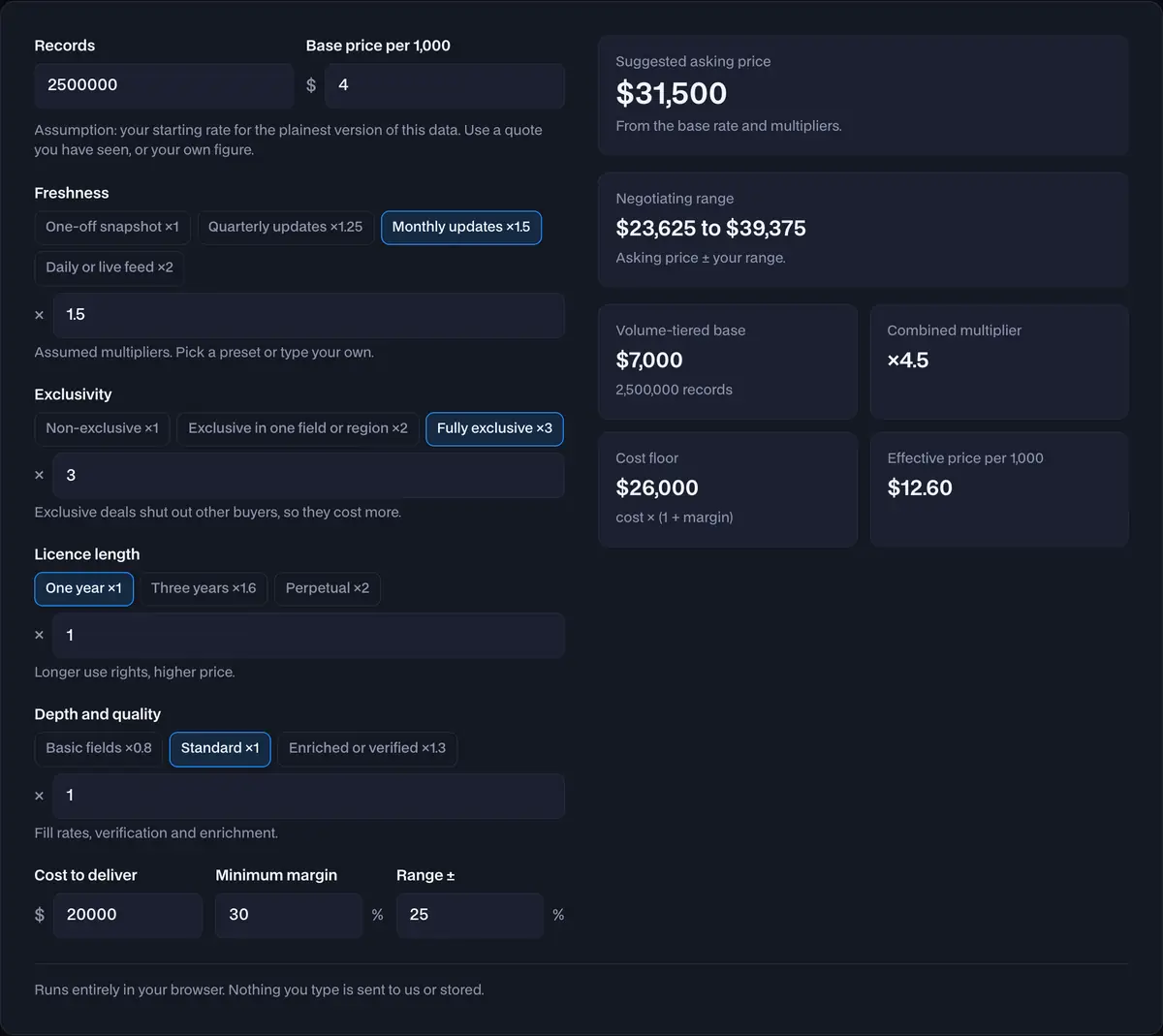 Data pricing calculator
Data pricing made concrete: start from a base rate, apply volume tiers and multipliers you control, and get an asking price and range.
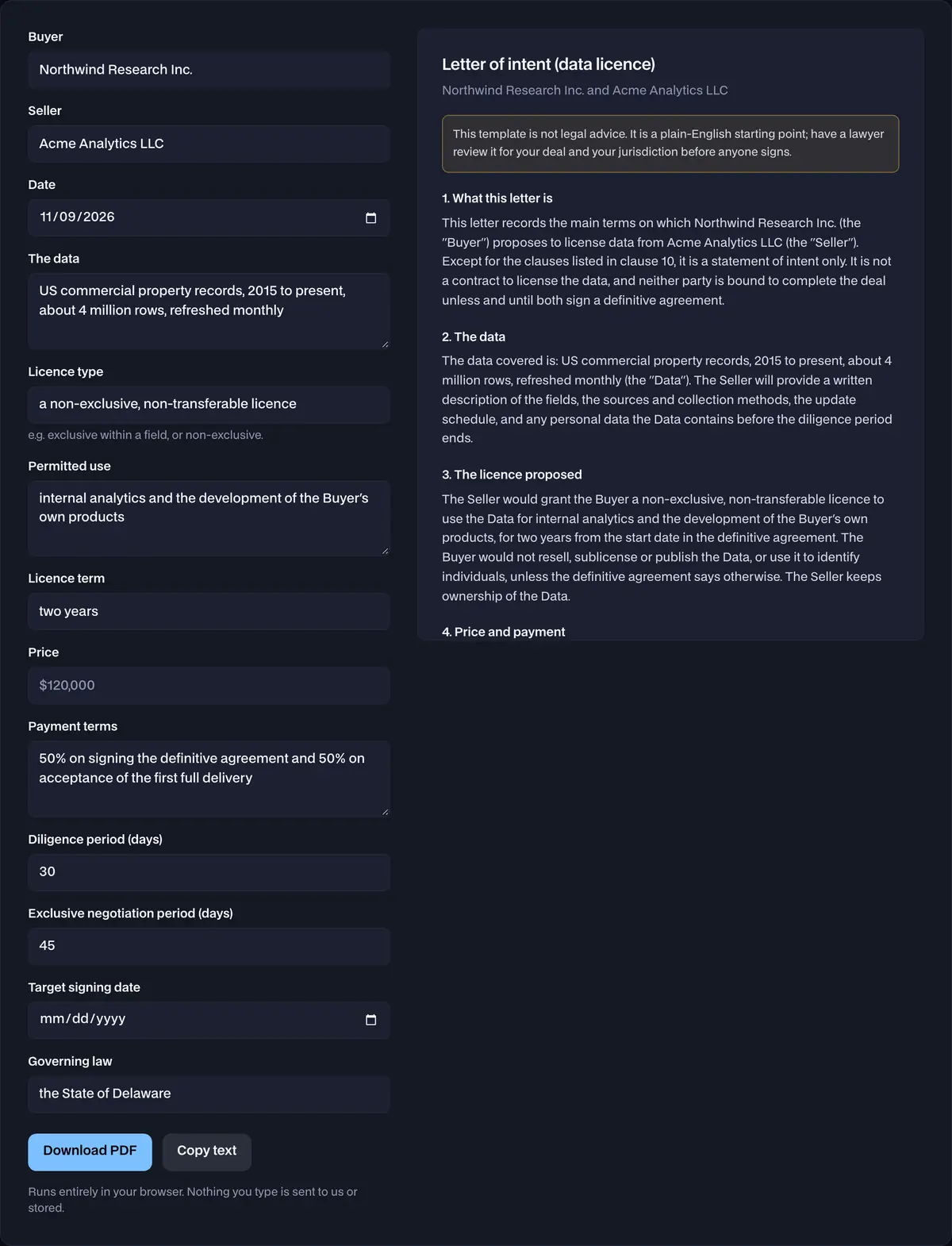 Letter of intent generator
A letter of intent generator for data deals: set price, scope, diligence and exclusivity, then download a clear, mostly non-binding letter as a PDF.
- How to price data
How to price data you plan to sell or license: the five common pricing models, when each fits, and how to set the number.
- Data licensing
Data licensing lets a buyer use a dataset under written conditions while the seller keeps control, which is how most data deals are structured.
- AI data licensing
AI data licensing deals differ in two ways that matter most: how the owner gets paid, and which uses the buyer is allowed.
- What is a data sample
A data sample is the slice of a dataset a buyer sees first; here is what goes in one and how many rows it needs.



More from the blog
- Can you sell a dataset on Kaggle or Hugging Face?
Can you sell a dataset on Kaggle? Not directly, and Hugging Face has no checkout either; here is what both hubs let a seller do instead.
- Data broker vs business broker
Data broker vs business broker is mostly a question of what changes hands: a whole company once, or a right to use data.
- Who can approve a data sale at a company?
Who can approve a data sale depends on the company's form, the deal's size and whose promises cover the data.


Free tool
Try the data pricing calculator
Data pricing is setting what a buyer pays to use a dataset, usually a rate per record or per period, adjusted for volume, freshness, exclusivity, licence length and quality, and never below what delivery costs.
- Free
- No sign-up
- Runs in your browser