The broker business
Gross versus net commission: which should a broker ask for?
Gross vs net commission decides what your rate is a percentage of, so settle it before you argue about the rate.
Published · 6 min read

The short answer
Ask for gross: a percentage of the price the buyer pays, before marketplace fees, refunds or the seller's costs. All four finder agreements we read on SEC EDGAR used gross proceeds. The three published referral programmes we read used net revenue with long exclusion lists. If you accept net, list every deduction, because a 30% marketplace cut takes 30% of your fee.
Key takeaways
- All four finder agreements we read on SEC EDGAR paid a percentage of gross proceeds.
- The three published referral agreements we read paid on net revenue and listed what comes out first.
- On a data marketplace, the platform's cut comes off a net base before your rate applies: 3% on AWS Data Exchange public offers, 15% to 30% on Datarade.
What does gross vs net commission mean?
Gross commission is a percentage of the full price the buyer pays. Net commission is the same percentage of what is left after agreed deductions, such as taxes, refunds, a marketplace's fee or the seller's delivery costs.
The rate can be identical and the payment still differ. Hauseit's example for a New York new-build sale: 3% of a $1,500,000 gross price is $45,000, while 3% of the $1,425,000 net price after $75,000 of developer concessions is $42,750.
The other meaning: your split
Real-estate pages use the same words for the agent's income before and after the brokerage's split. Inman's example agent keeps $69,400 of $100,000 on a 70-30 split. If you share a fee with a co-broker, that question comes after the base is settled.
What do real agreements use: gross or net?

Finder agreements filed with the SEC use gross; software referral programmes use net. We read four finder agreements on SEC EDGAR, three referral agreements the companies publish, and two of our own templates.
| Agreement | Rate | Base | Taken out before the rate |
|---|---|---|---|
| BioDrain Medical finder (2008) | 10% | Gross proceeds from introduced investors | Nothing; paid once funds clear |
| EnSync and Network 1 finder (2018) | 7% | Gross proceeds of each financing, from any investor | Nothing; a $25,000 retainer is extra |
| Star Resorts finder (2007) | 3.5% | Gross proceeds from introduced financiers | Nothing; gross is not defined |
| Avanir and Leerink Swann finder (2005) | 4% | Gross offering proceeds from one named investor | Nothing |
| Optery for Business referral | 15% | Net revenue in the 12 months after signing | Taxes, refunds, discounts, third-party products, services, renewals |
| Moxo referral partner | 30%, capped at $30,000 | Net revenue collected in the first year | Taxes, credits, discounts, one-time and set-up fees, unpaid fees |
| Tipalti referral | Set in a schedule | Net customer revenue | Taxes, bank charges, commissions, third-party fees, one-time fees |
| Our commission agreement template | Blank | Net revenue | Taxes, refunds, credits, pass-through costs |
| Our broker agreement template | Blank | Consideration received | Not stated |
The finder agreements pay on money raised, not data sold, so read them as drafting patterns. The referral agreements were written by the company paying the fee, hence the long net lists; Tipalti's even calculates net revenue at its sole discretion.
How much does a net base cost on a data deal?
The deductions times your rate. On a data marketplace the biggest is usually the platform's cut, taken before the seller is paid.
AWS lists a 3% fee on AWS Data Exchange public offers and 1.5% on renewals, charged on pre-tax total contract value, per its seller guide read 2026-11-19. Datarade's provider page lists commissions of 30% on its commission-only plan, 20% with a $6,000 annual fee and 15% with a $12,000 annual fee.
| Base | Base amount | Commission at 10% |
|---|---|---|
| Gross: the price the buyer pays | $200,000 | $20,000 |
| Net of AWS renewal fee (1.5%) | $197,000 | $19,700 |
| Net of AWS public-offer fee (3%) | $194,000 | $19,400 |
| Net of Datarade Silver (15%) | $170,000 | $17,000 |
| Net of Datarade Bronze (20%) | $160,000 | $16,000 |
| Net of Datarade commission-only (30%) | $140,000 | $14,000 |

Renewals repeat the gap
A recurring licence repeats the deduction every year your agreement pays on renewals, so settle renewals with the same care as a tail clause. We ran our commission calculator on three fictional yearly payments of $200,000 with 15% off each: $170,000 a payment at 10% gives $51,000, against $60,000 on gross.

When is a net base fair to the seller?

When the deduction is money the seller never gets and the broker didn't cause. Taxes, refunds of the buyer's money, and a marketplace fee the seller chose before you arrived all fit.
Gross is fairer when you found the buyer, or when the costs are the seller's to control. De-identification, storage and legal bills are what a seller spends to sell, and none of the four filed finder agreements deducts costs like these. Virginia REALTORS notes most brokerage agreements use gross, so a fee offered on net can fall short.
How do you write the base into a data deal?
- 1
Name the base in one phrase
Write "the total price payable by the buyer, before any deduction" for gross, not "proceeds" or "revenue" alone.
- 2
If it is net, list the deductions
Name each one, as the referral agreements above do, and add that nothing else comes off. A closed list stops a fee shrinking later.
- 3
Cap the platform deduction
Name the platform and its published rate at signing, so a move to a dearer plan isn't charged to you.
- 4
Say what happens to refunds
Agree whether a refund of the buyer's money claws back your fee, and only in proportion to the refund.
- 5
Settle renewals the same way
State whether renewals pay commission, for how many years, and on the same base.
- 6
Ask for a statement
Our commission template asks for a monthly statement of revenue and commission due, and a yearly right to inspect records. A net base needs both.
What this post doesn't cover

We read nine agreements and two fee pages on one day and have no data deals of our own to report, so the table shows wording, not a market rate. Whether a base clause binds depends on its wording and the governing state's law; fees on securities raise broker-dealer questions left out here.
Sources
12 sources · checked Nov 19, 2026
The DataBroker team checked the facts on this page against 12 public sources, last on .
- BioDrain Medical, EX-10.13 (2008)10% of gross · Checked
- EnSync, EX-10.2 (2018)7% of gross · Checked
- Star Resorts Development, finder's fee agreement (2007)3.5% of gross · Checked
- Avanir Pharmaceuticals, exhibit to 8-K (2005)4% of gross · Checked
- Optery for Business Referral Agreement15% of net · Checked
- Moxo referral partner terms30% of net, capped · Checked
- Tipalti Referral AgreementNet revenue, sole discretion · Checked
- AWS Marketplace Seller Guide, listing fees3% and 1.5% fees · Checked
- Datarade provider application page15% to 30% by plan · Checked
- Hauseit, gross vs net purchase price (2020)$45,000 against $42,750 · Checked
- Virginia REALTORS, broker compensation on gross price (2025)Most agreements use gross · Checked
- Inman, effective commission split (2018)$69,400 of $100,000 · Checked

Gross versus net commission FAQ
Is commission usually calculated on gross or net?
In the finder agreements we read on SEC EDGAR, gross. Software referral programmes we read pay on net revenue, defined by the company paying.
What does net revenue usually exclude?
Taxes, refunds, credits and discounts in every published definition we read, and often third-party and one-time fees too.
Should a broker's fee come out of a marketplace's commission?
Only if the agreement says so. If the seller already used the marketplace, a net base is a fair ask; if you found the buyer, ask for gross.
Does a refund reduce the broker's commission?
Only if a clawback or a net base says it does. Agree in writing that a refund reduces the fee in proportion, not in full.
Related
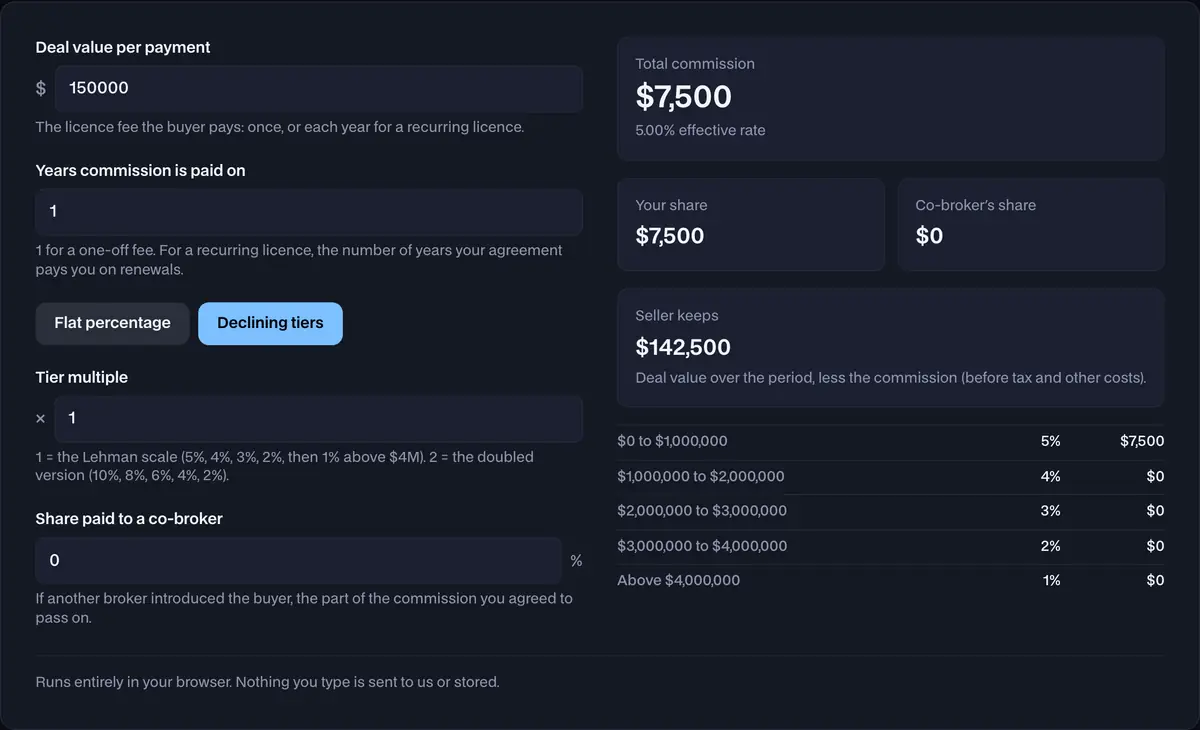 Data broker commission calculator
Work out a data broker commission on any deal: flat or tiered rates, recurring licences, and a split with a co-broker.
- Data broker salary
Data broker salary questions have no clean answer: no agency counts the job, so here are the nearest official figures and the pay models.
- What is a tail clause in a broker or finder's fee agreement?
A tail clause keeps your fee owed after the agreement ends; here is what eight filed agreements set and how to write one.
- Finder's fee
A finders fee rewards someone for an introduction that leads to a deal; in some fields only licensed people can lawfully receive one.
- Datarade and its alternatives for selling data
Datarade lists commercial data products for buyers to find; here is how it charges providers and what else you can use instead.
- AWS Data Exchange and the alternatives for selling data
AWS Data Exchange sells data products to AWS customers; here are its fees, rules and delivery options, and when to use something else.




More from the blog
- Who can approve a data sale at a company?
Who can approve a data sale depends on the company's form, the deal's size and whose promises cover the data.
- How do you find companies that recently shut down?
To find companies that recently shut down, read the public records a closure leaves, starting with the ones filed before the last day.
- What is a datasheet for a dataset
A datasheet for a dataset answers 57 standard questions about your data; here is what buyers read in one and how to write it.


Free tool
Try the data broker commission calculator
A data broker commission is the fee a broker receives for arranging a data sale or licence, usually a percentage of what the buyer pays, agreed in writing with the seller before any introduction.
- Free
- No sign-up
- Runs in your browser