Comparison
Data broker vs data marketplace
Data broker vs data marketplace: one is a person who arranges a sale, the other is a venue where sellers list and buyers browse.
Published

The short answer
A data marketplace is a platform where sellers list data products and buyers find them, usually for a listing fee or commission. A data broker is an intermediary who finds the buyer and negotiates the deal, paid by commission. Marketplaces suit packaged, repeatable data; brokers suit one-off, unpackaged or sensitive data that needs a buyer found.
A venue and an agent
The marketplace
TechTarget defines a data marketplace as an online store where people can buy data: providers list products with pricing and metadata, and consumers browse and acquire them, often self-service. The platform sits in the middle and handles discovery, and often delivery and billing. Nobody at the marketplace goes out to find a buyer for your particular dataset.
The broker
A broker is the opposite shape. Instead of waiting for buyers to arrive, a broker goes looking for them, works out what the data is worth to each, negotiates terms and gets the paperwork signed, usually for a commission from the seller.
Brokers often use marketplaces as one channel among several, so the two aren't rivals so much as different ways to reach a sale.
Data broker vs data marketplace side by side

| Data marketplace | Data broker | |
|---|---|---|
| What it is | A platform where sellers list and buyers browse | A person or firm who finds a buyer and arranges the deal |
| Fees | Published examples: AWS Data Exchange 3% on public offers; Datarade 15% to 30% commission plus an annual fee on paid plans; Snowflake and Databricks fees not published in their docs | A commission negotiated with the owner, often only on a closed deal; no published industry rate |
| Control over terms | Seller sets price and licence within the platform's policies and contract templates | Seller and buyer negotiate every term; the broker advises but the owner signs |
| Speed to a listing | Days to weeks once approved; approval steps such as Snowflake provider profiles or the Databricks Data Partner Program | No listing; time goes into finding owners and buyers |
| Speed to a sale | Depends on whether buyers search for that data; nothing guarantees one | Depends on the broker's network and the deal; negotiations and diligence take time |
| Who finds the buyer | The buyer finds you | The broker finds the buyer |
| Rights and consent | Seller attests; platforms set rules (Databricks bans personal data in listings) | Checked deal by deal, ideally before any buyer sees the data |
| Best for | Packaged, refreshed data that many buyers want | One-off, unpackaged or sensitive data with a short list of buyers |
| Weak spot | Fees, platform lock-in, and listings that never get found | Commission, slower and manual, quality varies by broker |
Fees: published percentages vs negotiated commission
- AWS Data Exchange on public offers
- 3%
- Datarade's commission-only plan
- 30%
- Datarade Silver, with a $12,000 annual fee
- 15%
- A broker's commission, set deal by deal
- Negotiated
Marketplace fees are at least visible. AWS charges 3% of total contract value on public offers and 1.5% to 3% on private offers. Datarade publishes three plans: commission-only at 30%, Bronze at 20% with a $6,000 annual fee, and Silver at 15% with a $12,000 annual fee.
Snowflake says its Stripe payout account costs providers nothing extra, but neither Snowflake nor Databricks publishes a commission on the pages we checked.
Broker fees
Broker fees aren't public because each deal sets its own. The owner and broker agree a percentage, a fixed fee or a mix in a broker agreement, often payable only when a deal closes.
Model a few rates with our commission calculator before you agree one, and remember the fee is the price of the work the marketplace doesn't do: finding the buyer.
Control and speed

On a marketplace
On a marketplace, you control the listing but not the audience. You set the price and pick from the licence options the platform allows, and buyers who search for that category see it.
If nobody searches, nothing happens. Platform policies also shape what you can sell; Databricks, for example, bars personal data from listings and expects answers to access requests within three business days.
With a broker
With a broker, you give up some control over who approaches buyers on your behalf in return for active outreach. Owners should insist on a written agreement naming which buyers the broker may contact, what may be shown under NDA, and when the commission is due.
Neither route is fast by default: marketplace approval can take weeks, and a negotiated licence with an AI lab can take longer.
Who each suits
- A data company with a maintained product and a sales team: list on the marketplaces your buyers use. A broker adds little.
- A company that has never sold data and holds something unusual, such as a codebase, support logs or a media archive: a broker or direct approach usually works better, because buyers aren't searching catalogues for it.
- A seller with personal data: check the law first. Many marketplaces restrict it, and a broker can't make an unlawful sale lawful.
- Someone wanting to work in the market rather than own the data: that is the broker role. Our guide on how to become a data broker covers it.
Where DataBroker sits
DataBroker sits on the broker side. It is a paid academy plus an app with a lead finder that ranks companies likely to hold sellable data, value ranges for codebases, tasks and raw data, contract templates and a CRM.

More about data broker vs data marketplace
Limits of this comparison
Sources
7 sources · checked Nov 9, 2026
The DataBroker team checked the facts on this page against 7 public sources, last on .
- TechTarget: What is a data marketplace?Marketplace definition, how providers list and consumers buy · Checked
- California Privacy Protection Agency: data broker registryLegal sense of data broker; January registration · Checked
- AWS Marketplace Seller Guide: listing feesAWS Data Exchange public and private offer fees · Checked
- Datarade provider application pageDatarade plans, annual fees and commission · Checked
- Snowflake docs: Use listings as a providerProvider profile approval, Stripe payouts at no extra cost · Checked
- Databricks docs: Get started as a providerData Partner Program approval · Checked
- Databricks docs: Provider policiesPersonal data rule, response times · Checked

Data broker vs data marketplace FAQ
Is a data marketplace better than a data broker?
Neither is better in general. A marketplace is cheaper and simpler for packaged data that buyers already search for. A broker earns its commission when the data is unusual and the buyer has to be found.
Do data brokers sell on data marketplaces?
Often, yes. Large data companies list products on marketplaces as one sales channel. A deal-making broker may also list a client's data there, alongside approaching buyers directly.
How much do data marketplaces charge sellers?
It varies. AWS Data Exchange publishes 3% on public offers. Datarade publishes 15% to 30% commission depending on plan, with an annual fee on paid plans. Snowflake and Databricks don't publish a commission on the pages we checked.
How are data brokers paid?
Usually by a commission or fee agreed with the data owner in a broker agreement, often due only when a deal closes. There is no standard published rate.
Is a data marketplace a data broker under the law?
Not automatically. State registry laws such as California's turn on collecting and selling consumers' personal information without a direct relationship. A platform that only hosts listings may fall outside that, but check with a lawyer.
Related
- Data broker vs data aggregator
Data broker vs data aggregator: one sells or licenses information to others, the other gathers and combines it from many sources.
- Data marketplace
A data marketplace lists datasets from many sellers in one catalogue, so buyers can search, sample and subscribe without separate negotiations.
- Data broker
The data broker definition in plain words and in state law, the six kinds of data broker, and the rules each kind answers to.
- Where to sell data
Where to sell data depends on the dataset: compare cloud marketplaces, listing sites, brokers, direct deals and asset sales on fees and fit.
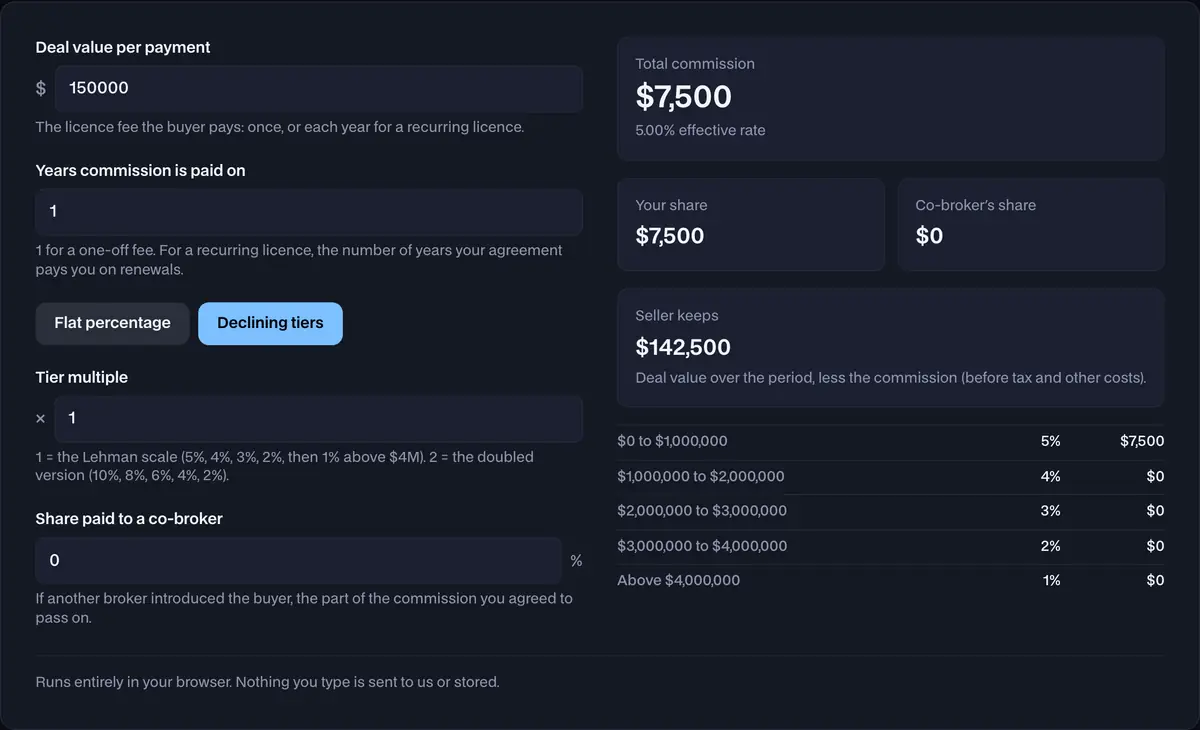 Data broker commission calculator
Work out a data broker commission on any deal: flat or tiered rates, recurring licences, and a split with a co-broker.




Free tool
Try the data broker commission calculator
A data broker commission is the fee a broker receives for arranging a data sale or licence, usually a percentage of what the buyer pays, agreed in writing with the seller before any introduction.
- Free
- No sign-up
- Runs in your browser