Comparison
SimpleClosure alternatives when you are closing a startup
SimpleClosure alternatives split into two jobs: winding the company down legally, and selling the code and data it leaves behind.
Published

The short answer
SimpleClosure handles startup shutdowns and, through AssetHub, sells a closing company's code and workspace data to buyers including AI labs. Alternatives depend on which half you need: a lawyer for the wind-down, Acquire.com to sell the business whole, Labelbox or micro1 to sell code or operational data directly, or a broker who runs the sale for you.
What SimpleClosure and AssetHub do
SimpleClosure, founded in 2023 according to its about page, runs startup shutdowns end to end: filings, state withdrawals, payroll tax accounts and the rest of the paperwork that follows a decision to close. AssetHub is its asset-sale arm.
Founders submit a short form or connect a GitHub repository, get a viability assessment, and SimpleClosure matches what they have to what it calls a vetted network of strategic buyers, including AI foundation labs and builders of reinforcement learning environments.
What it sells
Two asset types lead the page: source code (repositories, documentation, tests) and workspace data, meaning the team's record of how it worked across Slack, Google Drive, email, Notion and Figma.
Fees and who qualifies
Its FAQ says there is no upfront cost and SimpleClosure takes a percentage only when assets sell or are licensed, but the percentage isn't stated. It also says you don't have to be shutting down: operating companies can license data while still using it.
Why founders look for SimpleClosure alternatives

- They only need half the service. A company that already has a lawyer handling dissolution may just want a buyer for the code.
- They want to know the fee before starting. AssetHub's percentage is not on its public page.
- They want to compare buyers. A single operator's network is one channel; selling the same codebase through several can change the price or the terms.
- The company isn't closing at all, and the founder would rather sell the whole business as a going concern than strip out its assets.
SimpleClosure alternatives side by side
- Acquire.com closing fee, by asking price
- 8%, 7% or 6%
- Full-time staff micro1 asks for
- 30+
- Opendatabay commission per sale
- 30% to 5%
| Route | What it takes on | Who qualifies | Seller's cost | Where it is weaker |
|---|---|---|---|---|
| SimpleClosure AssetHub | Code, workspace data, IP, domains; wind-down available from the same company | Closing or operating startups | No upfront cost; a percentage on success, not published | One network of buyers; rate only on request |
| Acquire.com | The whole business, listed to buyers | No revenue minimum on the standard seller plan | Closing fee of 8%, 7% or 6% by asking price, plus a monthly listing fee of $25, $50 or $100 | Built for running businesses, not code or data on its own |
| Labelbox legacy code program | Codebases from fully defunct startups for AI training and evaluation | Defunct companies; more collaborators, pull requests and issue history help | Not published; described as a one-time transaction | Code only; no price or timeline published |
| micro1 Company Data Partnerships | Operational data: code docs, tickets, CRM, SOPs, internal communications | Established companies with 30+ full-time staff and mostly English data | None stated; micro1 pays the company | Excludes small teams; prioritises US companies |
| Opendatabay listing | Any dataset you list yourself | Anyone listing data, paid to a verified business account | Free to list; 30% down to 5% commission per sale | You do the packaging, pricing and PII work |
| A broker | Finding buyers, pricing, contracts, the data room | Whoever owns the assets and signs with the broker | A commission agreed with the broker | Quality varies by broker; no built-in buyer network |
What micro1 says it pays
micro1's partnerships page publishes payment ranges, from $100,000 to $500,000 for qualifying enterprise partnerships up to $3 million or more for highly unique data, paid within 30 days of acceptance. Those are the ranges micro1 states for companies with 30 or more staff; they are not a guide to what a small startup's data would fetch.
Where SimpleClosure is the stronger choice

If you are closing and want one party to handle everything, SimpleClosure is hard to replace with a patchwork. The wind-down and the asset sale happen in the right order, under one team, and its FAQ says sensitive employee, compensation and health information is excluded and data is prepared before it reaches AI training.
Charging nothing upfront also means a founder with no cash left can still start. None of the alternatives in the table offers both halves.
Doing the sale yourself, or through a broker
The alternative to a packaged service is running the sale as a project.
That means listing the assets, confirming the company owns them (employee and contractor IP assignments, open-source licences in the code, customer contracts that limit how their data can be used), stripping personal information, putting a value on each piece and approaching several buyers under NDA so they bid against each other.
Through a broker
A broker can carry that work for a commission. DataBroker trains people to do it: a paid academy plus an app with a lead finder that ranks companies likely to hold sellable data, value ranges for codebases, tasks and raw data, contract templates (mutual NDA, letter of intent, data license agreement, broker agreement) and a CRM.
It has no wind-down service, no buyer network of its own and no marketplace, so a founder who wants a done-for-you closure gets more from SimpleClosure. The broker route fits a founder or adviser who wants control over which buyers see the assets and on what terms.
A shutdown order that keeps the assets sellable

- 1
Freeze before you delete
Export repositories, issue trackers and workspace history before cancelling the accounts. Deleted Slack or GitHub data can't be sold.
- 2
Check ownership
Confirm the company holds the IP and that customer contracts and privacy notices allow the sale or licence.
- 3
Get a value range
Size the codebase and the data so you know a reasonable price before the first offer arrives.
- 4
Approach more than one buyer
Ask at least two routes from the table above for terms, in writing, before signing with any of them.
- 5
Then dissolve
Finish the legal wind-down once the asset sale is signed, so there is still a company to sign it.

More about simpleClosure alternatives when you are closing a startup
Caveats
Sources
6 sources · checked Nov 9, 2026
The DataBroker team checked the facts on this page against 6 public sources, last on .
- SimpleClosure AssetHubAssets, buyer network, process, PII handling, fee model, operating companies, deal-size wording · Checked
- SimpleClosure about pageFounding year and shutdown services · Checked
- Acquire.com seller pricingClosing fees and monthly listing fees by asking price · Checked
- Labelbox blog, 20 January 2026Legacy code program for defunct startups, one-time transaction · Checked
- micro1 data partnershipsData types, 30+ staff eligibility, payment ranges and timing, US priority · Checked
- Opendatabay feesFree listing and commission bands · Checked

SimpleClosure alternatives when you are closing a startup FAQ
Does SimpleClosure AssetHub cost anything?
Its FAQ says there is no upfront cost and that SimpleClosure takes a percentage only if your assets are sold or licensed. The percentage is not published on the page, so ask for it in writing before you start.
Can I use AssetHub if my startup isn't shutting down?
Yes, according to SimpleClosure: operating companies can license data while continuing to use the underlying assets. Companies winding down can license or sell outright.
Who buys code from shut-down startups?
The buyers named on the pages we checked are AI labs, reinforcement learning environment builders and AI data companies. Labelbox runs a program for defunct startup codebases, and micro1 licenses operational data from larger companies.
Should I sell the code before or after dissolving the company?
Before, or at least before deleting accounts and repositories. The company has to exist to sign a sale or licence, and exported data is the only data you can sell.
Is Acquire.com a SimpleClosure alternative?
Only for the sale, and mainly when the business still runs. Acquire.com lists whole companies for a closing fee of 6% to 8% plus a monthly listing fee; it does not handle dissolution or sell code and data separately.
Related
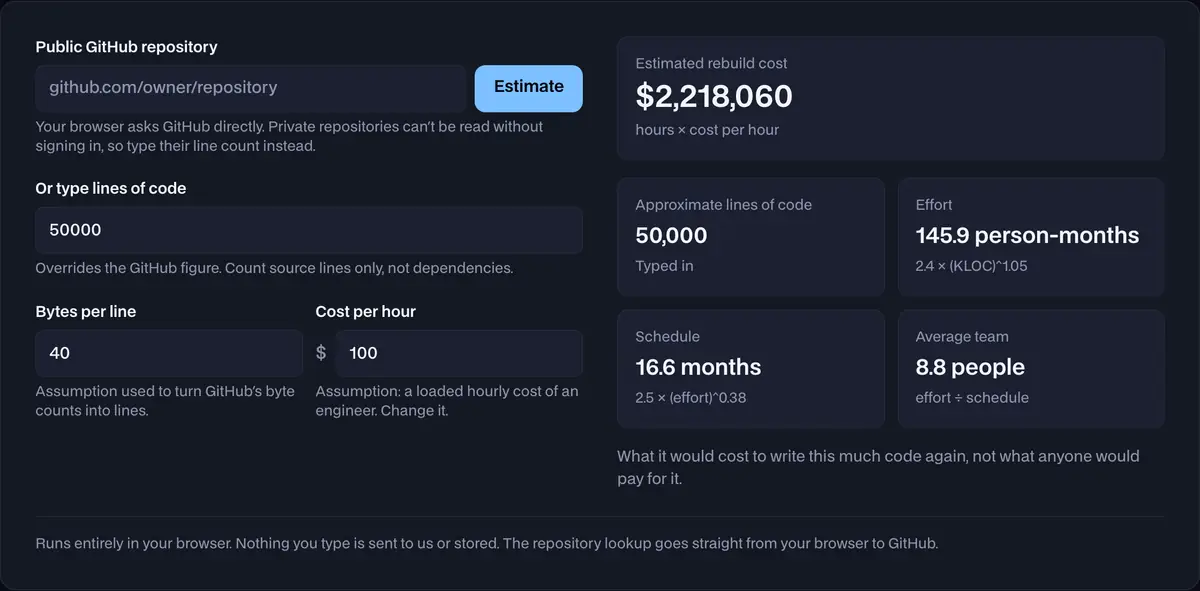 Codebase value calculator
A codebase value calculator that reads a public GitHub repository in your browser and estimates rebuild effort and cost with basic COCOMO.
- AI data marketplace options for dataset sellers
An AI data marketplace puts your dataset in front of model builders; here is what six of them charge sellers and want to buy.
- How to sell software you have built
How to sell software you have built, whether that means the whole product, the IP, or licensing the codebase as training data.
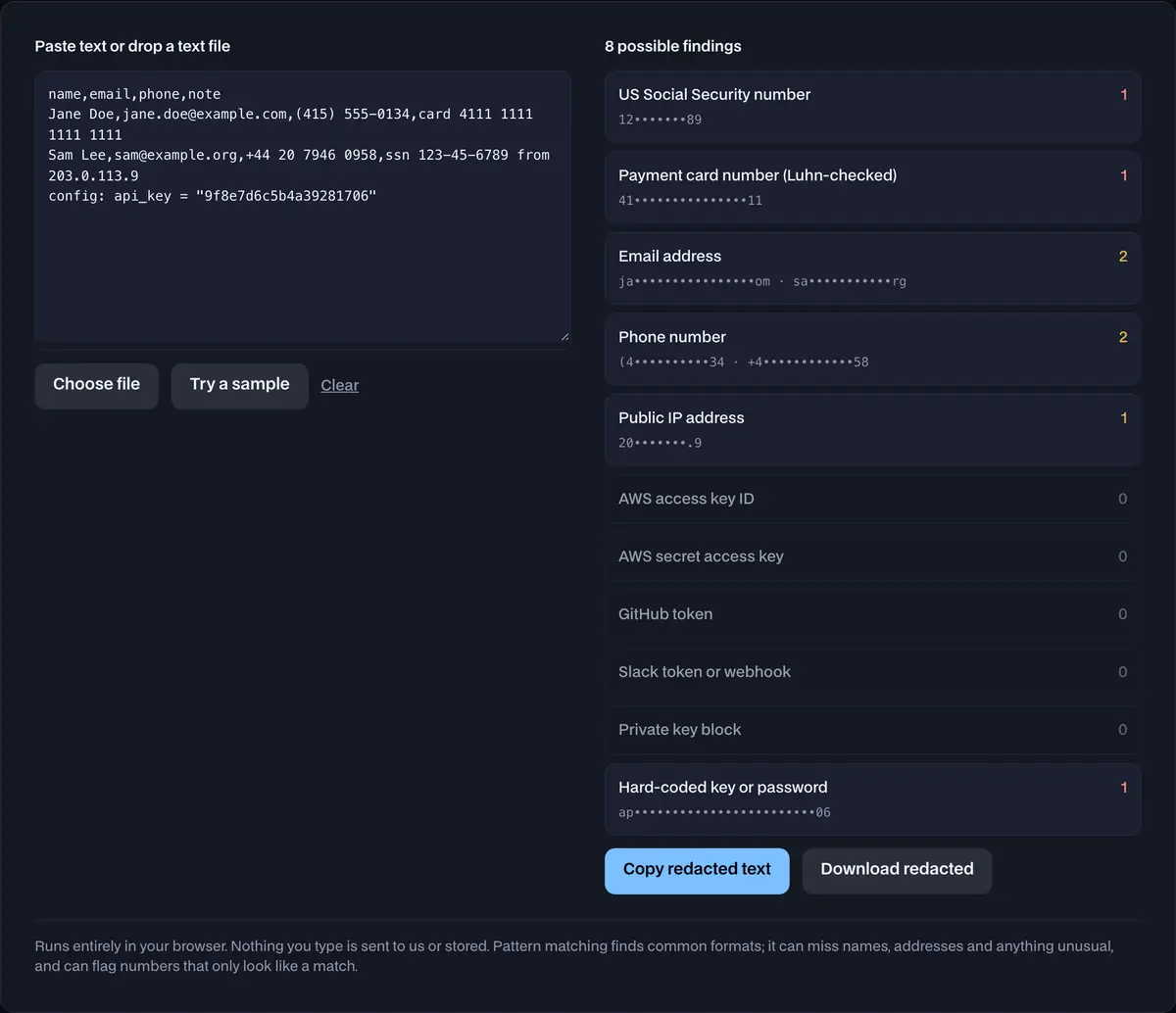 PII scanner
A PII scanner that runs in your browser: paste text or drop a file to see personal data and leaked secrets before you share it.
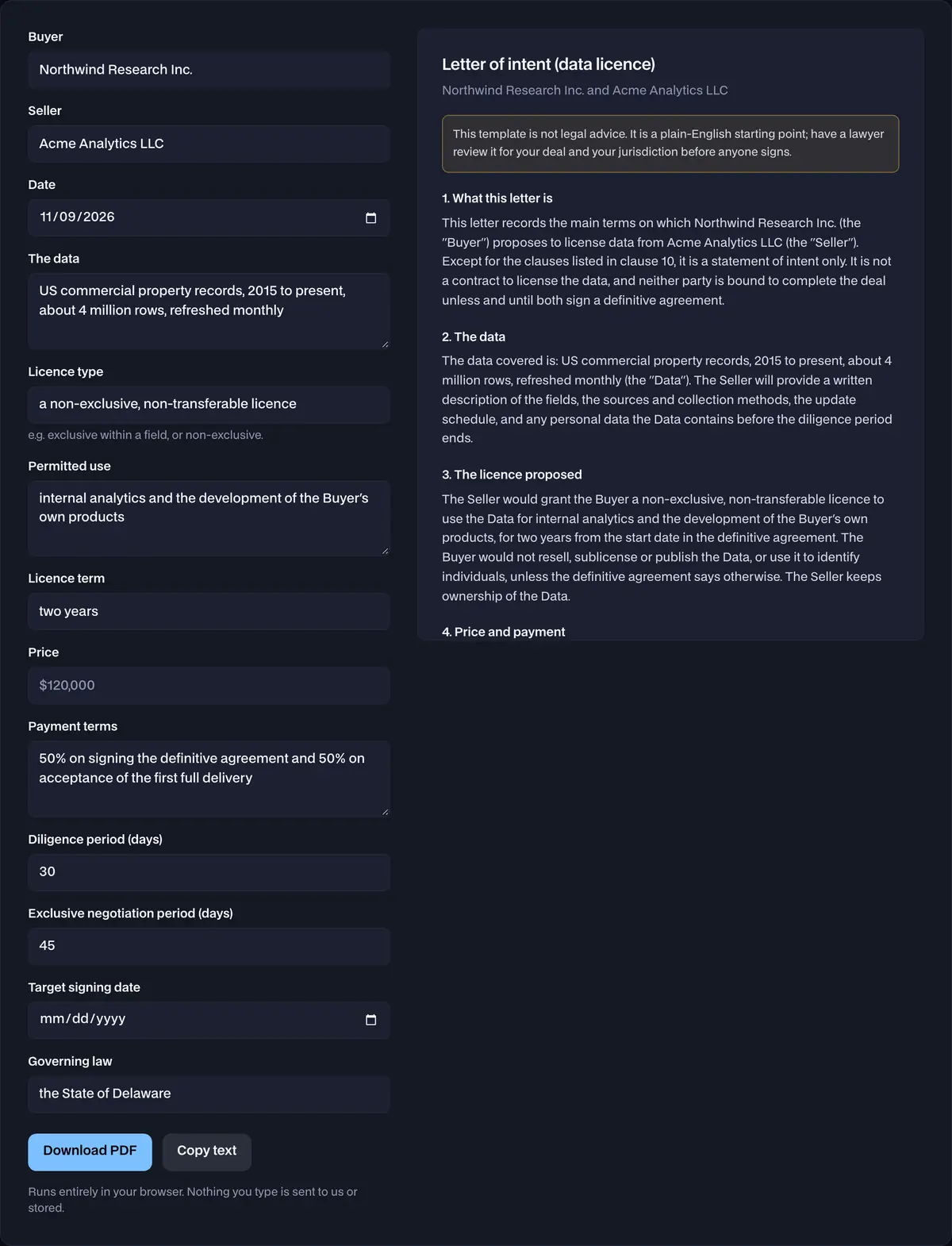 Letter of intent generator
A letter of intent generator for data deals: set price, scope, diligence and exclusivity, then download a clear, mostly non-binding letter as a PDF.





Free tool
Try the codebase value calculator
A codebase value calculator estimates what it would cost to write a piece of software again, from its size in lines of code, an effort model such as COCOMO, and an hourly engineering cost.
- Free
- No sign-up
- Runs in your browser