Data type
Audio datasets: licences, formats and who sells them
Audio datasets for AI run from free public speech corpora to commercial sets priced per hour; the licence and the speakers' consent decide what you can do.
Published

What is an audio dataset?
An audio dataset is a collection of recordings, such as speech, music or environmental sound, packaged with transcripts or labels and metadata so a model can learn to recognise, generate or classify audio.
What audio datasets are used for
Most audio bought for AI is speech: recordings with transcripts for speech recognition, clean single-speaker recordings for text-to-speech, and labelled speakers for voice identification. The rest is sound events (a door, a siren, a cough) and music. Public options are plentiful.
Free datasets and their licences
- Speech recognition datasets on the Hub, Dec 2022
- 77
- Audio classification datasets, same date
- 28
When Hugging Face wrote its audio datasets guide in December 2022 the Hub already held 77 speech recognition and 28 audio classification datasets. The catch is the licence: much of the free material is limited to research, so companies shipping a product often license commercial data or record their own.
This page is about recordings in general. For call-centre dialogues, chat logs and other two-way exchanges, see conversational data.
Audio datasets by licence

| Dataset or seller | What it offers | Licence stated | Published price |
|---|---|---|---|
| Mozilla Common Voice | Crowd-read speech in many languages, released as MP3 clips with TSV metadata | CC0 public domain dedication; users agree not to try to identify speakers | Free |
| LDC Switchboard-1 Release 2 | About 260 hours of telephone conversation, 2,400 calls among 543 speakers | LDC user agreement; members and non-members can license | Fee shown after login |
| Defined.ai Data Access Plan | Discounted access to off-the-shelf speech datasets in several tiers | Defined.ai data licence | From €50,000 for 315 hours (Standard plan, launched September 2024) |
| Nexdata on Datarade | Multilingual conversational telephone speech, 8 kHz, in 100+ languages | One-off purchase; no other licence terms listed | From $100,000 per purchase |
| Andovar | Custom speech collection in 200+ languages, plus some ready datasets | Full commercial licence with perpetual training rights; says every speaker consents to AI training use | Quoted per recorded hour; projects typically start at 50 hours |
Two things stand out. Published prices run from free to over $100,000, so a quoted price only means something next to the hours, languages and licence it buys. And a 'commercial' label tells you little until you read what the licence permits: training only, model deployment, redistribution or exclusivity. Our dataset pricing calculator helps compare offers on a per-hour basis.
The delivery spec to agree
- File format: lossless WAV or FLAC for training; MP3 is smaller but loses detail.
- Sample rate and channels: 16 kHz and above for wideband speech; telephone audio is often 8 kHz (Nexdata lists 8 kHz u-law and a-law mono). Calls are most useful with each speaker on a separate channel.
- Transcripts: time-aligned, with speaker labels and a written convention for fillers, overlaps and noise.
- Metadata: language and accent, recording device and environment, and speaker demographics where consented.
- Splits: speakers kept apart across train, validation and test sets, so a model isn't graded on voices it has already heard.
Voices are biometric data

- Class actions filed in Chicago, May 2026
- 9
- Illinois's Biometric Information Privacy Act
- BIPA
A voice can identify the person speaking, which brings biometric privacy law into play. In May 2026 nine class actions were filed in Chicago federal court under Illinois's Biometric Information Privacy Act against companies including Amazon, Adobe, Google, Apple, Microsoft, Meta, Nvidia, Samsung and ElevenLabs, alleging that journalists', narrators' and podcasters' voices were used to train AI voice models without consent.
Why buyers ask for consent records
The cases are at an early stage, but they show why buyers now ask for speaker consent records, not just a licence from whoever holds the files.
If you hold recordings
Podcast networks, call centres, transcription firms, language schools and broadcasters can all hold audio with training value. Before offering it, check that you own the recordings or have the right to license them, that speakers agreed to this kind of use, and that you can deliver the spec above.
Then license it under a written licensing agreement that sets the permitted use and bans attempts to identify speakers.
What DataBroker is, and isn't

DataBroker doesn't sell audio datasets and holds no recordings. We run a paid academy and a set of tools for people who broker data deals: finding organisations with useful audio, checking the rights and consent, valuing it and taking it to buyers. The sellers above are listed for comparison only.
Sources
8 sources · checked Nov 9, 2026
The DataBroker team checked the facts on this page against 8 public sources, last on .
- A Complete Guide to Audio Datasets, Hugging Face, 15 December 2022Checked
- Common Voice datasets, MozillaChecked
- Sharing our Common Voices, Mozilla, 28 February 2019Checked
- Switchboard-1 Release 2 (LDC97S62), Linguistic Data ConsortiumChecked
- Defined.ai Launches Data Access Plan (DAP), Defined.ai, 26 September 2024Checked
- Nexdata Multilingual Conversational Speech Data (8kHz telephony), DataradeChecked
- Speech data, AndovarChecked
- Tech giants sued over 'stealing' voices of well-known journalists, voice actors to train AI, Chicago Sun-Times, 19 May 2026Checked

Audio datasets FAQ
Where can I get free audio datasets?
Hugging Face hosts many speech and sound datasets, and Mozilla's Common Voice is released under CC0. Check each licence: many free audio datasets are limited to research use.
How much does licensed speech data cost?
Published prices vary widely. Defined.ai's Data Access Plan started at €50,000 for 315 hours, one Nexdata telephony set on Datarade is listed from $100,000, and custom collection is quoted per recorded hour.
What audio format should a training dataset use?
Usually lossless WAV or FLAC at 16 kHz or higher for speech, with time-aligned transcripts and speaker labels. Telephone audio is often 8 kHz; agree the spec in writing before delivery.
Do I need speaker consent to license voice recordings?
In many places, yes, and buyers increasingly ask for it. Voices can count as biometric data, and Illinois's BIPA has been used in 2026 lawsuits over AI voice training.
Related
- Conversational data for AI training
Conversational data means real dialogue, from call recordings to chat and ticket logs; AI buyers want it consented, de-identified and labelled.
- Video datasets for AI training
Video datasets for AI come from stock libraries, creator platforms and paid recording programmes; here is who licenses footage and on what terms.
- AI training data
AI training data licensing explained: which datasets labs want, publicly reported deal values, and the copyright and transparency rules that now apply.
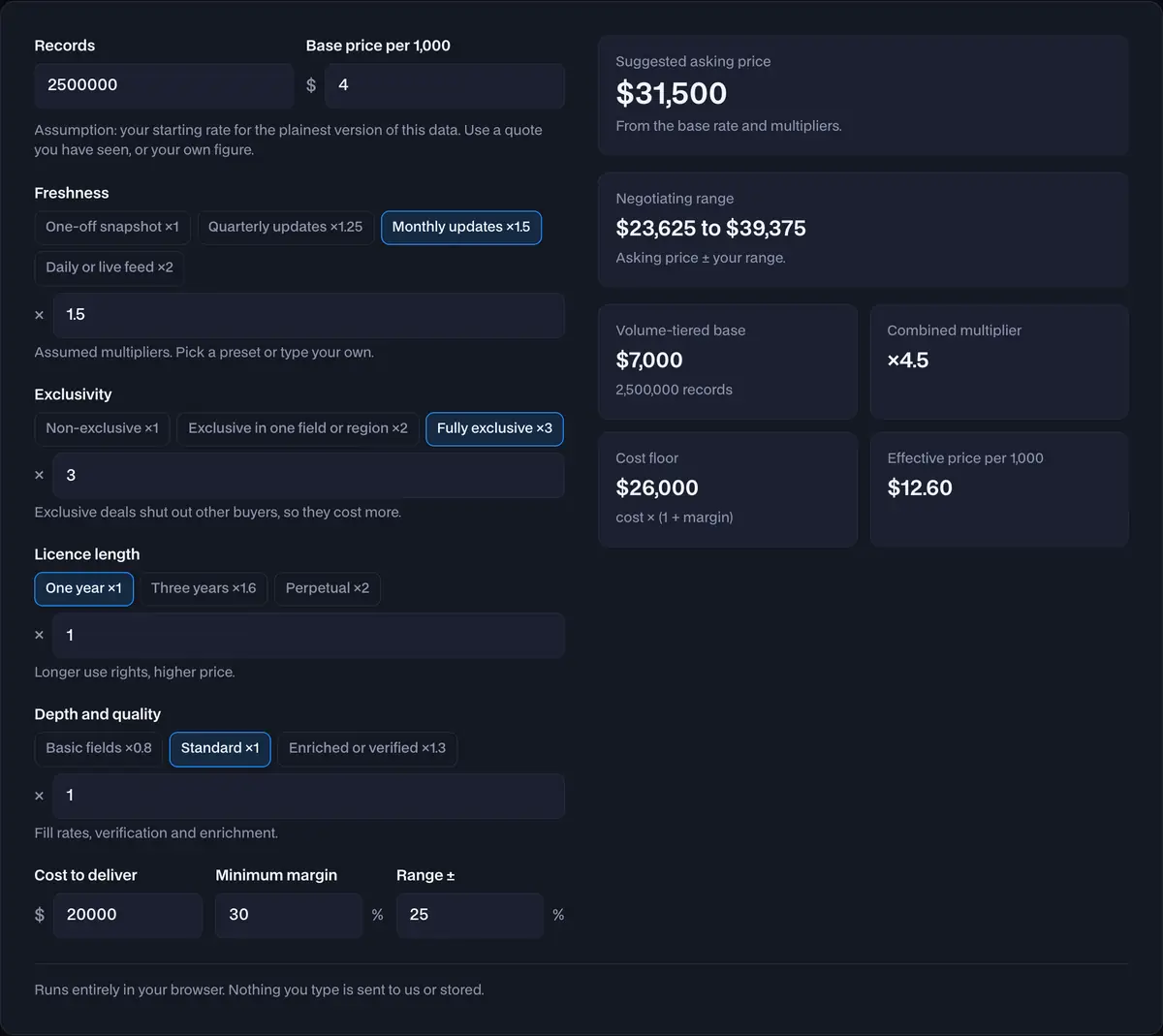 Data pricing calculator
Data pricing made concrete: start from a base rate, apply volume tiers and multipliers you control, and get an asking price and range.



Free tool
Try the data pricing calculator
Data pricing is setting what a buyer pays to use a dataset, usually a rate per record or per period, adjusted for volume, freshness, exclusivity, licence length and quality, and never below what delivery costs.
- Free
- No sign-up
- Runs in your browser