Law
HIPAA de-identification
HIPAA de-identification takes health data outside the Privacy Rule through one of two methods, and the choice shapes what a dataset is worth.
Published

The short answer
Under 45 CFR 164.514, health data is de-identified either by removing 18 listed identifiers with no actual knowledge that the rest could identify someone (Safe Harbor), or by a qualified expert finding the re-identification risk very small and documenting why (Expert Determination). De-identified data is no longer protected health information, so the ban on selling it doesn't apply.
What HIPAA de-identification does
The HIPAA Privacy Rule protects individually identifiable health information held by covered entities (health plans, clearinghouses and most providers) and their business associates. Section 164.514(a) sets the standard: health information that doesn't identify a person, and where there is no reasonable basis to believe it could, is not individually identifiable.
Section 164.502(d)(2) then says the Privacy Rule's requirements don't apply to information de-identified under 164.514. That is the whole reason the topic matters commercially: de-identified records can be licensed without patient authorisation.
The rule allows exactly two ways to meet the standard, set out in 164.514(b). A covered entity may also use protected health information to create de-identified data, or hand it to a business associate to do so, under 164.502(d)(1).
Safe Harbor vs Expert Determination

| Safe Harbor, 164.514(b)(2) | Expert Determination, 164.514(b)(1) | |
|---|---|---|
| Who decides | The covered entity, by following a fixed list | A person with appropriate knowledge of and experience with statistical and scientific methods for de-identification |
| The test | All 18 listed identifiers removed, for the person and their relatives, employers and household members, and no actual knowledge that what's left could identify anyone | The risk is very small that an anticipated recipient could identify someone, alone or with other reasonably available information |
| Paperwork | None required by the rule beyond doing it | The expert documents the methods and results that justify the finding |
| Dates | Only the year may stay; ages over 89 go into one 90-or-older group | Can keep more date detail if the analysis supports it |
| Geography | Nothing smaller than a state, except the first three ZIP digits where that area holds more than 20,000 people (others become 000) | Finer geography possible if the risk stays very small |
| Qualifications | Not applicable | OCR says no specific degree or certification is required; it looks at training and experience |
| Does it expire? | No | The rule sets no expiry, but OCR notes experts often time-limit a determination as data and technology change |
| Typical fit | Simple extracts where dates and locations aren't needed | Claims, EHR and longitudinal data where dates, places or linkage keep the value |
- Ways to meet the de-identification standard under 164.514(b)
- 2
- Identifiers Safe Harbor removes
- 18
- Direct identifiers a limited data set strips, keeping dates and ZIP code
- 16
The 18 identifiers
The 18 Safe Harbor identifiers are names; geographic units smaller than a state; date elements other than year; phone and fax numbers; email addresses; Social Security, medical record, health plan, account and certificate or licence numbers; vehicle and device identifiers; URLs; IP addresses; biometric identifiers; full-face photos; and any other unique identifying number, characteristic or code.
The last item is the one teams miss: an internal patient key copied into the extract can undo the whole method.
Re-identification codes and limited data sets
Section 164.514(c) lets the covered entity keep a code to re-link records later, if the code isn't derived from information about the person and the entity never discloses it or the way to reverse it. A hashed Social Security number fails that test.
A limited data set under 164.514(e) is different again: it strips 16 direct identifiers but keeps dates, town, state and ZIP code. It is still protected health information, may only be used for research, public health or health care operations, and requires a data use agreement. It is not a route to a commercial sale.
Can you sell de-identified health data?

Section 164.502(a)(5)(ii) bars a covered entity or business associate from selling protected health information without the patient's authorisation, and defines a sale as a disclosure where it receives direct or indirect payment from or for the recipient in exchange.
The exceptions include public health, research for a reasonable cost-based fee, treatment and payment, and the sale or merger of all or part of the covered entity. Data properly de-identified under 164.514 isn't protected health information, so this prohibition doesn't reach it.
- HIPAA isn't the only law. Health data collected by apps and wearables usually falls outside HIPAA and under state consumer health laws instead; our healthcare data page covers which law governs which data.
- California adds contract terms. Civil Code 1798.148 bans re-identifying HIPAA-de-identified patient information, with narrow exceptions, and requires contracts selling or licensing it to state that it contains de-identified patient data, ban re-identification and bind onward recipients to the same terms.
- Buyers check the method. Expect to be asked for the Expert Determination report, or the Safe Harbor field list, before a sample moves. You can scan a sample for personal data first to catch stray identifiers in free text.
When to ask a lawyer
- The data comes from a covered entity or business associate and you aren't sure it has been de-identified under 164.514.
- The buyer wants dates, ZIP codes or linkage that Safe Harbor would remove.
- The dataset includes free-text notes, images or genomic data.
- Any party is in California or another state with its own health data law.
Sources
4 sources · checked Nov 9, 2026
The DataBroker team checked the facts on this page against 4 public sources, last on .
- 45 CFR 164.514De-identification standard, both methods, the 18 identifiers, ZIP and age rules, re-identification codes, limited data sets · Checked
- 45 CFR 164.502Sale of protected health information and its exceptions; de-identified data outside the rule · Checked
- HHS OCR: Guidance on de-identification methodsExpert qualifications, no required expiry, time-limited determinations (hhs.gov blocked direct reads on 2026-11-09; checked through hhs.gov search excerpts that day) · Checked
- Cal. Civ. Code 1798.148Re-identification ban and contract terms for selling de-identified patient information · Checked

HIPAA de-identification FAQ
How do you de-identify patient data under HIPAA?
With one of two methods: Safe Harbor, which removes 18 listed identifiers with no actual knowledge that the rest could identify someone, and Expert Determination, where a qualified expert finds and documents a very small re-identification risk.
Which is better, Safe Harbor or Expert Determination?
Safe Harbor is simpler and needs no expert, but it strips dates and fine geography. Expert Determination costs more and takes longer, and it can keep the detail that makes claims or clinical data useful.
Who can be a HIPAA de-identification expert?
Someone with appropriate knowledge of and experience with statistical and scientific de-identification methods. HHS OCR says no particular degree or certification is required.
Is a limited data set de-identified?
No. A limited data set keeps dates and some geography, remains protected health information and can only be shared for research, public health or operations under a data use agreement.
Can a hospital sell de-identified data?
HIPAA's ban on selling protected health information doesn't apply to data de-identified under 164.514. State laws and contracts may still limit it, and California requires specific contract terms.
Related
- Healthcare data providers
Healthcare data providers sell provider directories, claims and de-identified patient data; what each is, who buys it, and what HIPAA permits.
- CCPA sale of personal information
CCPA sale of personal information reaches far beyond cash deals: any transfer for valuable consideration can count, with duties for seller and buyer.
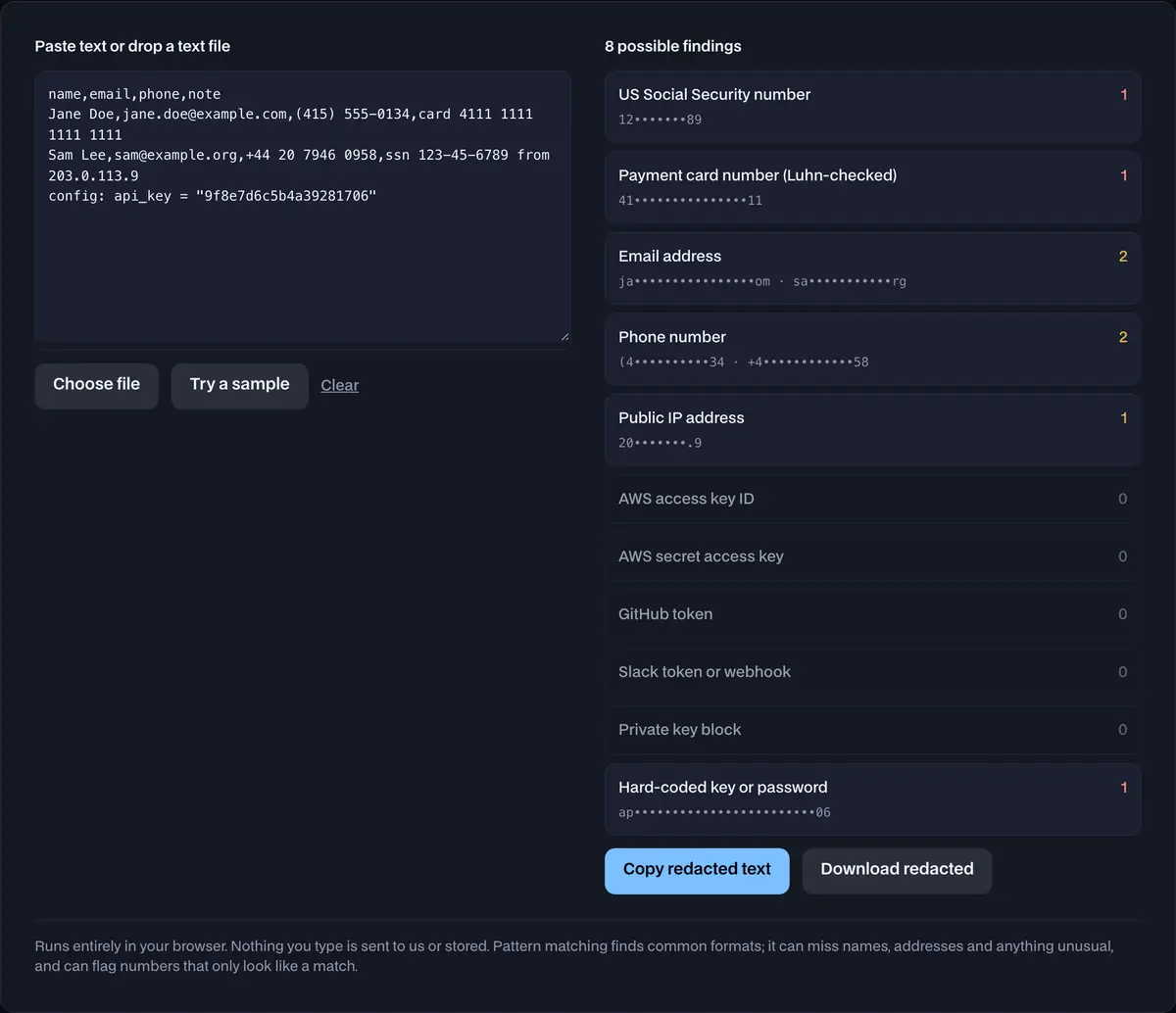 PII scanner
A PII scanner that runs in your browser: paste text or drop a file to see personal data and leaked secrets before you share it.
- Is selling data legal?
Is selling data legal? A plain look at when a sale is allowed, when registration applies, and when to call a lawyer first.



Free tool
Try the PII scanner
A PII scanner searches text for personally identifiable information, such as email addresses, phone numbers and government ID numbers, so it can be removed or protected before the text is shared.
- Free
- No sign-up
- Runs in your browser