

Free tool
Dataset card generator
A dataset card generator built on the Datasheets for Datasets questions: fill in the form and download a ready README.md.
Updated

---
---

# [Not stated]

[Not stated]

## Motivation

**Who created the dataset, and on whose behalf?**

[Not stated]

**For what purpose was it created?**

[Not stated]

## Composition

**What does each record represent?**

[Not stated]

**How many records are there?**

[Not stated]

**What fields does each record have?**

[Not stated]

**Does it contain data about people, or data that could identify them?**

[Not stated]

## Collection process

**How was the data collected?**

[Not stated]

**Over what time frame?**

[Not stated]

**Did the people involved know, and did they consent?**

[Not stated]

## Preprocessing, cleaning and labelling

**What was done to the raw data?**

[Not stated]

## Uses

**What is it suitable for?**

[Not stated]

**What should it not be used for?**

[Not stated]

## Distribution

**Licence**

[Not stated]

**Who can get it, and how?**

[Not stated]

## Maintenance

**Who maintains it, and how can they be contacted?**

[Not stated]

**Will it be updated?**

[Not stated]
Runs entirely in your browser. Nothing you type is sent to us or stored.
Runs in your browserBuilt and maintained by the DataBroker team

How to use the dataset card generator
- Step 1
Fill in the basics
Name, summary, licence, languages, tasks, tags and record count. These become the YAML header.
- Step 2
Answer the datasheet questions
Motivation, composition, collection, preprocessing, uses, distribution and maintenance. Skip what you don't know; it shows as Not stated.
- Step 3
Download or copy
Save README.md, or copy the Markdown into your repository, data room or listing.
What is a dataset card?
A dataset card is the README that documents a dataset: what it contains, how it was collected, what it is suitable for and under what licence, with machine-readable metadata at the top.
Dataset card generator specs and limits
| Output | A Markdown README.md: YAML metadata (pretty_name, license, language, task_categories, size_categories, tags) then seven sections |
|---|---|
| Sections | Motivation, Composition, Collection process, Preprocessing cleaning and labelling, Uses, Distribution, Maintenance |
| Size category | Worked out from the record count using Hugging Face's buckets, from n<1K to n>1T |
| Empty answers | Shown as [Not stated] so readers can see what wasn't documented |
| Where it runs | In your browser. Nothing you type is sent to us or stored |
| Not included | Uploading to Hugging Face, data file configuration and checking your licence id against the Hub's list |

More about the dataset card generator
What the dataset card generator produces
Hugging Face renders a dataset repository's README.md as its card and reads the YAML block at the top for licence, language, size and tags, which drive search filters on the Hub.
The header and the body
The questions below the header come from Datasheets for Datasets by Gebru and colleagues, which proposed that every dataset ship with a document covering its motivation, composition, collection process and recommended uses.
The generator combines both: a header the Hub understands and a body a buyer or reviewer can read.
An example card
Example: a company licensing five years of support tickets names the set, picks cc-by-nc-4.0 or other, lists English and German, enters 120,000 records, and answers that ticket bodies were de-identified with names and emails removed. The card's header gets size category 100K<n<1M; the Composition section records the personal-data handling.
Why a datasheet helps sell a dataset
- Buyers ask the datasheet questions anyway during diligence. Answering them up front shortens the back-and-forth.
- The collection and consent answers are what a buyer's lawyers read first. Vague answers there slow or stop deals.
- Writing down what the data should not be used for sets up the permitted-use clause in the licence.
- A card that marks unknowns as Not stated is more credible than one that skips them.
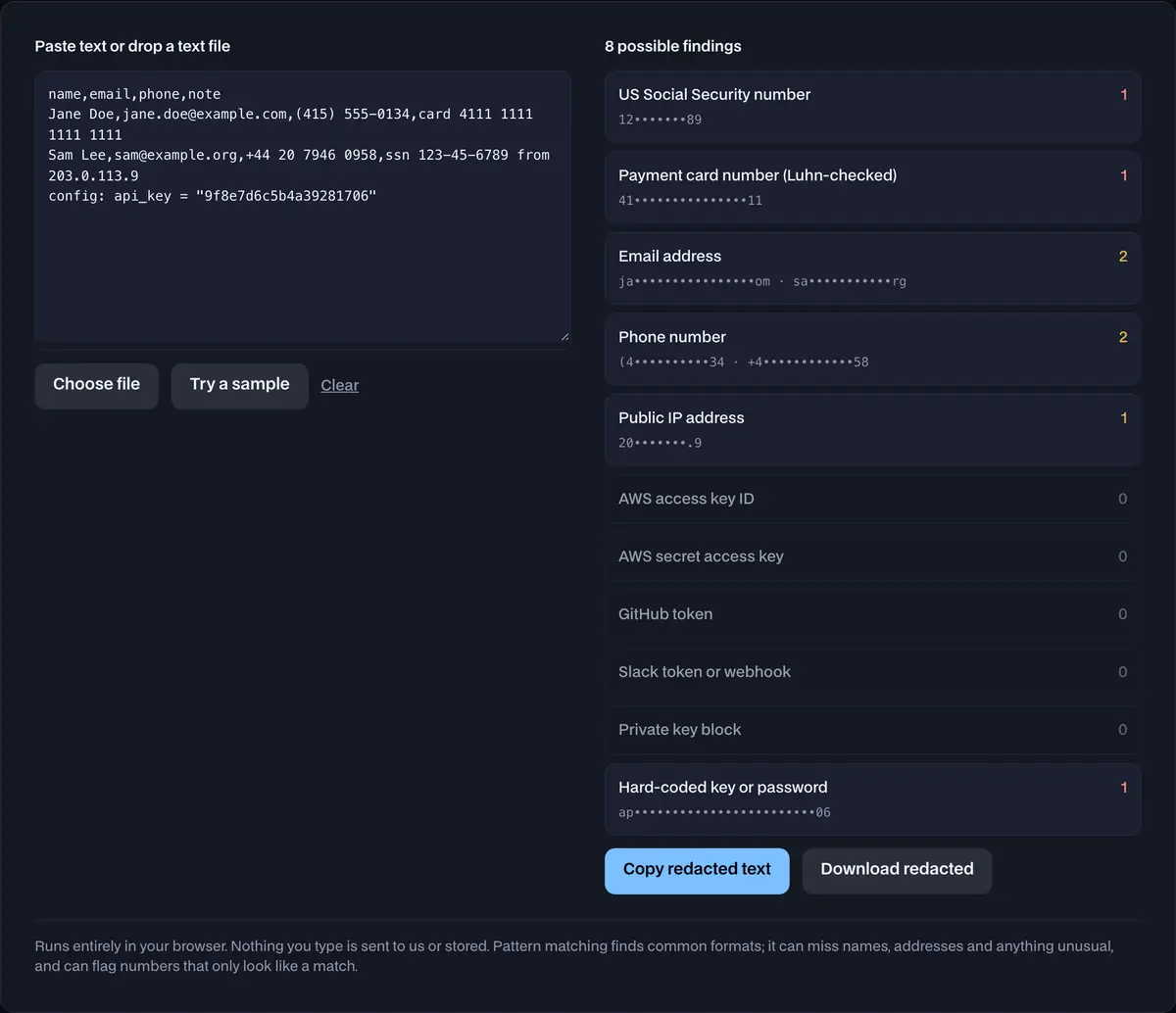
If you are selling data to AI companies, attach the card to the data room or listing together with a sample. Run samples through the PII scanner first so the card's claims about personal data are true.
If it doesn't work
- The licence doesn't display on Hugging Face
- The Hub shows a licence only for ids on its licence list, such as cc-by-4.0 or mit. Use 'other' and explain the terms in the Distribution section if yours isn't listed.
- Download does nothing
- Your browser may block downloads. Allow them, or press Copy Markdown and paste into a new README.md.
- My answers were gone when I came back
- Nothing is saved, on purpose. Download or copy the card before closing the tab.
Sources
2 sources · checked Nov 9, 2026

Dataset card generator FAQ
What is the difference between a dataset card and a datasheet?
A datasheet is the set of documentation questions proposed by Gebru and colleagues. A dataset card is the README file that holds that documentation, as used on Hugging Face. This generator writes the datasheet's answers into a card.
Where do I put the dataset card?
As README.md at the top of the dataset's repository. On Hugging Face it renders as the dataset page; elsewhere, include it in the data room or alongside the files.
Which licence should I choose?
The one your data is actually offered under. For a commercial licence that isn't a standard open licence, use 'other' and summarise the terms in the Distribution section.
Do I need a dataset card to sell data?
No law requires one, but buyers ask the same questions in diligence, and a clear card answers them before the first call.
Is what I type saved?
No. The card is built in your browser and nothing is sent or stored.
Related
- AI dataset
An AI dataset is the material a model learns from: what it contains, how it is organised, and what buyers check before licensing one.
- AI training data
AI training data licensing explained: which datasets labs want, publicly reported deal values, and the copyright and transparency rules that now apply.
- How to sell data to AI companies
Sell data to AI companies only after you can prove where it came from, that you may license it, and why it isn't online already.
- Data valuation
Data valuation explained for people selling or brokering a dataset: three standard methods, what each misses, and a worksheet to score one.
 PII scanner
A PII scanner that runs in your browser: paste text or drop a file to see personal data and leaked secrets before you share it.




Guides that use the dataset card generator
- What is a datasheet for a dataset
A datasheet for a dataset answers 57 standard questions about your data; here is what buyers read in one and how to write it.

Free tool
Try the dataset card generator
A dataset card is the README that documents a dataset: what it contains, how it was collected, what it is suitable for and under what licence, with machine-readable metadata at the top.
- Free
- No sign-up
- Runs in your browser