

Free tool
Finders fee calculator
A finders fee calculator for introductions: flat or tiered rates, a minimum and a cap, and how the result compares with published ranges.
Updated

What the buyer pays, or the amount the fee is based on in your agreement.
The rate you and the payer agree. There is no legal standard rate.
0 for none.
0 for no cap.
Finder's fee
$25,000
10.00% of the deal
Payer keeps
$225,000
Deal value less the fee, before tax and other costs.
Most common structure: 5% to 15% of deal value
$12,500 to $37,500
Your fee is inside this published range. Ranges are one guide's figures, not a rule.
Runs entirely in your browser. Nothing you type is sent to us or stored.
Runs in your browserBuilt and maintained by the DataBroker team

How to use the finders fee calculator
- Step 1
Enter the deal value
Type what the buyer pays, or whatever amount your agreement says the fee is based on.
- Step 2
Pick the structure
A flat percentage, the Lehman scale, or Double Lehman. Add a minimum fee or a cap if your agreement has one.
- Step 3
Compare with a range
Choose the kind of deal closest to yours to see the published range in dollars and whether your fee sits inside it.
What the result looks like

What is a finder's fee?
A finder's fee is a payment to someone who introduces a buyer and a seller, or an investor and a company, without negotiating the deal, usually a percentage of the deal value agreed in writing before the introduction.
Finders fee calculator specs and limits
| Fee structures | Flat percentage; Lehman (5%, 4%, 3%, 2%, then 1% above $4M); Double Lehman (10%, 8%, 6%, 4%, then 2%) |
|---|---|
| Limits | An optional minimum fee and an optional cap, applied after the formula |
| Ranges shown | Five published ranges from ReferralHero's finder's fee guide, as a percentage of deal value, capital raised or contract value |
| Results | The fee, its effective rate, what the payer keeps, and the range in dollars at your deal value |
| Where it runs | In your browser. Nothing you type is sent to us or stored |
| Not included | Tax, recurring payments and co-broker splits (the commission calculator does renewals and splits) |

More about the finders fee calculator
How the finders fee calculator works
| Figure | Formula |
|---|---|
| Flat fee | deal value × rate |
| Lehman fee | 5% of the first $1M + 4% of the next $1M + 3% of the next + 2% of the next + 1% of anything above $4M |
| Double Lehman fee | the same tiers at 10%, 8%, 6%, 4% and 2% |
| Minimum and cap | the fee is raised to the minimum or held at the cap when the formula falls outside them |
| Effective rate | fee ÷ deal value |
Example: a $250,000 data licence with a flat ten percent fee pays the finder $25,000. On the Lehman scale the same deal pays $12,500, five percent of a deal that never leaves the first tier.
A $2 million deal pays $90,000 on Lehman and $180,000 on Double Lehman. If the agreement caps the fee at $50,000, a ten percent fee on a $1 million deal stops at the cap, an effective rate of five percent.
Published finder's fee ranges
There is no legal standard rate. The ranges in the tool come from one published guide, ReferralHero's, which gives a most common structure of 5 to 15 percent of deal value and different bands by industry. We show them so you can see where a proposed fee sits, not as a recommendation.
| Kind of deal | Published range | Based on |
|---|---|---|
| Most common structure | 5% to 15% | Deal value |
| Investment and venture capital | 2% to 5% | Capital raised |
| Larger M&A transactions | 1% to 3% | Deal value |
| Consulting project referrals | 5% to 10% | Project value |
| SaaS and technology | 10% to 20% | First-year contract value |
The same guide puts real estate referral fees at 25 to 35 percent of the receiving agent's commission rather than of the sale price, so we left that band out of the tool: it isn't comparable with the others.
Finder or broker?
A finder makes the introduction and steps back. A broker stays in the deal: qualifying the data, pricing it, handling the documents and pushing it to signature. The difference matters for the fee, since brokers usually earn more for doing more, and for the law.
When a fee needs a licence
In securities deals, someone who regularly connects investors with companies may need to be a registered broker-dealer, and in most US states only licensed real estate agents can be paid referral fees on property. Selling a dataset licence is neither of those, but if the deal involves shares in a company or real property, check before you take a fee.
Put it in writing
Put the fee in a signed finder's fee agreement before you make the introduction: the guide we cite notes that verbal finder's fee agreements are very hard to enforce. If you will negotiate the deal, collect renewals or split with another broker, use the data broker commission calculator instead.
If it doesn't work
- The fee doesn't change when I edit the rate
- The rate only applies in Flat % mode. In Lehman modes the tiers are fixed; switch back to Flat % to type your own rate.
- The fee is higher than the formula
- A minimum fee is set. The result line says when the minimum or the cap has replaced the formula's figure.
- The range looks wrong for my deal
- Each range has its own base: capital raised, first-year contract value or deal value. Pick the one that matches what your fee is calculated on.
Sources
2 sources · checked Nov 9, 2026

Finders fee calculator FAQ
What percentage is a typical finder's fee?
There is no standard. One widely read guide, ReferralHero's, says the most common structure is 5 to 15 percent of the deal value, lower on large deals and capital raises. The fee is whatever the agreement says.
How much is a finder's fee on a $1 million deal?
At a flat 10 percent, $100,000. On the Lehman scale, $50,000. On Double Lehman, $100,000. A cap in your agreement can bring any of these down.
Is a finder's fee enforceable without a written contract?
A verbal agreement can be a contract, but proving its terms in a dispute is hard. Sign a finder's fee agreement before the introduction, naming the parties, the fee and when it is paid.
Do I need a licence to take a finder's fee?
It depends on the deal. Securities and real estate are the usual cases where a licence or registration is needed in the US. Ask a lawyer before taking a fee on either.
Who pays the finder's fee?
Usually the party that benefits from the introduction, most often the seller, out of the deal proceeds. The agreement should say who pays and when.
Does the calculator save my numbers?
No. It runs in your browser and nothing is sent or stored.
Related
 Data broker commission calculator
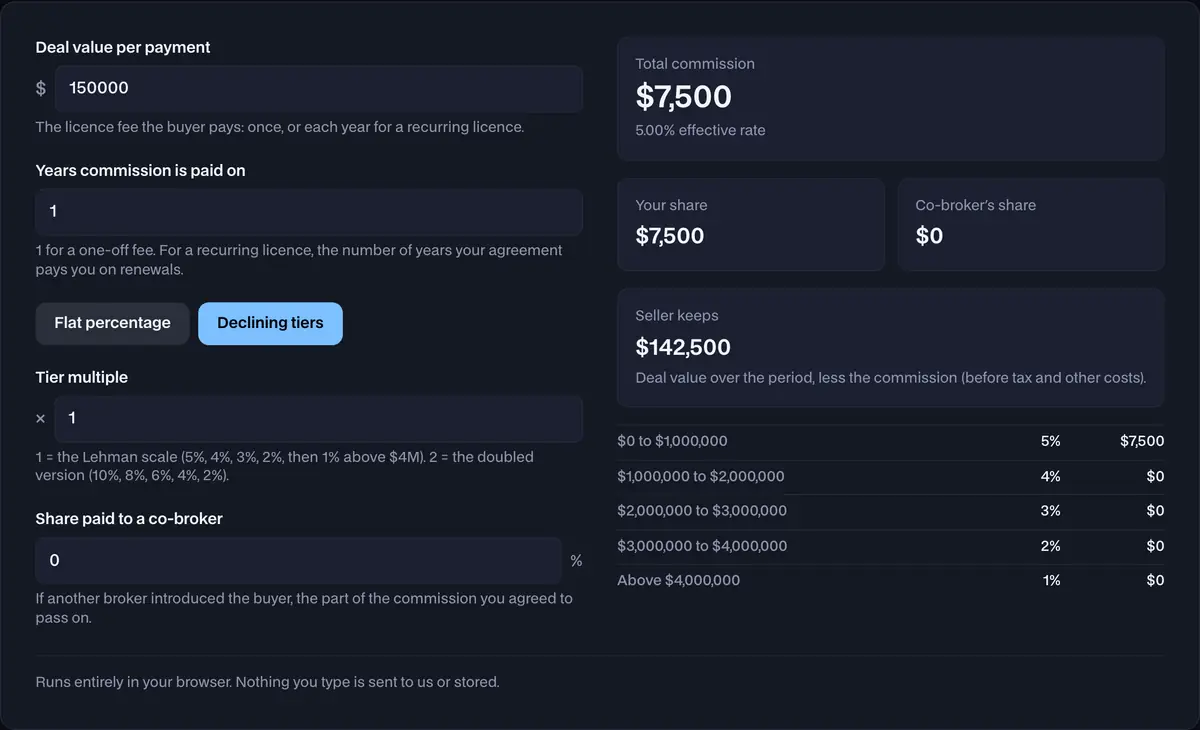
Work out a data broker commission on any deal: flat or tiered rates, recurring licences, and a split with a co-broker.
 How to become a data broker
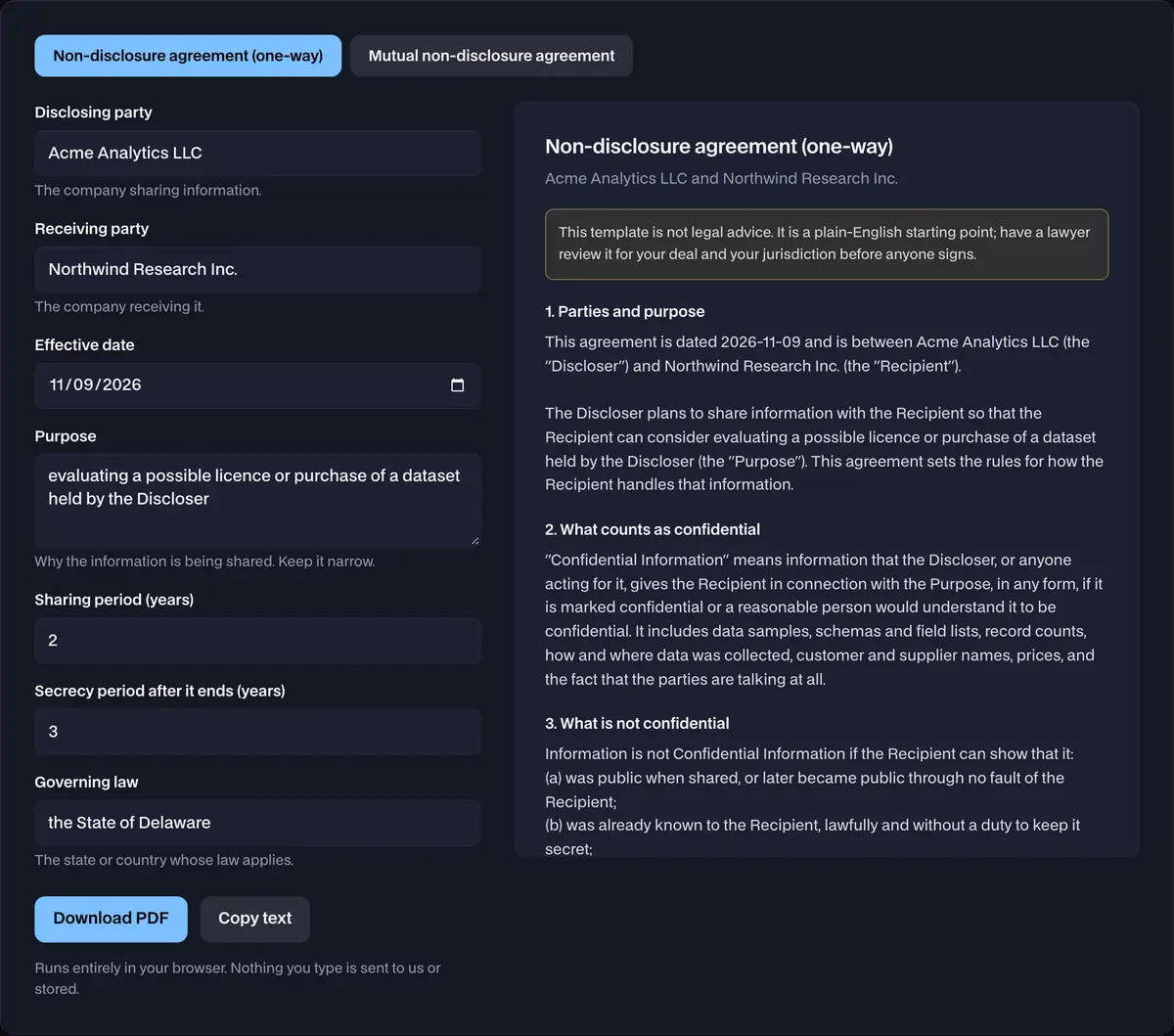
 who brings company datasets to buyers: the skills, the legal checks, the documents and the order you do them in.
- What is a tail clause in a broker or finder's fee agreement?
A tail clause keeps your fee owed after the agreement ends; here is what eight filed agreements set and how to write one.
- Data broker vs business broker
Data broker vs business broker is mostly a question of what changes hands: a whole company once, or a right to use data.


Free tool
Try the finders fee calculator
A finder's fee is a payment to someone who introduces a buyer and a seller, or an investor and a company, without negotiating the deal, usually a percentage of the deal value agreed in writing before the introduction.
- Free
- No sign-up
- Runs in your browser