Glossary
Data asset: what it means and how it is accounted for
A data asset is data a business manages as a resource of value, whether or not its accounts record it.
Updated

Definition
A data asset is a body of data, such as a database, a set of records or a licensed dataset, that an organisation manages as a resource because it expects value from it, through operations, products or sale.
Two meanings of data asset
In data management the phrase is broad. The US Committee on National Security Systems glossary, quoted by NIST, calls a data asset any entity made up of data, giving a database of records as the example. Catalogue tools use it the same way for a table, a file or a dashboard someone looks after.
The accounting sense
In accounting the phrase is narrow. An asset on the balance sheet has to meet specific tests, and most data a company builds for itself does not pass them. That gap explains a common puzzle: a business can talk about data as an asset in every board deck while its accounts show nothing for it.
Data assets on the balance sheet: what the rules say

Neither framework has a standard written for data. IAS 38 covers intangible assets in general: an identifiable non-monetary asset without physical substance, recognised only when future economic benefits are probable and the cost can be measured reliably.
US GAAP
KPMG notes that US GAAP has no specific guidance on data either; the FASB's task force discussed database content in EITF Issue 00-20 without reaching a consensus, so general intangible asset rules apply.
| Situation | IFRS (IAS 38) | US GAAP | In practice |
|---|---|---|---|
| Data the company collects or generates itself | Internally generated customer lists may not be recognised; research spending is expensed, development spending only capitalised if set criteria are met | Internally generated data costs are generally expensed as incurred (Subtopic 350-30) | Usually no asset on the books, however valuable the data |
| Data licensed from a third party | Can be recognised at cost if identifiable (for example arising from contractual rights) and the recognition tests are met | Capitalisable at cost, including transaction costs, because it arises from contractual-legal rights | An intangible asset, amortised over its useful life |
| Data licensed or generated solely for one R&D project, with no alternative future use | Not covered separately; research spending is expensed | Expensed as incurred under Subtopic 730-10 | No asset |
| Licensed data used to develop AI software | Not covered in the sources checked | Depends on the software rules (Subtopics 985-20 or 350-40) and on whether the data has an alternative future use | Can be expensed or capitalised; needs case-by-case review |
| Carrying data at market value | Revaluation allowed only where an active market sets fair value, which the IFRS summary describes as rare | Not covered in the sources checked | Data is normally carried at cost less amortisation, not at what a buyer would pay |
Why the gap matters when data is sold
Because most home-grown data is expensed, its book value tells a seller almost nothing about its price. A logistics firm can carry its scan history at zero while a buyer would pay for access.
Where price comes from instead
Pricing has to come from other methods: what the data would cost to rebuild, what similar data sells for, and what it is worth to the buyer's use. The data valuation guide walks through those three approaches, and the data value calculator sets them side by side with your own figures.
The buyer's books
The buyer side is different. Under KPMG's reading of US GAAP, a company that licenses data in may capitalise it and amortise it over its useful life to that company, then test it for impairment.
Its finance team may therefore ask about licence length, renewal terms and how long the data stays useful, questions worth having answers to before a negotiation starts.
Managing data as an asset, whatever the books say

- Keep an inventory: which datasets exist, where they live and who answers for each.
- Record provenance: sources, collection dates and methods, and what was changed since.
- Know the rights: contracts, consents and terms that allow or forbid sharing.
- Document quality: coverage, gaps, error rates where known, and update frequency.
- Track use: which products, reports or customers depend on each dataset.
Why it still pays off
None of this puts data on the balance sheet. It does make the data easier to license, sell or defend in a due diligence review, which is where the management sense of the term pays off.
Sources
3 sources · checked Nov 9, 2026
- IFRS Foundation: IAS 38 Intangible AssetsDefinition of an intangible asset; recognition tests; internally generated customer lists not recognised; research expensed; revaluation only with an active market · Checked
- KPMG Hot Topic: Software data costs (February 2026)No specific US GAAP guidance on data; EITF 00-20; internal data expensed, licensed data capitalised under 350-30; R&D data under 730-10; AI software rules · Checked
- NIST CSRC glossary: data assetData asset as any entity made up of data, such as a database (CNSSI 4009-2022) · Checked

Data asset FAQ
Is data an asset on the balance sheet?
Usually only when it was bought or licensed in. Data a company generates itself is generally expensed under both IFRS and US GAAP, so it rarely appears as an asset even when it is valuable.
Can a company capitalise the cost of collecting its own data?
Generally not under US GAAP, where internally generated data costs are expensed as incurred. Under IAS 38 internally generated customer lists cannot be recognised, and other internal spending is capitalised only in a development phase meeting strict criteria.
Is a customer list an intangible asset?
A purchased one can be. IAS 38 says an internally generated customer list is not recognised as an intangible asset, so the same list built in-house stays off the balance sheet.
How do you put a value on a data asset?
Book value rarely helps. Sellers and buyers estimate it from the cost to rebuild the data, prices of comparable datasets and the value it creates for a particular buyer, then negotiate within that range.
Related
- Data valuation
Data valuation explained for people selling or brokering a dataset: three standard methods, what each misses, and a worksheet to score one.
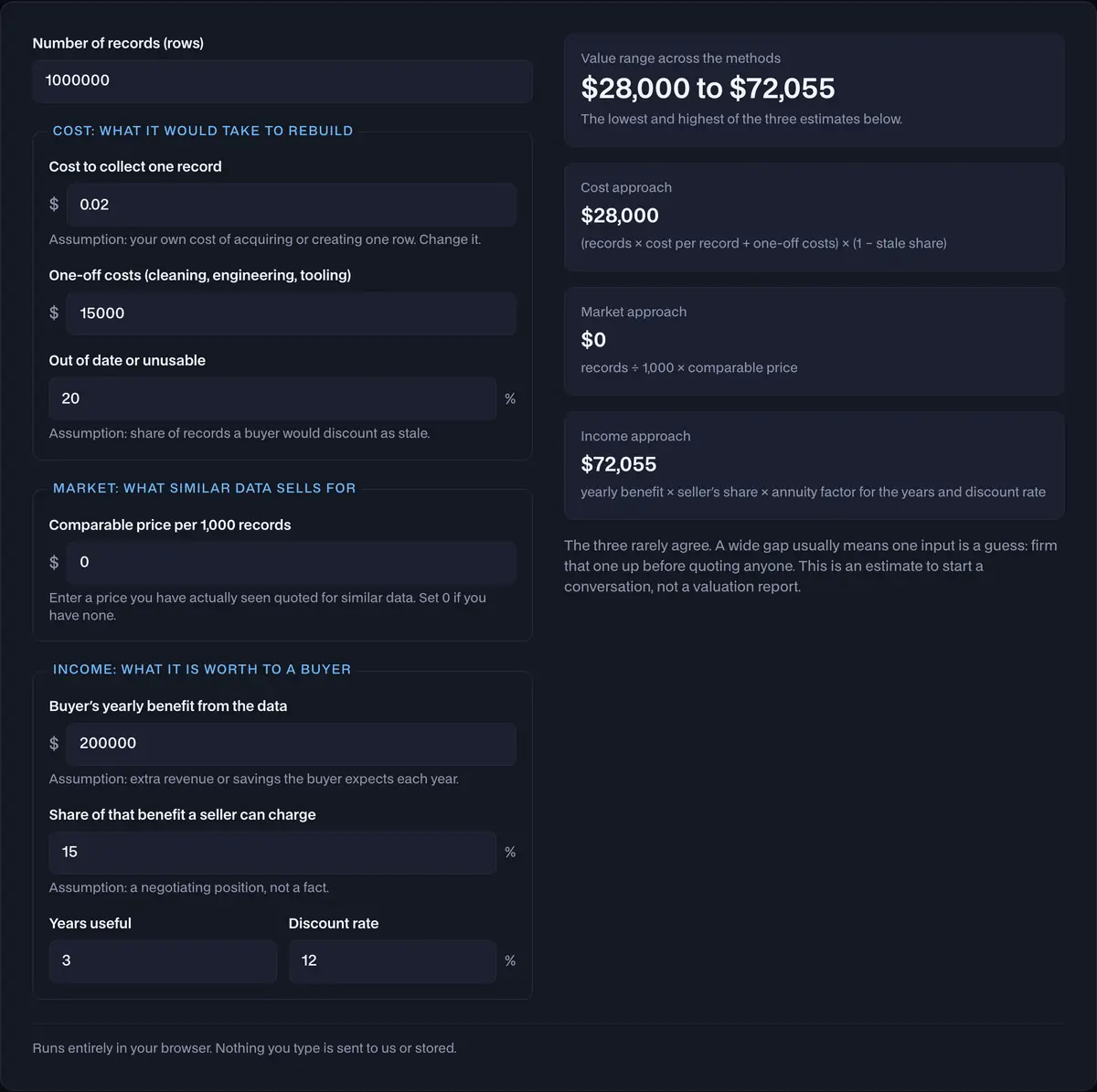 Data value calculator
How much is data worth to a buyer? Compare three standard estimates side by side, using your own figures and assumptions you can change.
- Data monetization
Data monetization is the umbrella term for every way an organisation turns its data into money, inside the business or outside it.
- Data product
A data product is data packaged so other people can use it repeatedly: defined contents, an owner, documentation and a promise of upkeep.
- Dataset
What is a dataset, beyond a big file? Records, a schema, metadata, documentation and the rights to use them.
- How to sell startup assets before you shut down
Sell startup assets before you cancel the accounts: what still has buyers, who they are, and the order that keeps the value.






Free tool
Try the data value calculator
Data value is what a dataset is worth to someone, estimated by what it would cost to recreate, what similar data sells for, or how much extra income or savings it brings the person using it.
- Free
- No sign-up
- Runs in your browser