Glossary
What is PII (personally identifiable information)?
PII, short for personally identifiable information, is data that can identify a person on its own or combined with other data.
Updated

Definition
PII (personally identifiable information) is information that can be used to distinguish or trace a person's identity, alone or combined with other information linked or linkable to them, such as a name, an ID number or a biometric record.
The official definition
PII is a US government term.
NIST's Guide to Protecting the Confidentiality of PII (SP 800-122, April 2010), quoting the Government Accountability Office, defines it in two parts: any information that can be used to distinguish or trace a person's identity, such as name, Social Security number, date and place of birth or biometric records; and any other information linked or linkable to a person, such as medical, educational, financial and employment information.
The OMB version
The shorter version used across NIST security standards comes from OMB Circular A-130: information that can be used to distinguish or trace an individual's identity, either alone or when combined with other information linked or linkable to that individual.
- To distinguish a person is to identify them. A list of credit scores alone does not; add age, address and gender and it probably would.
- To trace a person is to work out something about their activities or status, as an audit log of user actions can.
- Linked information is already logically tied to other details about the person on the same or a closely related system.
- Linkable information could be tied to them using another source, such as a separate system, public records or a search engine.
Examples of PII

NIST lists these as examples of information that may be PII:
- Names, including maiden names and aliases.
- Identification numbers: Social Security, passport, driver's licence, taxpayer, patient, bank account and card numbers. Partial numbers, such as the last digits of an SSN, can still count.
- Street and email addresses.
- Telephone numbers, including mobile, business and personal.
- Asset information such as an IP or MAC address that consistently links to a person or a small group.
- Personal characteristics: photos of faces, X-rays, fingerprints, voice signatures and other biometrics.
- Vehicle registration and title numbers.
- Facts linked or linkable to any of the above, such as date of birth, religion, employment, medical or financial details.
PII vs personal data vs personal information
Different laws, different words
Outside US federal guidance the law uses other words, and the scope differs. A dataset that holds no PII by one test can still hold personal data by another.
| Term | Where it comes from | Core test | Worth noticing |
|---|---|---|---|
| PII | US federal guidance: NIST SP 800-122, OMB Circular A-130 | Can distinguish or trace a person's identity, alone or combined with linked or linkable information | A guidance term for agencies, not a single statute; NIST asks agencies to rate PII by confidentiality impact: low, moderate or high |
| Personal data | EU GDPR, Article 4(1) | Any information relating to an identified or identifiable natural person, identified directly or indirectly | Pseudonymised data still counts (Recital 26) |
| Personal information | California CCPA, Civil Code 1798.140(v) | Identifies, relates to, describes or could reasonably be linked with a particular consumer or household | Covers households and inferences used to build a profile; excludes publicly available, deidentified and aggregate consumer information |
PII in datasets a broker comes across

- CRM exports: contact names, business emails and direct phone numbers. NIST's list includes business numbers, so business contact data is not automatically outside the term.
- Support tickets and chat logs: free text where customers type addresses, order numbers and account details.
- Server and app logs: IP addresses and device identifiers next to user actions.
- Transaction records: card fragments, delivery addresses and purchase histories, the last of which the CCPA names as commercial information.
- Images and audio: faces, voices and number plates.
Finding versus removing
Finding PII is a separate job from removing it safely. The PII scanner on this site checks pasted text for emails, phone numbers, US Social Security numbers, card numbers and public IP addresses, and gives back a redacted copy. Making what is left non-identifying is data anonymization, a different step with its own legal tests.
What this page doesn't cover
We are not a compliance service and don't classify datasets for clients. This entry gives the core definitions so a broker can recognise when a seller's data raises privacy questions, such as a consumer data set or a log full of customer IPs.
Not summarised here
Sector rules (health, finance, education, children's data) and state laws beyond California add their own definitions that are not summarised here.
Sources
4 sources · checked Nov 9, 2026
- NIST SP 800-122, Guide to Protecting the Confidentiality of PII (April 2010)Two-part PII definition; distinguish and trace; linked vs linkable; examples; confidentiality impact levels · Checked
- NIST CSRC glossary: personally identifiable informationOMB Circular A-130 definition used across NIST standards · Checked
- GDPR Article 4Personal data, Article 4(1) · Checked
- California Consumer Privacy Act text (CPPA, January 2025)Personal information, 1798.140(v), its categories and exclusions · Checked

PII (personally identifiable information) FAQ
What does PII stand for?
Personally identifiable information. The term comes from US federal privacy and security guidance; EU and California law use personal data and personal information instead.
Is an email address PII?
Yes. NIST lists email addresses among its examples, and the CCPA names them as identifiers within personal information.
Is an IP address PII?
Often. NIST counts an IP address that consistently links to a person or small group as PII, and the CCPA lists IP addresses as identifiers. Whether a given log counts depends on what it can be linked to.
Is PII the same as personal data?
Not exactly. PII is a US guidance term focused on identifying someone. GDPR personal data covers any information about an identifiable person, which is usually broader.
Is business contact information PII?
It can be. A named person's work email or direct line identifies that person, and NIST's examples include business phone numbers. Privacy laws differ on how they treat such data.
Related
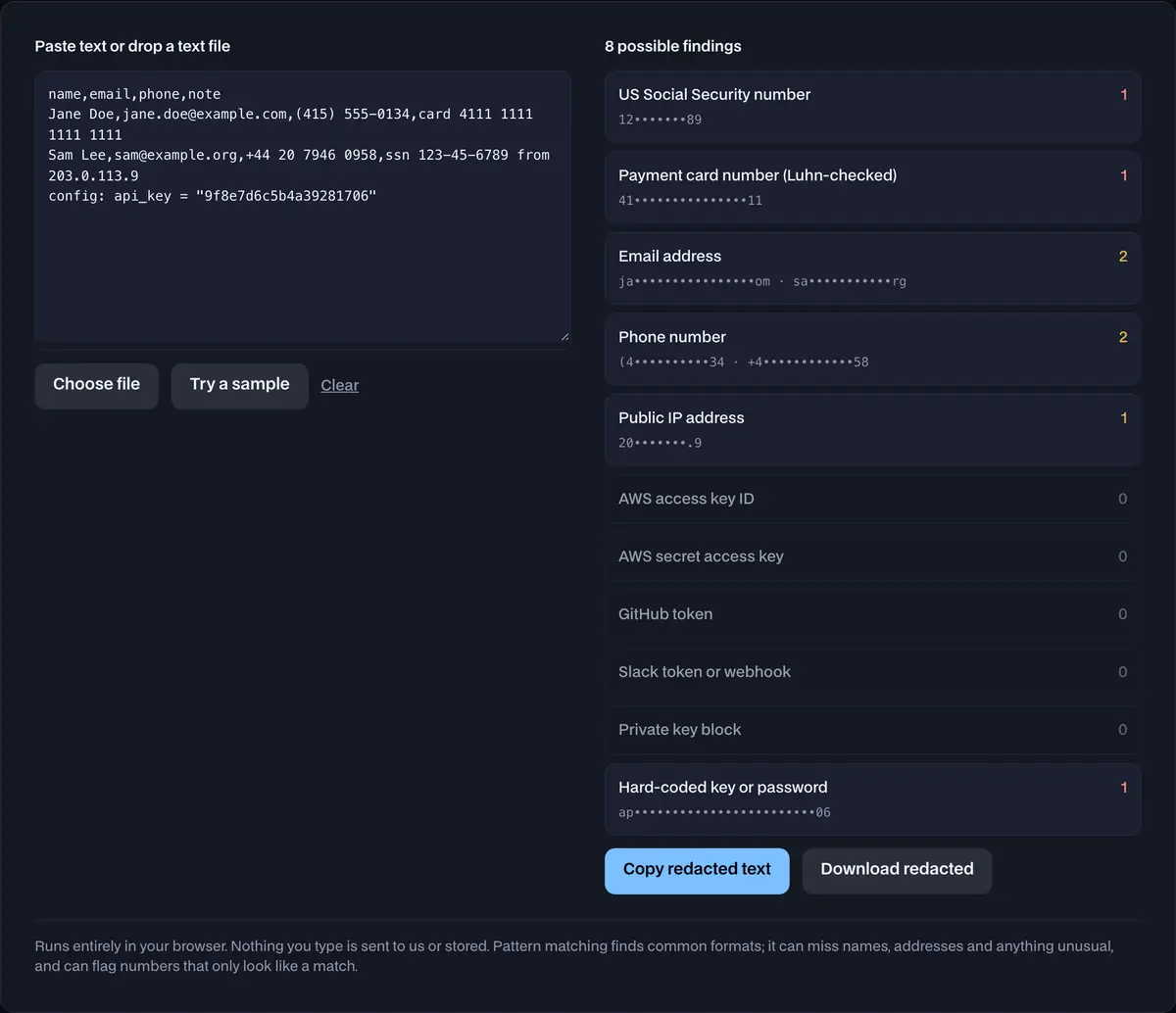 PII scanner
A PII scanner that runs in your browser: paste text or drop a file to see personal data and leaked secrets before you share it.
- Data anonymization
Data anonymization changes a dataset so the people in it can no longer be identified by any reasonable means.
- Consumer data
Consumer data covers information about individual people in their private lives: who they are, where they live, what they buy and do.
- Is selling data legal?
Is selling data legal? A plain look at when a sale is allowed, when registration applies, and when to call a lawyer first.
- Data provenance
Data provenance tells a buyer where a dataset came from, who produced it, how, and under what rights.




Free tool
Try the PII scanner
A PII scanner searches text for personally identifiable information, such as email addresses, phone numbers and government ID numbers, so it can be removed or protected before the text is shared.
- Free
- No sign-up
- Runs in your browser