Glossary
Data anonymization: techniques and legal tests
Data anonymization changes a dataset so the people in it can no longer be identified by any reasonable means.
Updated

Definition
Data anonymization is the process of altering personal data so the people it describes can no longer be identified, directly or indirectly, by means reasonably likely to be used. Truly anonymous data falls outside laws such as the GDPR.
Anonymization, pseudonymization and de-identification
The three words are often used as if they mean the same thing. In law they do not. Anonymization is the end state where nobody can be picked out. Pseudonymization swaps direct identifiers for codes but keeps a way back. De-identification is the term US laws use, each with its own test.
- Anonymous data, in GDPR Recital 26, is information that does not relate to an identified or identifiable person, judged by all the means reasonably likely to be used, taking into account cost, time and available technology. Such data is outside the regulation.
- Pseudonymisation, in GDPR Article 4(5), is processing so data can no longer be attributed to a person without additional information kept separately. Recital 26 says pseudonymised data is still personal data.
- The Article 29 Working Party, the body of EU regulators before the GDPR, put it bluntly in 2014: pseudonymisation is not a method of anonymisation; it only reduces linkability.
- De-identified data under HIPAA and the CCPA must meet the specific conditions set out in the table further down.
Data anonymization techniques compared

Three risks regulators test
Regulators test anonymization against three risks: singling out one person, linking records about the same person across datasets, and inferring a fact about someone. The Working Party's Opinion 05/2014 scored common techniques against each. 'May not' means the technique can remove the risk if applied well, not that it always does.
| Technique | What it does | Singling out still a risk? | Linkability still a risk? | Inference still a risk? |
|---|---|---|---|---|
| Pseudonymisation | Replaces identifiers with codes | Yes | Yes | Yes |
| Noise addition | Adds small random changes to values | Yes | May not | May not |
| Substitution (permutation) | Shuffles values between records | Yes | Yes | May not |
| Aggregation or k-anonymity | Groups records so each matches at least k others | No | Yes | Yes |
| L-diversity | K-anonymity plus variety in sensitive values within each group | No | Yes | May not |
| Differential privacy | Releases answers with calibrated noise instead of records | May not | May not | May not |
| Hashing or tokenisation | Turns identifiers into fixed-length codes or tokens | Yes | Yes | May not |
A warning about hashing
Hashing deserves a warning of its own. The US Federal Trade Commission wrote in July 2024 that hashed emails or phone numbers are not anonymous: the same input always gives the same hash, so it still tracks a person, and common inputs can be recovered by guessing.
What each law accepts
| Law | Term used | The test | What stays regulated |
|---|---|---|---|
| GDPR (EU) | Anonymous information (Recital 26) | No identified or identifiable person, considering all means reasonably likely to be used | Pseudonymised data remains personal data |
| HIPAA Safe Harbor, 45 CFR 164.514(b)(2) | De-identified health information | Remove 18 listed identifiers of the person and their relatives, employers or household (names, geography below state, dates except year, contact numbers, IDs, IP addresses, biometrics, full-face photos and more) and have no actual knowledge the rest could identify them | ZIP codes: first three digits only where that area holds more than 20,000 people; ages over 89 grouped as 90 or older |
| HIPAA Expert Determination, 45 CFR 164.514(b)(1) | De-identified health information | A qualified expert applies statistical methods, finds the risk of identification very small and documents the methods and results | Re-identification codes are allowed only under 164.514(c) conditions |
| CCPA (California), Civ. Code 1798.140(m) | Deidentified | Information cannot reasonably be linked to a consumer, and the business takes reasonable measures, publicly commits not to re-identify, and binds recipients by contract to the same | Pseudonymized data (1798.140(aa)) is not deidentified; deidentified and aggregate consumer information fall outside personal information (1798.140(v)(3)) |
What this means when a dataset is sold

Removing names is rarely enough. A table of transactions with dates, postcodes and ages can identify people as surely as one with names. Buyers will ask which technique was used, which test it was measured against, and whether the seller kept a re-identification key. A seller who keeps the key holds pseudonymised data, not anonymous data, under the GDPR.
Finding direct identifiers
A practical first step is to find the direct identifiers. Our PII scanner flags emails, phone numbers, US Social Security numbers, card numbers and IP addresses in a pasted sample and produces a redacted copy.
Detection is not anonymization
That is detection, not anonymization: it cannot judge indirect identifiers or linkage risk. For what counts as identifying in the first place, see the entry on personally identifiable information, and for the wider legal picture, the guide on whether selling data is legal.
Sources
6 sources · checked Nov 9, 2026
- GDPR Recital 26Anonymous information outside the GDPR; means reasonably likely to be used; pseudonymised data remains personal data · Checked
- GDPR Article 4Definition of pseudonymisation, Article 4(5) · Checked
- Article 29 Working Party, Opinion 05/2014 on Anonymisation Techniques (WP216)Three risks; Table 6 of technique strengths and weaknesses; pseudonymisation is not anonymisation · Checked
- 45 CFR 164.514 (Cornell LII)HIPAA Expert Determination, Safe Harbor identifiers, ZIP and age rules, actual knowledge, re-identification codes · Checked
- California Consumer Privacy Act text (CPPA, January 2025)Section 1798.140(m) deidentified, (aa) pseudonymize, (v)(3) exclusion · Checked
- FTC Technology Blog: No, hashing still doesn't make your data anonymous (July 2024)Hashed identifiers still track people and can be reversed · Checked

Data anonymization FAQ
Is pseudonymised data still personal data?
Under the GDPR, yes. Recital 26 says pseudonymised data that could be attributed to a person using additional information should be treated as information about an identifiable person.
Is hashing a form of anonymization?
No. The FTC and EU regulators both treat hashed identifiers as still able to single out and link a person. A hash is a consistent code, so it works like a pseudonym.
Does removing names and emails make data anonymous?
Not by itself. Combinations of remaining fields such as dates, locations and ages can still identify people, which is why legal tests look at what is reasonably likely to re-identify someone, not only at which columns were deleted.
Can anonymized data be sold?
Data that is truly anonymous falls outside the GDPR, and deidentified data that meets the CCPA conditions is not personal information under that law. Contract terms, other laws and the risk of later re-identification still apply, so buyers usually ask how it was tested.
Related
- PII (personally identifiable information)
PII, short for personally identifiable information, is data that can identify a person on its own or combined with other data.
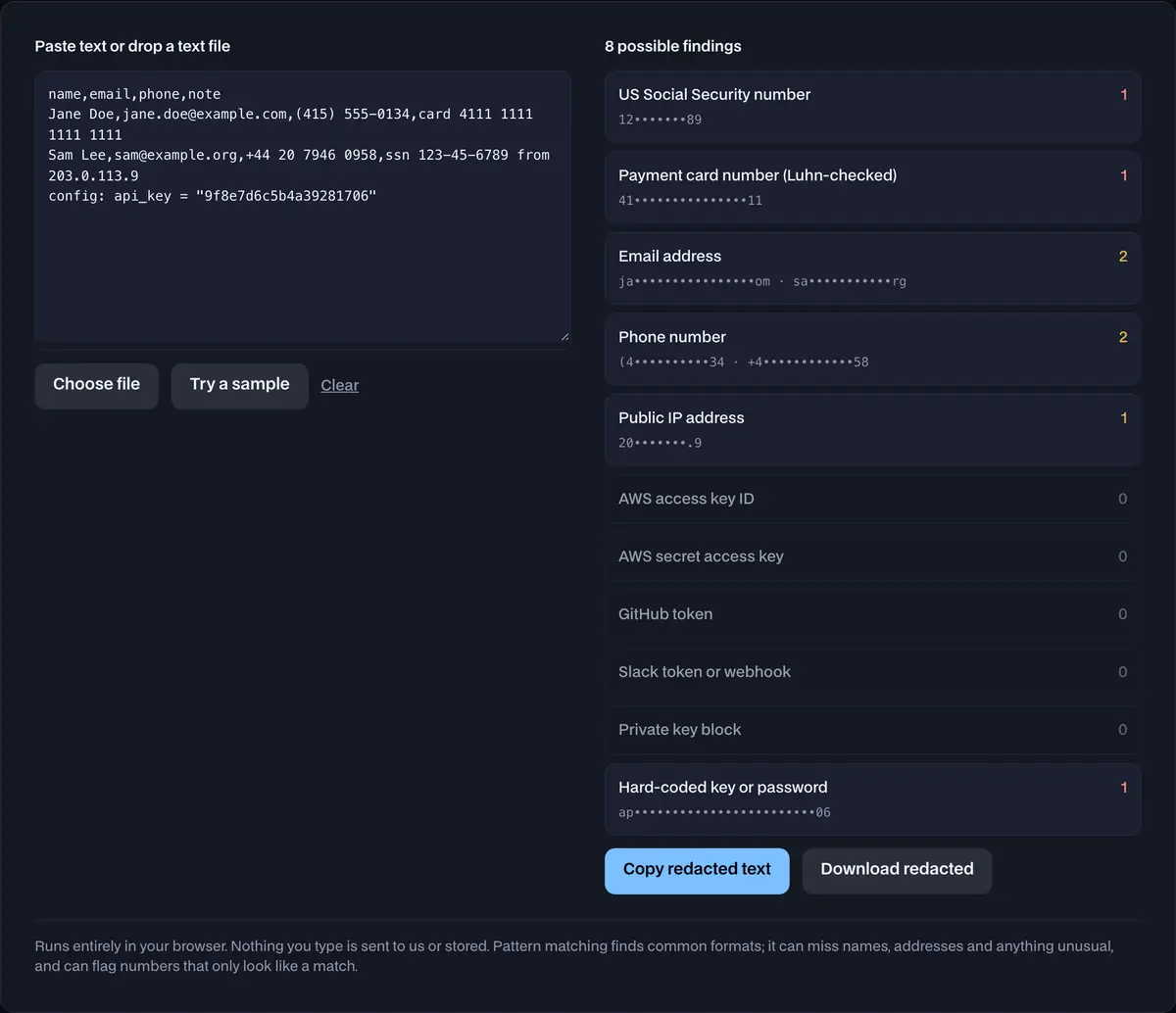 PII scanner
A PII scanner that runs in your browser: paste text or drop a file to see personal data and leaked secrets before you share it.
- Data provenance
Data provenance tells a buyer where a dataset came from, who produced it, how, and under what rights.
- Is selling data legal?
Is selling data legal? A plain look at when a sale is allowed, when registration applies, and when to call a lawyer first.



Free tool
Try the PII scanner
A PII scanner searches text for personally identifiable information, such as email addresses, phone numbers and government ID numbers, so it can be removed or protected before the text is shared.
- Free
- No sign-up
- Runs in your browser