Leads
Aged leads: what they cost and when they are worth it
Aged leads are older inquiries resold at a discount; this page shows how price falls with age and why consent decides their value.
Published

What is an aged lead?
An aged lead is a consumer inquiry sold again after its first, real-time sale, typically from a week to over a year old, priced far below fresh leads because contact and close rates fall with time.
The secondary market for leads
Every fresh lead is sold first in real time, often to several buyers. Whatever isn't closed then becomes inventory for a second market: aged leads, sold in bulk to agents and call centres willing to work harder for a lower cost per record. Insurance, mortgage, solar and debt relief all have active aged markets.
For a broker, aged leads look attractive because the inventory already exists and generators want to monetise it. The catch is that the consent behind each record ages too, and so does the consumer's interest.
Price by age band

- 7–14 days old
- 25–35% of fresh
- 31–60 days old
- 8–15% of fresh
- 90+ days old
- 2–5% of fresh
| Vertical and age | Published range | Source |
|---|---|---|
| Any vertical, 7–14 days | $8–$35 (25–35% of fresh) | Lead Gen Economy |
| Any vertical, 31–60 days | $3–$10 (8–15% of fresh) | Lead Gen Economy |
| Any vertical, 90+ days | $0.50–$3 (2–5% of fresh) | Lead Gen Economy |
| Insurance, 30–60 days | $1.50–$3.00 | Mav |
| Insurance, 85+ days | $0.15–$0.75 | Mav |
| Mortgage, 30–85 days | $2–$5; contact rate 20–35% | Prospeo, citing agedleadstore.com |
| Mortgage, 366+ days | $0.50–$1; contact rate 8–18% | Prospeo, citing agedleadstore.com |
| Solar, 7–30 days | $15–$45 | Lead Gen Economy |
Cheap for a reason
Mav reports close rates of 2–5% on aged insurance leads against 10–20% on fresh ones. Lead Gen Economy puts aged leads at 5–20% of the fresh price overall. The low unit price is a fair reflection of how much harder they are to convert, not a bargain by default.
Consent is what really ages
The TCPA doesn't put an expiry date on prior express written consent, but consent is given to a named seller for a purpose. A lead sold to a different company than the one named on the original form, months later, may carry no valid consent for that buyer at all.
What a verifiable consent record holds
Checks before every campaign
- Rescrub against the national and state Do Not Call lists before every campaign; the Telemarketing Sales Rule safe harbour expects lists refreshed at least every 31 days.
- Check reassigned numbers: a mobile number from a year ago may now belong to someone else.
- Honour opt-outs carried over from earlier buyers if the seller provides them, and ask why if they don't.
- Florida and Oklahoma's state laws apply to aged leads exactly as to fresh ones.
- Medicare data can't be passed between marketing organisations without the beneficiary's consent to each recipient.
- Email follow-up still needs CAN-SPAM's opt-out and sender identification.
When aged leads make sense

- Training new agents, who need volume to practise on before they get expensive leads.
- Text or email nurture campaigns where the consent covers that channel.
- Products with long buying cycles, such as solar or mortgage purchase, where a 'not yet' months ago can become a 'yes'.
They make less sense in fast-moving products like auto insurance, where a driver who shopped two months ago has usually already bought a policy.
Red flags when buying or brokering aged inventory
- No original consent record, only a spreadsheet of names and numbers.
- 'Aged' records that were never sold fresh, which often means they were scraped or bought from list compilers.
- Mixed verticals in one file: a solar form being sold as an insurance lead.
- Age bands that don't match the timestamps in the file.
Where DataBroker fits

We have no aged inventory to sell and don't run a lead store. DataBroker is a paid academy and toolset for people who broker data and lead deals.
Aged leads are a common first deal for new brokers, so the academy spends time on checking consent provenance, pricing by age band, and writing contracts that put responsibility for calling compliance where it belongs.
Sources
7 sources · checked Nov 7, 2026
The DataBroker team checked the facts on this page against 7 public sources, last on .
- Aged Leads vs Fresh Leads: Economics, Best Practices, and When Each Makes Sense, Lead Gen Economy, updated 20 January 2026Checked
- Aged Insurance Leads: Are They Worth Working at Scale?, Mav, October 2026Checked
- Leads for Brokers: 2026 Cost Guide, Prospeo (table attributed to agedleadstore.com)Checked
- 47 CFR 64.1200, Delivery restrictions (TCPA rules), eCFRChecked
- 16 CFR 310.4, Abusive telemarketing acts or practices (Telemarketing Sales Rule), eCFRChecked
- CMS Restricts Marketing Companies From Sharing Medicare Beneficiary Data, Manatt, 22 April 2024Checked
- CAN-SPAM Act: A Compliance Guide for Business, Federal Trade CommissionChecked

Aged leads FAQ
What counts as an aged lead?
Any lead resold after its first real-time sale. Sellers usually start the aged bands at 7 to 30 days and go past a year.
How much do aged leads cost?
Published ranges run from about $8 to $35 at one to two weeks old down to $0.15 to $1 past three months or a year, depending on vertical.
Are aged leads TCPA compliant?
Only if the original consent covers the company calling and the channel used, and the numbers are scrubbed against Do Not Call lists. Many aged files fail the first test.
Do aged leads convert?
Less often than fresh ones. One source reports 2 to 5% close rates on aged insurance leads against 10 to 20% for fresh leads.
Related
- Exclusive leads
Exclusive leads go to one buyer only, cost more per lead, and pay back only when contact rates and deal value are high enough.
- Mortgage leads
Mortgage leads are borrowers asking about a purchase loan or refinance; here is what lenders pay, where leads originate and the federal limits.
- Life insurance leads
Life insurance leads are inquiries from people shopping for cover; here is how agents buy them, what they cost and which rules apply.
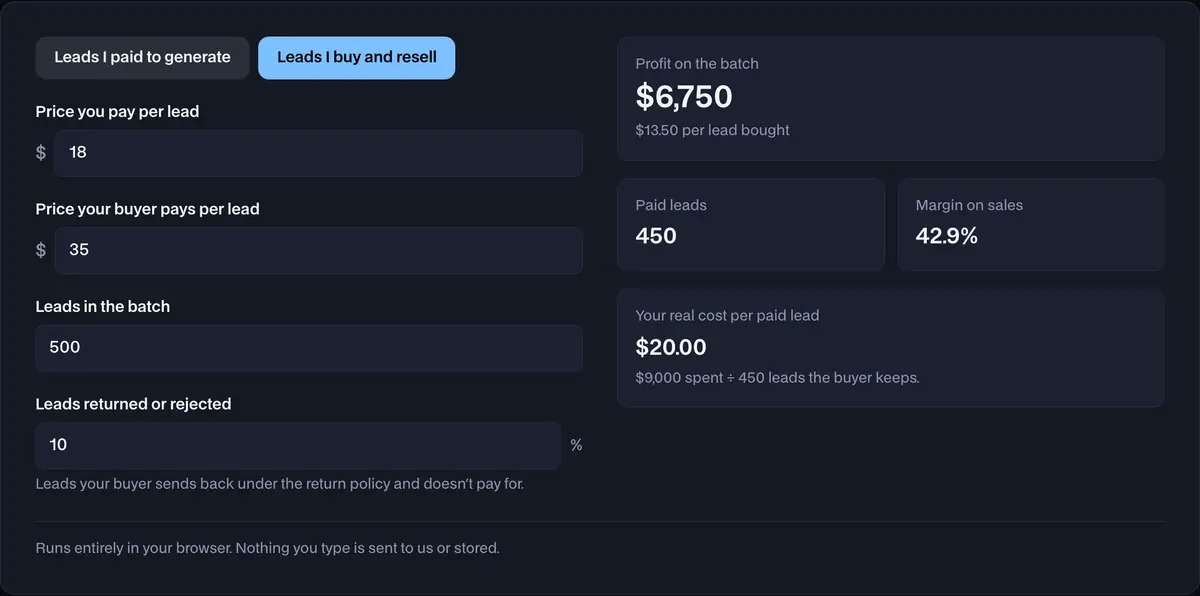 Cost per lead calculator
A cost per lead calculator for both sides of the trade: what your leads cost, what they can cost, and what reselling them leaves you.




Free tool
Try the cost per lead calculator
Cost per lead (CPL) is what it costs to get one new lead: the total spent on a campaign divided by the number of leads it produced. It is a different number from the cost of winning a paying customer.
- Free
- No sign-up
- Runs in your browser