

Free tool
Open source license checker
An open source license checker for a whole repository: it finds every licence it can and flags those to review before selling the code.
Updated

It reads licence files, package manifests (package.json, composer.json, Cargo.toml, pyproject.toml, gemspecs) and SPDX headers. If node_modules is installed, each top-level dependency's licence is read too. Nothing is uploaded.
Runs entirely in your browser. No file is sent to us or stored. A first pass, not legal advice: confirm anything flagged with a lawyer before you sell or license the code.
Runs in your browserBuilt and maintained by the DataBroker team

How to use the open source license checker
- Step 1
Choose the repository folder
Pick the project's top folder. If dependencies are installed in node_modules, their licences are read too.
- Step 2
Read the project licence
The top box shows the licence found at the root of the folder, which is what covers your own code.
- Step 3
Review what's flagged
Open each group marked Check to see which files carry those licences, then decide with a lawyer what they mean for the sale.
What is an open source license checker?
An open source license checker scans a codebase for licence files, package licence fields and per-file licence headers, so you can see which licences cover the code and its dependencies.
Open source license checker specs and limits
| Where it looks | LICENSE, LICENCE, COPYING and UNLICENSE files; the licence field of package.json, composer.json, Cargo.toml, pyproject.toml and gemspecs; SPDX-License-Identifier headers in source files |
|---|---|
| Dependencies | Top-level packages in node_modules, if installed. Other ecosystems' dependency folders aren't read |
| Licences recognised | Common licences by text (MIT, BSD, Apache-2.0, ISC, GPL, LGPL, AGPL, MPL-2.0, EPL, EUPL, SSPL, BUSL, Elastic-2.0, PolyForm, Commons Clause, Creative Commons, Unlicense, CC0, Boost, zlib) and any SPDX id by prefix |
| Groups | Permissive, weak copyleft, strong copyleft, network copyleft, non-commercial or source-available, unrecognised or missing |
| Dual licences | 'A OR B' counts as the less restrictive option; 'A AND B' as the more restrictive |
| Where it runs | In your browser. No file is uploaded or stored |

More about the open source license checker
What the open source license checker flags
Groups follow the GNU licence list and the Open Source Definition, checked 2026-11-09. A guide, not legal advice.
Permissive
- Examples
- MIT, BSD, Apache-2.0, ISC
- What it usually means for a sale
- Can be sold and relicensed inside your product; keep the notices
Weak copyleft
- Examples
- LGPL, MPL-2.0, EPL
- What it usually means for a sale
- Changes to those files stay under their licence; the rest of your code is generally unaffected
Strong copyleft
- Examples
- GPL, CC-BY-SA
- What it usually means for a sale
- Distributed works built on it carry the same licence; no closed or exclusive resale of that part
Network copyleft
- Examples
- AGPL
- What it usually means for a sale
- Like GPL, plus users of a network service can ask for the source
Non-commercial or source-available
- Examples
- BUSL, SSPL, Elastic-2.0, PolyForm, Commons Clause, CC-BY-NC
- What it usually means for a sale
- Not open source; commercial use or resale is limited, so permission is usually needed
Unrecognised or missing
- Examples
- No licence field, custom text
- What it usually means for a sale
- Unknown terms; with no licence at all, the authors keep all rights
Why licences decide whether code can be sold
A buyer of a codebase, whether an acquirer or an AI lab licensing it for training, wants to know the seller owns what it is selling. Your own code is yours, or your company's, to license. Code copied in from other projects isn't, and its licence travels with it.
Selling copyleft code is allowed: the GNU project encourages charging for free software, on condition that buyers get the source and keep their freedoms. What you can't do is sell that part on closed or exclusive terms.
Non-commercial and source-available licences are a different problem. The Open Source Definition says an open source licence may not stop anyone selling the software or using it in any field, which is exactly what these licences do. Code under them usually can't be resold without the rights holder's agreement.
- Run the lines of code counter on the same folder to describe the codebase's size.
- Remove or isolate anything flagged before you share samples, or disclose it to the buyer.
- Record the result in the data license agreement's warranties: what is yours, and what is third-party code under its own terms.
If it doesn't work
- No licence found at the top of the folder
- Your project may have no licence file. That means all rights are reserved by its authors, which is usually what a seller wants, but confirm who the authors are.
- Lots of unrecognised entries
- Often these are package.json files with no licence field, such as internal packages in a monorepo. Open the group to see the paths.
- Dependencies are missing
- Only installed node_modules are read. Run your package manager's install first, or use your ecosystem's own licence tool for Python, Java or Go dependencies.
Sources
4 sources · checked Nov 9, 2026

Open source license checker FAQ
How do I check the licences in a repository?
Pick the repository folder in the checker above. It lists the licence files, manifest licences and SPDX headers it finds, grouped by type, without uploading anything.
Can I sell code that uses GPL libraries?
You can charge for it, but the GPL-covered parts and works built on them must stay under the GPL with source available, so they can't be sold on exclusive or closed terms. Ask a lawyer how it applies to your code.
Is MIT code safe to include in a sale?
MIT allows commercial use and resale as long as the copyright and licence notice stay with the code. The original authors keep their copyright in that part.
What if my repository has no licence?
Then nobody else has been granted rights to it: the authors keep all rights. For a seller that is usually fine, provided the company actually owns what its staff and contractors wrote.
Does it check Python or Java dependencies?
It reads pyproject.toml and other manifests in your folder, but only installed node_modules for dependencies. Use your ecosystem's licence tool for the rest.
Is my code uploaded?
No. Files are read in your browser on your computer and nothing is sent or stored.
Related
- Lines of code counter
A lines of code counter for whole repositories: choose a folder and see code, comments and blank lines by language, without uploading anything.
 Codebase value calculator
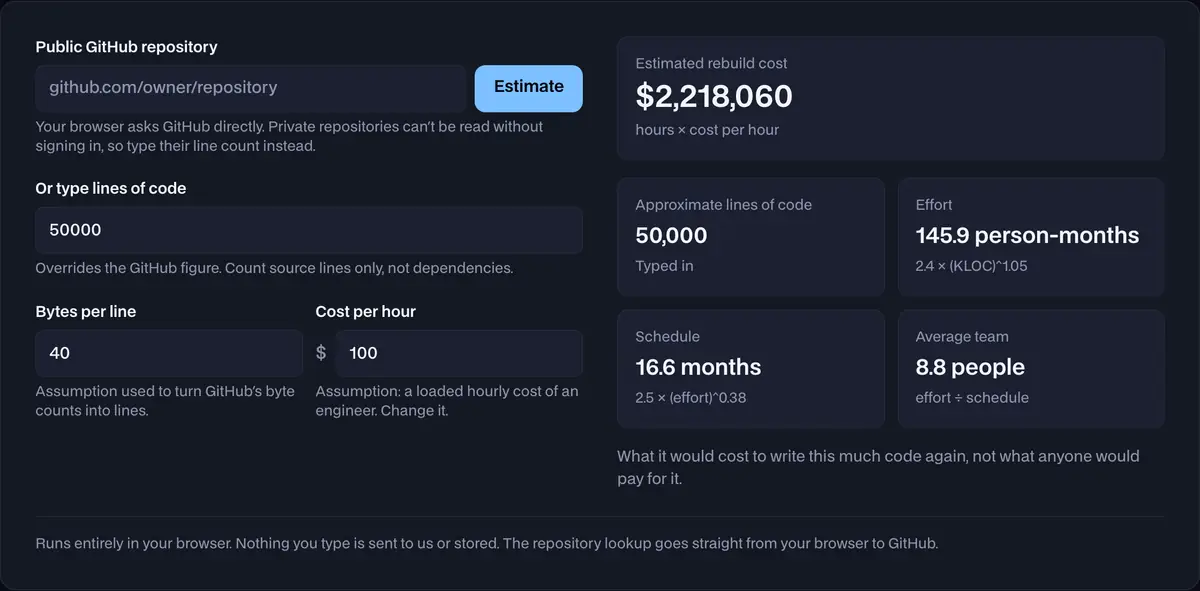
A codebase value calculator that reads a public GitHub repository in your browser and estimates rebuild effort and cost with basic COCOMO.
- How to sell software you have built
How to sell software you have built, whether that means the whole product, the IP, or licensing the codebase as training data.
 PII scanner
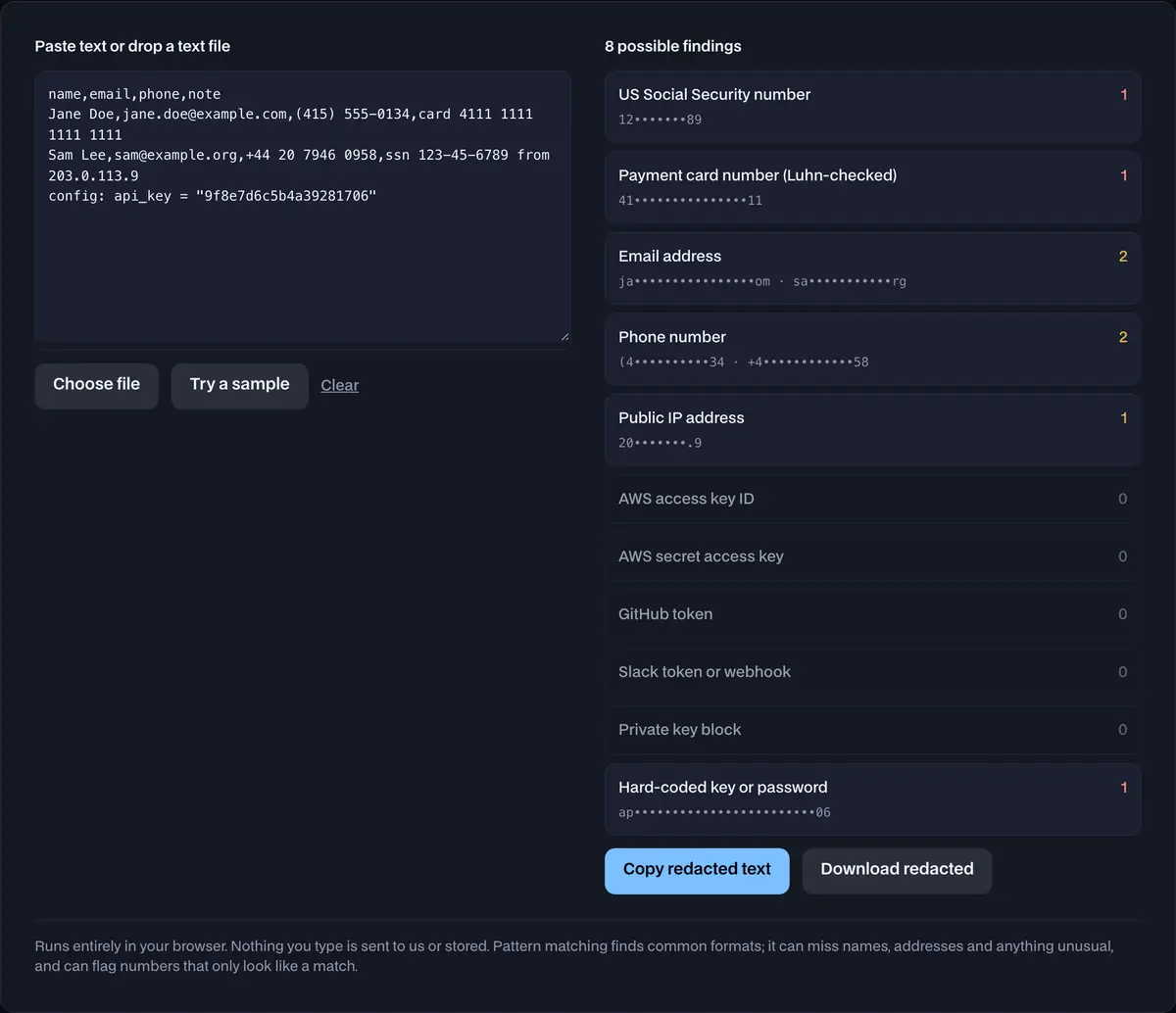
A PII scanner that runs in your browser: paste text or drop a file to see personal data and leaked secrets before you share it.
- Dataset licensing
Dataset licensing decides whether you may use, share or sell work built on a public dataset, and on what conditions.




Guides that use the open source license checker
- Open source licenses in a codebase sale
Open source licenses in a codebase sale rarely stop it; they limit what the seller can promise about the borrowed parts.

Free tool
Try the open source license checker
An open source license checker scans a codebase for licence files, package licence fields and per-file licence headers, so you can see which licences cover the code and its dependencies.
- Free
- No sign-up
- Runs in your browser